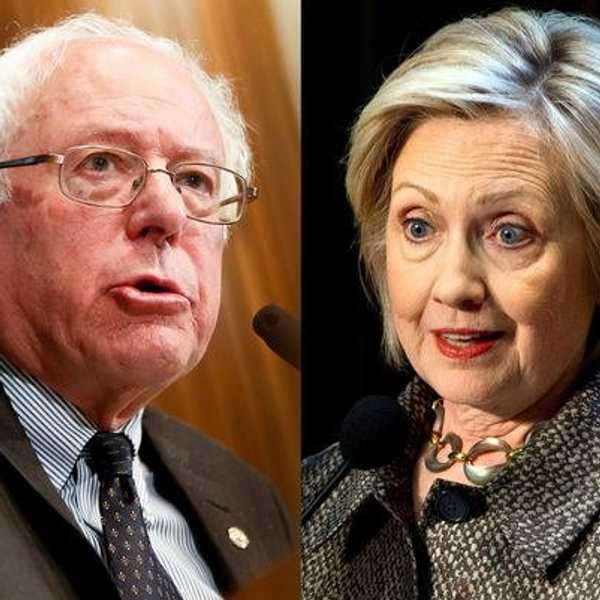
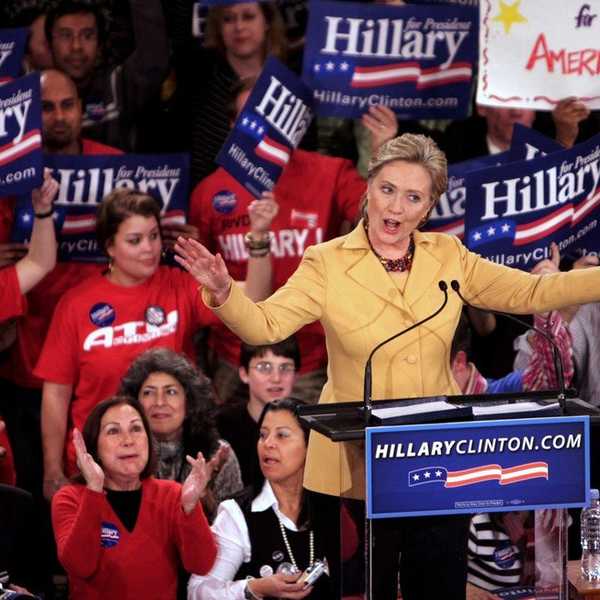
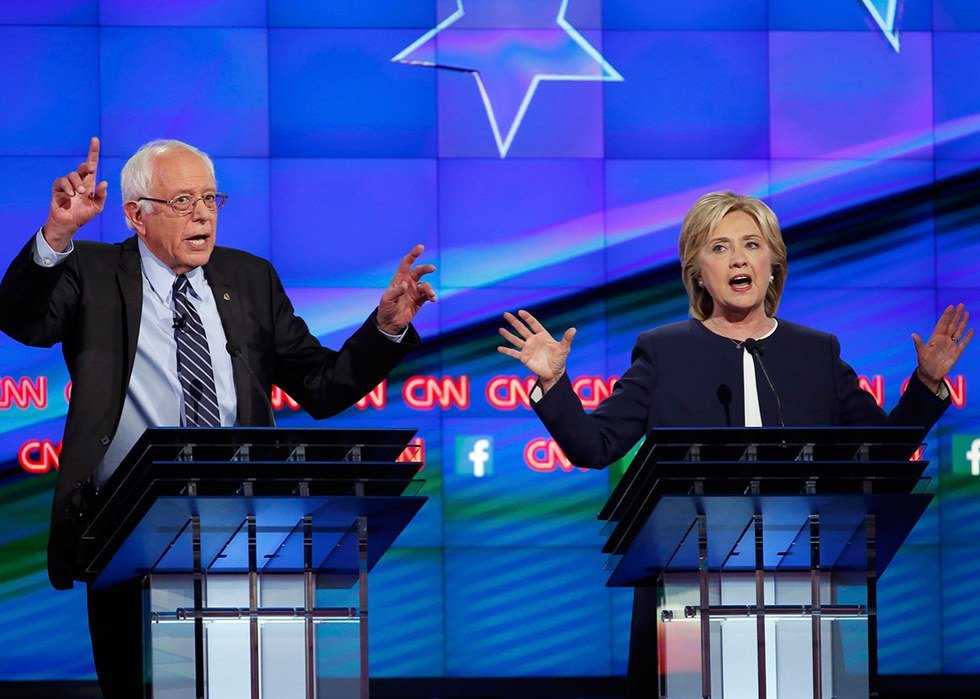
The Democratic presidential race differs much from the Republican race. The sixteen (now fourteen) Republicans are all equally well-known (even with Trump’s and Carson’s leads) and all attack one another openly. The Democratic race has been a Hillary Clinton versus Bernie Sanders duel, ignoring the other four candidates (with Lawrence Lessig not even being invited to the debate) and with minimal attacks on other candidates. This was truly exhibited Tuesday night, as Clinton and Sanders were finally forced to attack one another, with Jim Webb, Lincoln Chafee, and Martin O’Malley being mostly ignored and not given as much time to speak.
Sanders got the crowd roaring with quotes such as, “Do I consider myself part of the casino-capitalist process by which so few have so much and so many have so little, by which Wall Street’s greed and recklessness wrecked this economy? No, I don’t,” “Congress does not regulate Wall Street; Wall Street regulates Congress,” and “The American people are sick and tired of hearing about your damn emails!”
On the other hand, Clinton was weak when faced with the question of her changing her stances so frequently, often focusing on being experienced and the potential first female president and even borrowing lines of Sanders’s like “so few have so much and so many have so little.” Sanders barely talked about himself, which made him stand out from his competition. From Webb’s talk of his experience as a marine, to O’Malley’s review of the state of gun control and police brutality during his time as Maryland’s governor, to Clinton’s claim that she went to Wall Street and told them all to “cut it out,”
Sanders vehemently focused on the issues. He could have pulled the card that he would be the first Jewish president, or pointed out him being the eldest of the candidates, or talked about him being the longest-serving Independent Congressperson, or mentioned his ambitions when he was a mayor, but he did not. Although Clinton was well-prepared for the debate, her problem for so many years has been that the people do not trust her, and Sanders was so genuine. Sanders faltered when asked about his stance on guns and the need for an American interventionist policy, but he set the stage for discussion. He has set forth a huge dialogue for the corruption of corporate America, and generates excitement for his campaign being a political revolution.
The debate gave viewers the opportunity to meet other candidates, since all they see in televised media consists of Hillary Clinton’s positions and an analysis of whether or not Vice President Joe Biden will run. Bernie Sanders was involved in the most Google searches during the debate. He also received the most Twitter followers of 35,000 as a result. Most all polls asking who won the debate overwhelming exhibit Bernie Sanders as the victor, yet all the corporate media reporting crowns Hillary Clinton, incongruent with their own polls.
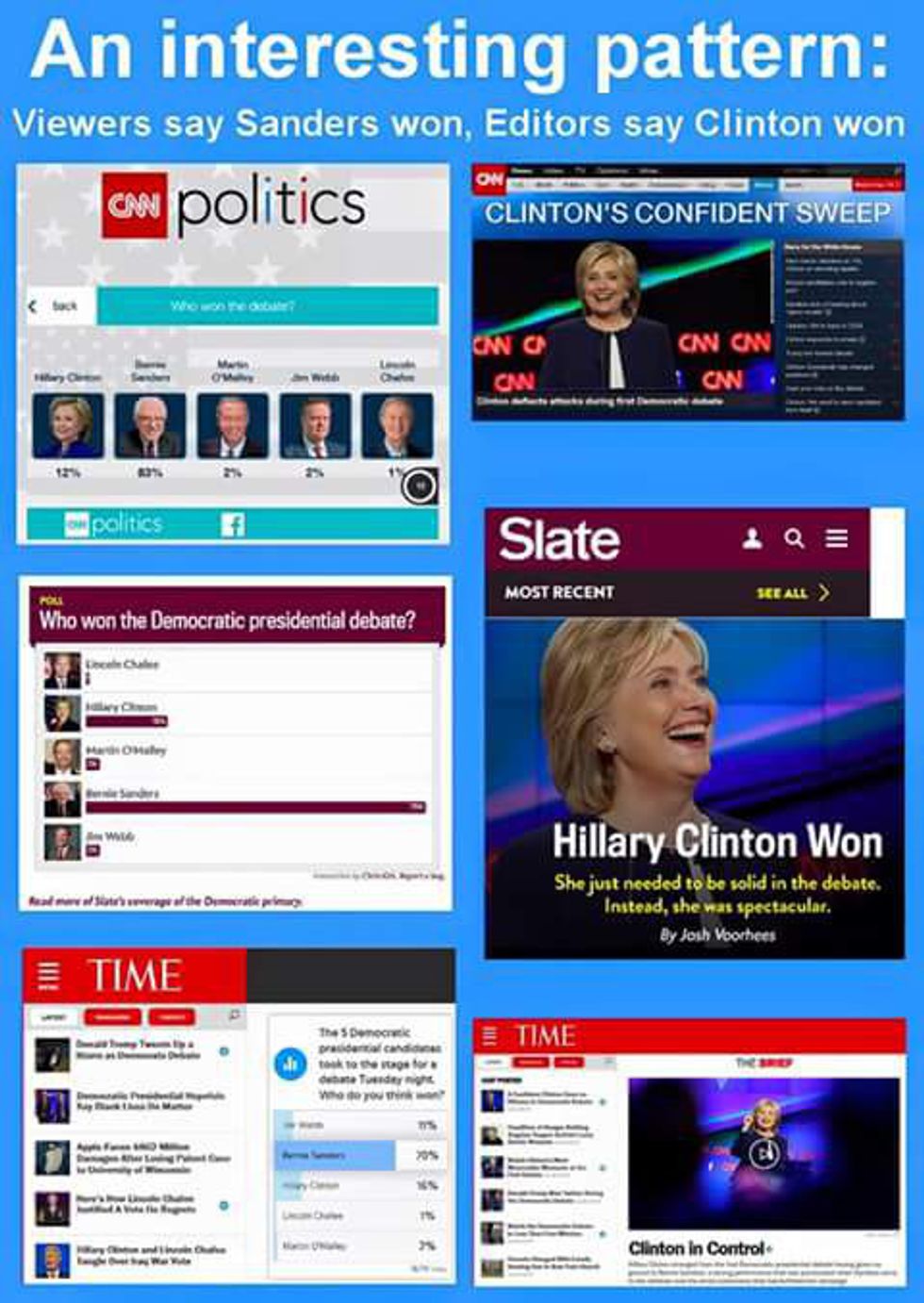
This has enraged Sanders’s supporters, who have been long frustrated with media not covering the candidate’s amazing success when considering his crowds of tens of thousands and him raising more money than President Barack Obama had at this point in the race. CNN has since been deleting their comments on their Facebook page refuting their statement that Hillary won.
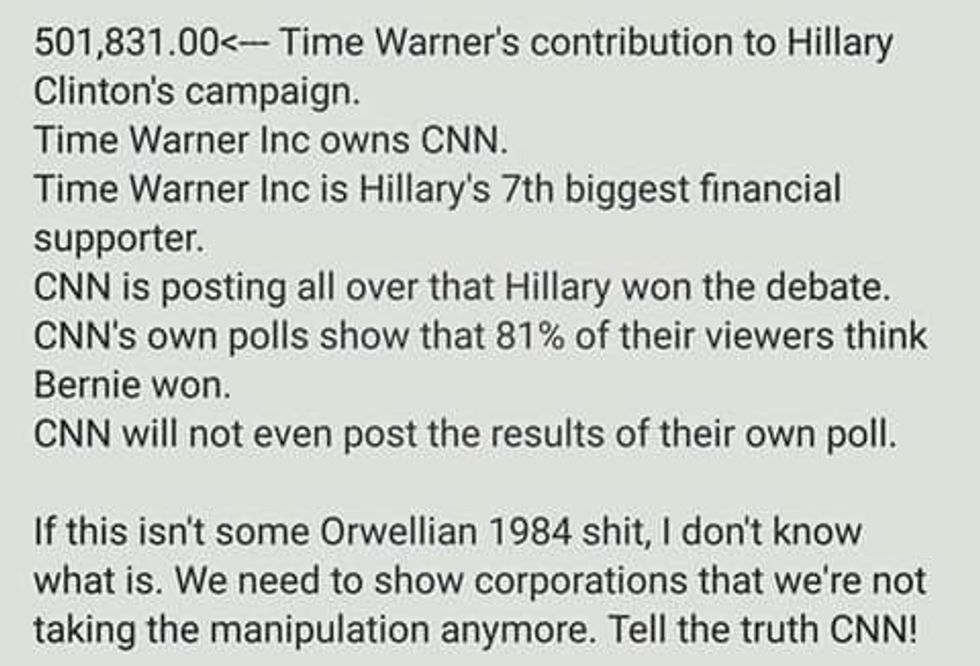
Why is this happening? Time Warner, a mass media industry and the owner of CNN has donated $87,835 to Clinton’s campaign, and $501,831 to her career between 1999 and 2016.
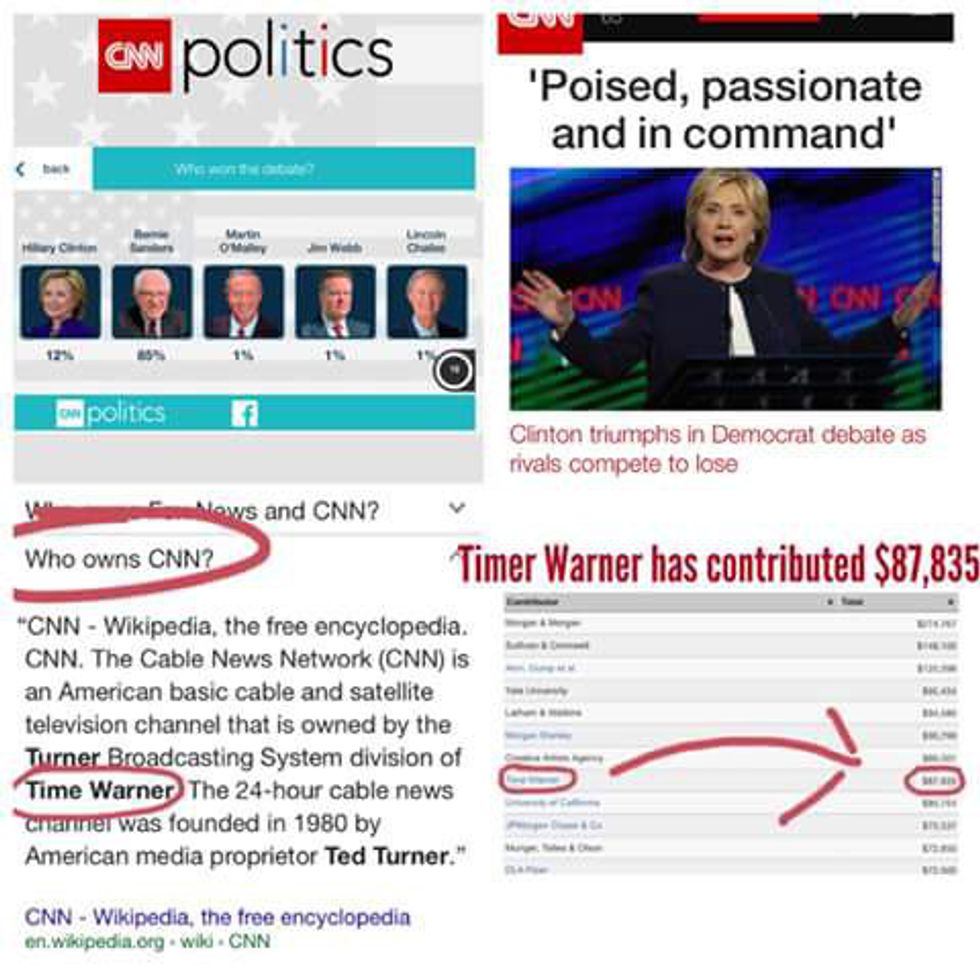
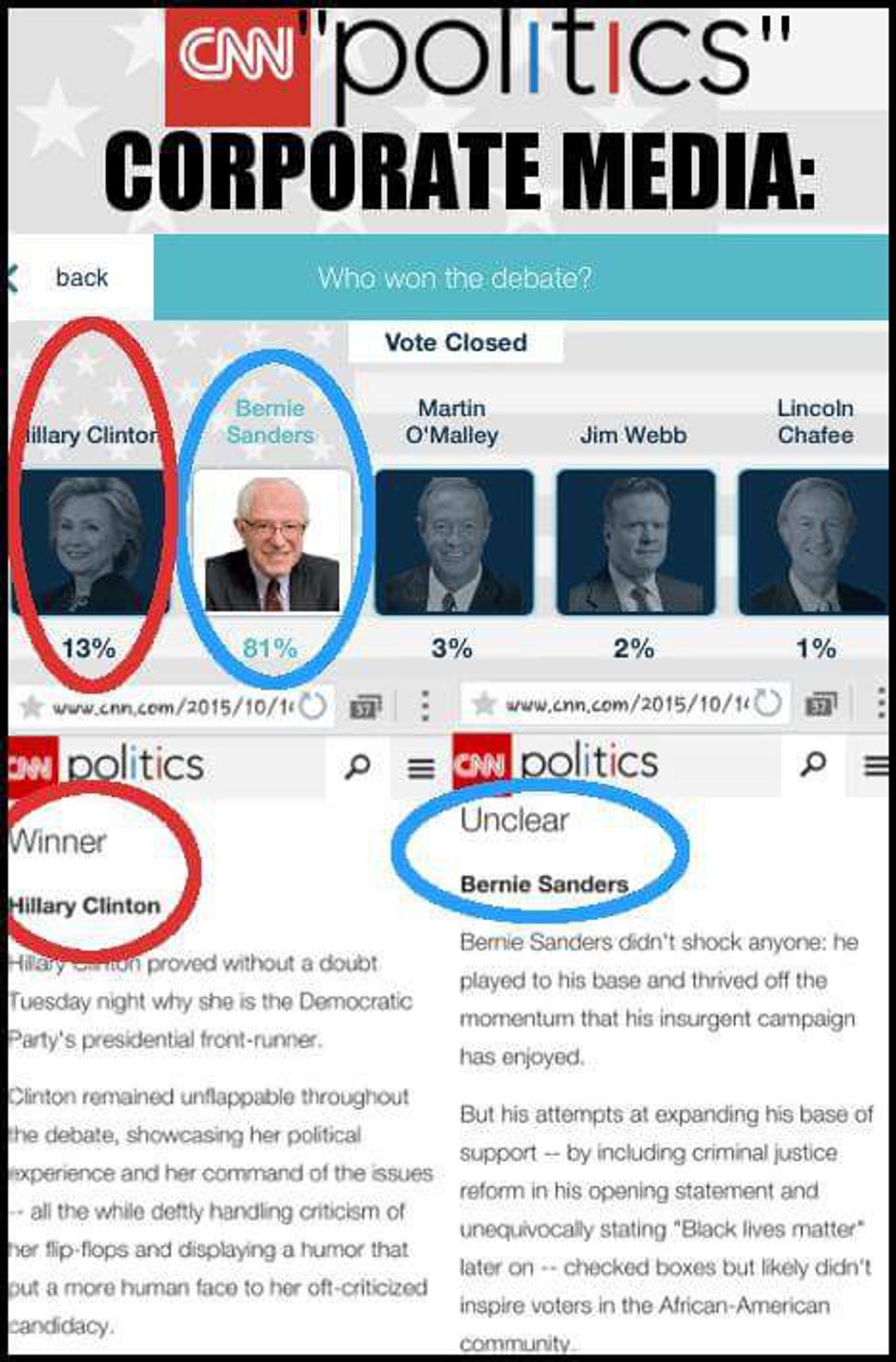
This discovery has generated further outrage from Sanders’ supporters, leading them to spam the following comment on CNN’s Facebook page:
Recently, the writer of the Slate article claiming Clinton won the debate made another article in response to the backlash. He argues that Clinton won because she exceeded expectations, “instead of turning in the safe and solid performance she needed, Clinton was close to spectacular on Tuesday night.” Sanders was expected to be fiery, and that is what he was. The writer, Josh Vorhees, admits that Sanders has been ignored by the media and may garner the most advantages from the debate due to gaining more acknowledgement. He also points out that Sanders’s supporters are more passionate and active and frequent polls and the internet more often, thus claiming that the polls were not representative of the Democratic base. However, he notes the relevance of the attention Bernie received via Google and Twitter, but still asserts that it does not crown him the winner of the debate but the reaper of the rewards. He finishes by saying that this is just his own opinion.
This all makes Sanders’s supporters seem very rabid, biased, and petty, all too concerned with who “won” the debate. In fact, both candidates will benefit well from the debate, with Sanders gaining more attention and Clinton solidifying her shift to the left in response to Sanders’s success. The point is not the relevance of who won the debate, but the effects of the debate and the representation of those effects. That has been a problem with the media for a long time and with many other issues, in that it is often biased, skewed, and unrepresentative of what is happening in the world – and what is happening in America is that its people are sick of establishment politics and the corruption of their government, both of which are embodied by Hillary Clinton.