

If I had to choose a favorite historical event, it would have to be the Second Defenestration of Prague. I choose it for a variety of reasons, the first being that it is humorous. Defenestration is the act of throwing an individual or group out of a window, which in itself is amusing, but the humor truly lies in the fact that it was the second time that someone had been thrown out a window in Prague that had been memorable enough to be referred to by name in the history books.
The First Defenestration took place in 1419 when a mob of Hussite heretics were pelted with stones, thought the rocks were thrown from the windows of the city hall, and stormed the building.Fifteen city officials were thrown out the window to their deaths. This kicked off the series of conflicts known as the Hussite Wars, which lasted until 1436. But the First Defenestration has nothing on the Second.
In 1618, The Holy Roman Empire (Which at the time included the lands that are now Germany, the Czech Republic, Slovakia, Austria, and the Low Countries) was a real mess. Martin Luther’s sparking of the Protestant Reformation in 1517 had led to a series of conflicts and rebellions, only ending in 1555 with a treaty that stated that Imperial princes could determine the religion of their subjects on their own. Prague, as part of the Habsburg family lands of Bohemia, was technically supposed to be Catholic, but this was never enforced due to the large Protestant population. It was never enforced until 1617, that is, when Ferdinand of Styria, the new King of Bohemia, decided to embrace the Catholic Counter-Reformation movement.
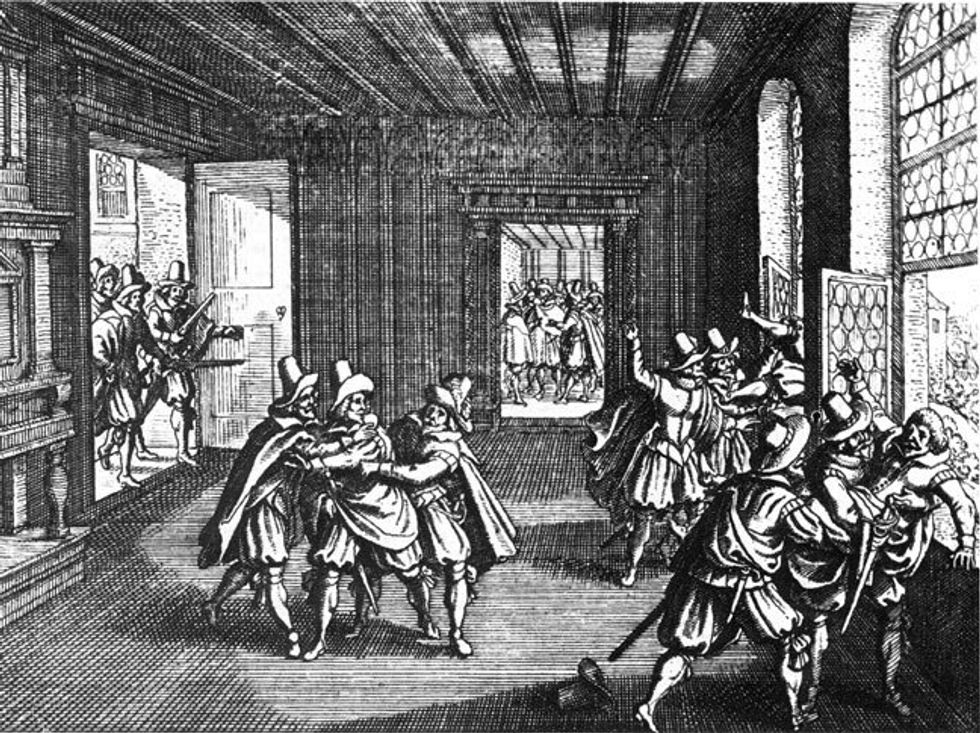
To further this end, he ordered a ban placed on the construction of Protestant chapels in Bohemia. When the landlords protested, Ferdinand ordered their titles dissolved. They were less than pleased about this, and the now-unemployed officials and landlords assembled at the city hall to await the arrival of several Catholic officials they believed had a hand in the recent circumstances. Two of the officials had no role in the dissolution of Protestant estates, and were allowed to leave. The other three, though, basically said that although they didn’t play a part in the dissolution they wished they’d had.
At this point, the Protestants picked them up and hurled them out the window. The three Catholics fell seventy feet to the ground, but somehow survived. Immediately both religious factions latched onto the Defenestration, the Catholics using it as evidence that Protestants were evil meanies and that angels had intervened to save the Catholics! The Protestants shot back saying that the three officials had managed to land in a pile of “filth” and in conclusion Catholics were poopy-faces.
As amusing as all of this sounds in hindsight, religious conflicts were serious business back then. The Second Defenestration of Prague kicked off the Thirty Years War, which rivaled the First World War in terms of incomprehensibility and damage to Germany. France, Sweden, Bohemia, the Netherlands, Saxony, Brandenburg-Prussia, Brunswick-Luneburg, England, Scotland, Transylvania, and Denmark were fighting against the Habsburg rulers of the Holy Roman Empire. Supporting the Habsburgs were Spain, Hungary, Croatia, Poland, and…Denmark.
It was a weird war.
In the end, though, most of Germany had been flattened and burned, the King of Sweden had died, and an estimated half of the German population had starved to death, all because three people were thrown out a window in Prague.
The Second Defenestration of Prague is my favorite historical event because it shows just how cause-and-effect goes into action. Some angry people lashed out and tossed their rivals into a pile of feces, one thing led to another, and suddenly half of Germany was dead.
The best part, though, is that history is chock-full of events even stranger and more off-the-wall than this one, events that really make you realize just how human history really is.

















