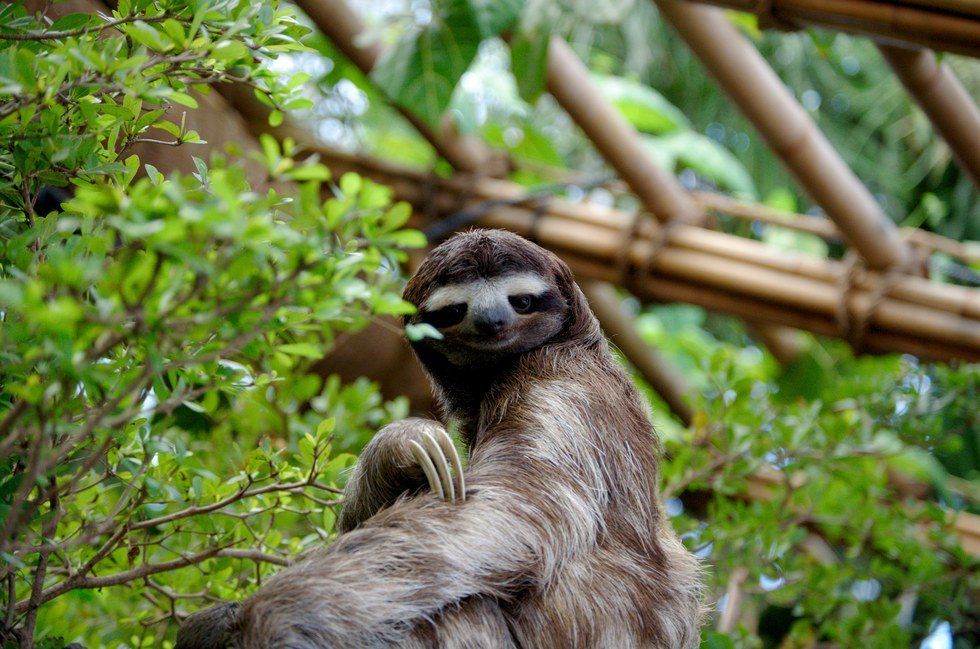
There is no animal that I have a deeper appreciation for than the sloth. My favorite animal has become an overnight internet sensation lately, but it seems as though people still do not know much about this slow, funny looking creature. Therefore, allow me to properly introduce you to the world's cutest creature.
Named after one of the seven deadly sins, sloths are known for being slow and lazy. At least at a first glance. While they are slow moving most of the time, it is a way for them to conserve their energy. Sloths can be surprisingly fast in attempting to escape from predators and are are quite agile moving among tree branches. There are two main types of sloth: the two-toed and the three-toed sloths.
While in actuality, every sloth has three toes, what these terms refer to are their elongated "fingers." These "fingers" are actually claws and are one of the sloths only defense mechanisms. They are very sharp and can be used to hurt a predator or scare them away. Unfortunately, sometimes sloths mistake their own arms for a tree branch and end up falling to their death.
Two-toed sloths tend to be on the aggressive side and are not very friendly, while three-toed sloths are very docile. Sloth fur is strange in and of itself, because sloths spend the majority of their lives in trees, upside down with their legs above their bodies. Their fur grows towards their extremities versus away from them and is home to an abundance of non-parasitic insects due to the fact it is a host to two types of algae.
While sloths may move slowly when on the ground, they are quick in trees and even in water. Also, sloths have babies about one per year, but also less often due to the fact that their minimal movement sometimes prevents females and males from finding each other. Baby sloths cling to their mother's fur and in many cases, a mother will make a nest of leaves underneath her home in case the baby falls.
Orphaned baby sloths do well if they are given a soft stuffed animal that they can cling onto. Sloths are very temperamental, they have sensitive stomachs which require a special diet of leaves, twigs and fruit and they must live in a humid habitat. They do not make good pets unless you are well prepared to take care of them.
There is a sloth living in the butterfly sanctuary near my school where they tell you that you cannot touch him due to the oils on your skin. This isn't necessarily true, people can handle sloths without them getting sick, but it should be done in a controlled environment with people who are experts. You should never handle a wild sloth unless it is an immediate emergency.
There is something special about these goofy looking creatures. I don't know if it's their bowed arms, their short snout or their large eyes, all I know is that these mammals are a blessing to all that meet them.