



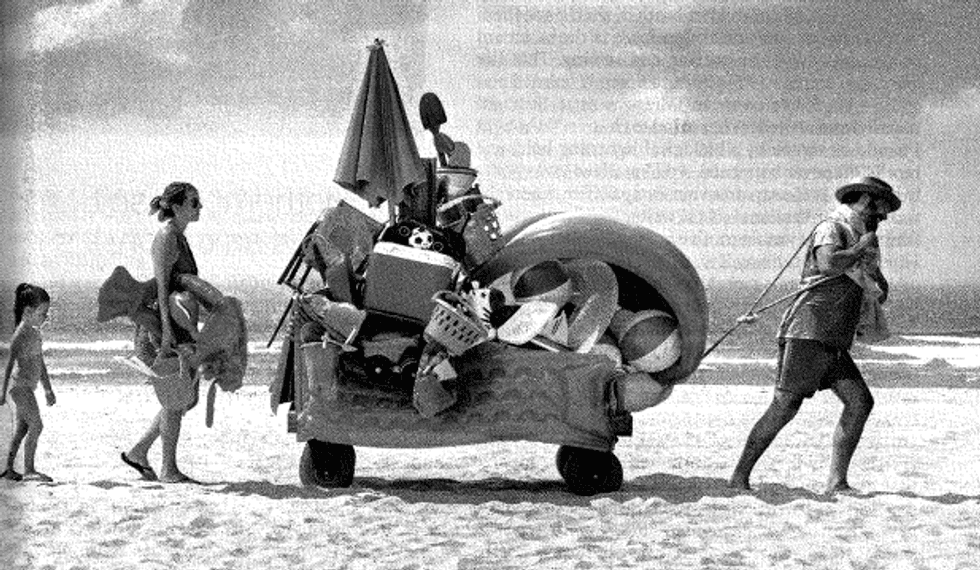
The two pictures leading into the article “Having it all without Kids” (by Lauren Sandler) depict an image of a blissful American family contrasted with an image of a struggling family. Of course, every family is different in regards to income, opportunities, and priorities. Some families may struggle more than others; however, society have a perception that having a family means that one has obtained great success.
Unlike the other articles I’ve read so far, this particular article demonstrates the freedom of women. Usually, women choose to not have kids because of their careers or their environment. However, this article implies that more and more women are choosing not to have kids just because they do not feel the need to. Although these women feel fulfilled without becoming mothers, societal expectations and pressure make it harder on them to live their lives freely.
In today’s society, with adoption agencies and fertility treatment widely available, women have a lot more options to become mothers. Consequently, women who choose to not have children are more likely to feel the societal judgment for “choosing freedom” over kids. This is ironic in a country known for its freedom of choice.
There is a study that found that high intelligence correlated with not having children. This U.K. National Child Development Study tracked some people for 5 decades and an economics professor, Satoshi Kanazawa has concluded with math that intelligent women generally go on to college and grad school, resulting in higher opportunity costs compared to their peers who are less intelligent or did not choose to pursue higher education. Thus, the more educated a woman is, the higher the chance that she will not have children.
This article also explores debate about racial and cultural factors that may or may not play a role in the decision to become or not to become mothers. Statistics show that there is 30% increase in childless African American women from 1994-2008. Jennifer Lundquist, a sociologist, comments that her theory is that these single women do not want to become the stereotype of the unmarried black mother, as it is depicted by the Western media in the past. However, some argue that this is not always the case. Some of the women who choose not to have kids have reasons that lean towards freedom. As described by Jenna Johnson, a childless woman, she is able to “do all sorts of things buy an unnecessary beautiful object, plan trips with aging parents, sleep in, spend a day without speaking to a single person, send care packages to nieces and nephews, enroll in language classes, go out for drinks with a friend at the spur of the moment” (6).[i] This sort of life is seen as a paradise for women who decide not to have kids.
On the financial side, if a couple is financially unstable, they would most likely not have children (until they are financially secure). Over the years, culture has changed in the way that there is a rise of attachment parenting, resulting in higher economic costs in raising a child. The media always shows the perfect family with a sizable house and a million of toys. If one does not spend at least $230,000 on a child in 18 years, she/he will seem like a bad parent. These demands have made the idea of being a mother a formidable prospect.
Ultimately, with all these societal expectations of a mother, more and more women feel that in exchange for a child, they are giving up their freedom. Consequently, these women will decide to not have children, as they have fulfilling lives already.
[i] Sandler, L. (2013). One and only: Having it all without Kids. New York: Simon & Schuster.