


Guillermo Del Toro’s "Crimson Peak" opens by utilizing one of cinema’s most tired tropes – beginning at the end. As if just escaping from the decrepit mansion standing tall behind her, a battered and bloody Edith Cushing (Mia Wasikowska) frightfully scans a wintry landscape while whispering in a voiceover, “Ghosts are real. This much I know to be true.” The arc of the narrative has at this point already been explained to us, though Del Toro must have something else up his sleeve, right? Unfortunately, the answer here is no. While beautiful to look at on the surface, "Crimson Peak" lacks the fascinatingly strange and creative ambition of Del Toro’s previous works in a story that plays out all too familiarly.
To clarify, "Crimson Peak" is not a horror film. While advertised to audiences as something closer to the jump scares found in "The Conjuring" or "Insidious", "Crimson Peak" only mirrors elements of such traditional horror films to move along a very different primary plot. Del Toro confronted this misunderstanding head-on in a tweet reading, “One last time before release. Crimson Peak: not a horror film. A gothic romance. Creepy, tense, but full of emotion… Like my dancing!” Despite his attempts to counteract Warner Bros. scare-heavy marketing, audiences will most likely find themselves walking out of the theatre with “Drive”-level confusion.
This romance Del Toro speaks of takes place between young Edith, an aspiring writer from the town of Buffalo, and Thomas Sharp (Tom Hiddleston), a traveling entrepreneur searching for funding for his next invention. After quickly sweeping Edith off her feet and asking for her hand in marriage, the two move back to Allerdale Hall, a suspicious and weathered mansion in which both Thomas and his strange sister Lucille (Jessica Chastain) have resided for years.
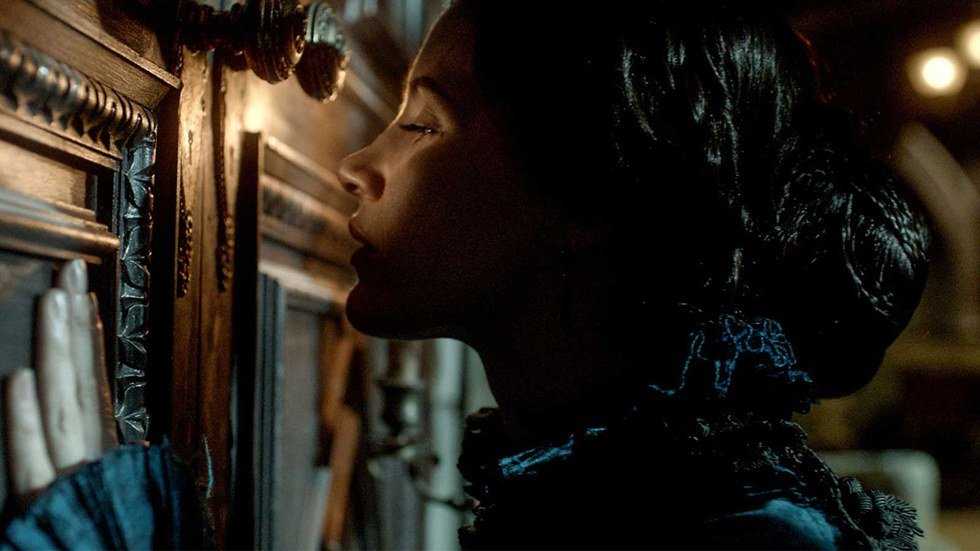
Allerdale Hall is undoubtedly the heart and soul of "Crimson Peak". Both dreamy and intricate in design, one can’t help but think that Del Toro first conceived this extravagant hall only to work backwards. Del Toro is a director with big ideas, and his giddiness for his own work is clearly evident on screen. If nothing else, "Crimson Peak"’s legacy will lie in the rooms the characters inhabit, not the other way around.
However, everything inside Allerdale Hall – the love story, the characters, and the scares – are as artificially designed as the set. Even in Del Toro’s direction, it often looks as if he simply dropped a camera in a room with the expectation that the set alone would do the rest of the work. It doesn’t. Instead, I often found myself thinking “what a beautiful set” rather than “what a beautiful house.” It wasn’t hard to imagine that, with a few steps in the wrong direction, an actor might accidently wander into a "Crimson Peak"-themed gift shop.
"Crimson Peak"’s attempts to scare are also lazy in design, both in comparison to mainstream horror and Del Toro’s other work. With such an emphasis on creepy atmosphere, Del Toro plays it unusually safe here. While most of the film is driven by mood and melodramatic monologues, his attempts to scare the audience come off as tired and unoriginal. Del Toro is a weird director with weird ideas, and gothic romance is a genre that he should have easily excelled at. Why does he fail here?
"Crimson Peak"’s reliance on gorgeous set-design alone proves to cause problems that even excellent performances can’t save. There are hints of Del Toro’s greatness here – the blood-soaked finale outside the mansion, among a couple of other instances – which remind us what he’s ultimately capable of. This constant reminder that Del Toro ought to be doing something great is certainly frustrating, and maybe the only really scary thing about the film.

















