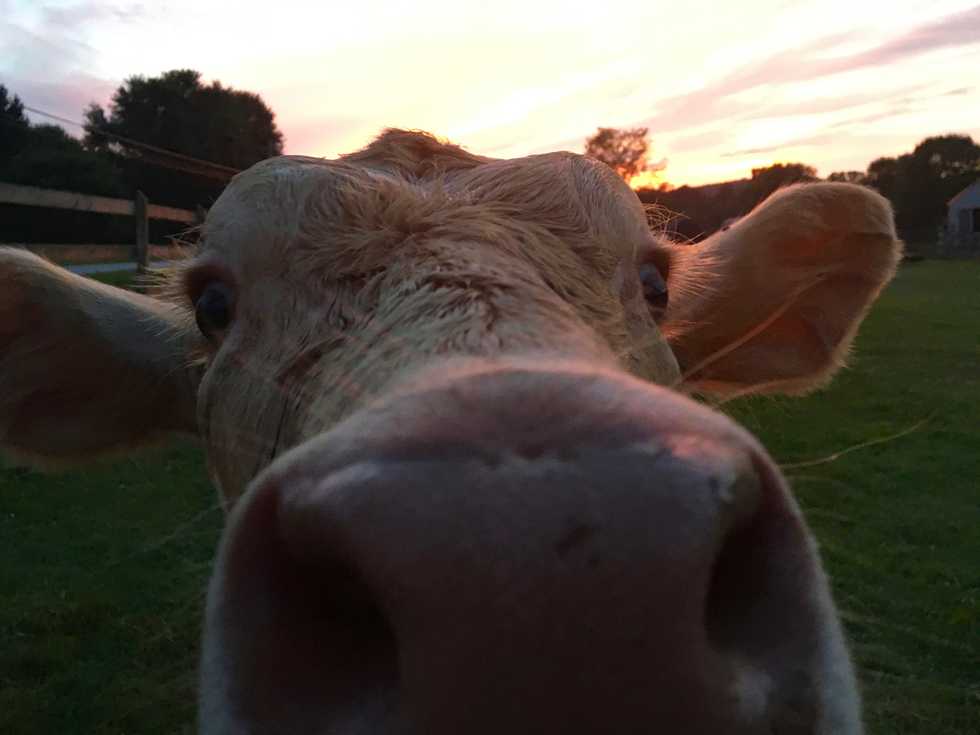
We call ourselves the "cow orphanage" and we have good reason to.
In case you didn't know, not every pregnancy goes well. We hope that all pregnancies end up with a healthy cow and calf. But of course, this does not always happen. Some of the mothers die giving birth, leaving the calf all alone. Sometimes the mother does not produce milk, forcing the calf to either be bottle fed or found dead in a pasture. Other times, the mother has twins, and the stronger calf survives because the mother can rarely sustain two and the other calf is left behind.
This is where we come in, the "ICU" or Intensive Cow Unit. We take in calves who have to be separated from their mothers or who have no other choice and give them a second chance on life. Helping them learn how to drink from a bottle, using a feeding tube if necessary. Bottle feeding them two times a day. Carrying them to and from the barn when they are too weak. We see the beginning product and the end result. We watch the calves grow stronger and get bigger. We watch the calves we carried have their own healthy babies, and their babies having their own babies, and the cycle goes on and on.
But our cows are different. Our cows are "pampered" and are what most farmers call "pets". They are brushed, given loaves of bread as treats, get a barn to sleep in, and aren't just taken care of, but loved. Thanks to the close contact I have with cows on a daily basis, sometimes more than three times a day, I have learned that cows are people too, they just look a little different.
1. Cows are smarter than you think.

We have 24 cows, each with a different name. Each cow knows his or her name and responds to it by picking up its head, or even walking over to the fence. The cows know the time of day, every day at 6:00 they start heading to the barn because they know it is feeding time.
2. Cows can make you laugh.

Have you ever seen baby calves running around a field with their tails straight up in the air? They run at full speed, stop in a split second, butt heads, spin around in a circle, and then run off in the other direction. They also have the longest, most slimy tongues and LOVE to give people kisses.
3. Cows are strong.

When the calves are little, it easier to take care of them. As each day goes by, the cow gets bigger and bigger, meaning it also grows stronger and stronger. They are gentle giants but can hurt you in the blink of an eye.
4. Cows love to be pampered.

Believe it or not, cows love to be brushed. On the head, on the back, on the neck, and even on the tail. Our cows fight each other for a spot in line to be brushed and once you are done, you have a follower until you step on the other side of the fence.
5. Cows have families.

This may seem obvious, but cows have families just like we do. At our house, each family has a specific theme. For instance, Mama Bell's babies names are Tinkerbell, Taco Bell, and Liberty Bell. The families look similar, have similar personalities, and love each other.
6. Cows love to eat.

Do I even have to explain this one? Our cows eat feed in the morning, grass during the day, they snack on hay, they eat feed in the evening, and are still hungry after that. To make it even better, the "cud" you see cows chewing is regurgitated from their stomach and chewed again.
7. Cows protect each other.

If you look in a field of 100 cows, 99 of the cows can be lying down but 1 cow is always standing up, protecting the others. Mother cows are over protective over their babies, sometimes to the point where they become dangerous.
8. Cows have best friends.

Calves grow up together just like we grow up together. They have their buddies that they sleep beside, run around with, eat with, and head butt with. They stick together when they are younger and become inseparable when they get older.
9. Cows have big hearts full of love.

Are cows the most glorious animals on the planet, no. Yes they smell, yes they have long tongues, yes their breath stinks when they burp, yes they lick you, yes they might possibly chew on your pants. But cows love to love. When you not only raise them from a bottle but take care of them on a daily basis, you become a part of the "herd" one way or another. They count on you to love them and they love you in return.