

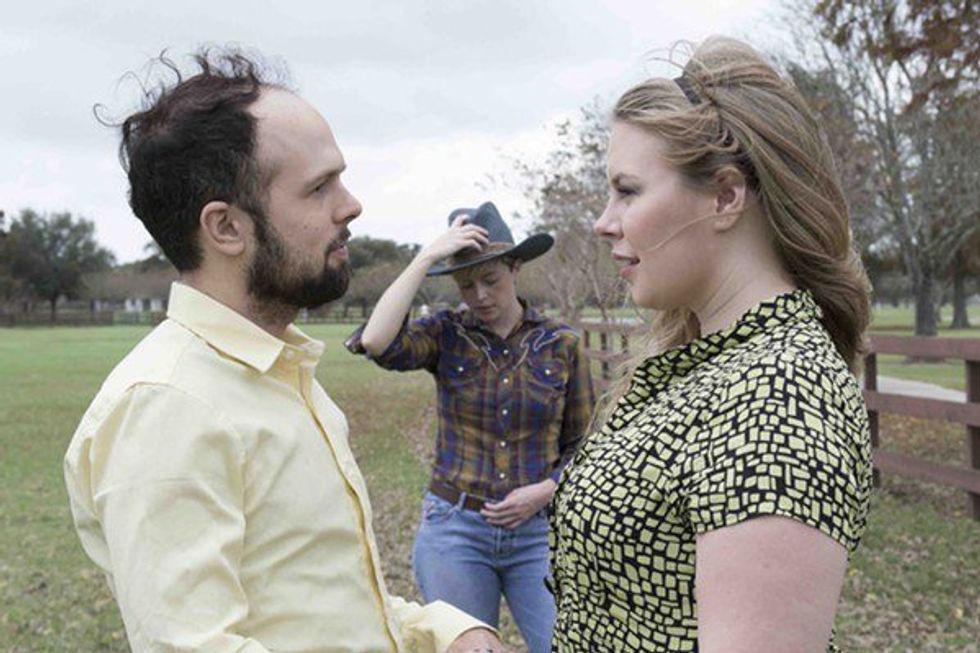
The play is called Late: A Cowboy Song, written by Sarah Ruhl, and it was performed at the Old Marquer Theater. The pamphlet advertising the play boasted a man and woman facing each other and in the background a woman in dirty jeans, boots, a cowboy hat and a flannel plaid shirt. We see the draw here for lesbian spectators. As I sat next to my girlfriend to watch the show, we waited for what would inevitably be an encounter between the two women. As could be expected, the first woman was married to a man but unhappy in their relationship. The most compelling scene for me was the fast-forwarded snapshots of yearly holidays repeated over and over, with no feeling.
Feeling suffocated by her quirky husband who does not welcome change or anything interesting really, she finds a friend in the obviously lesbian cowboy, a girl she knew from high school. As they meet again and again, however, the main character never makes a change, she stays in her dull life, with her complicated husband, and remains miserable hiding secrets. In the end, when she leaves her husband, she takes her daughter (unborn at the beginning of the play), who is now about 6 years old, and they go to the farm to be with the cowboy. But in this scene, as in any other scene of the play, the two women do not even share a kiss.
It comes off as fear of really defining what is happening, softening the blow that the married woman with the baby could be interested in the cowboy dyke. The disappointing part of the play is not that the story is left open, it is that throughout the entire performance it is treated very softly and timidly, when really the relationship between the two women is the main point of the storyline. When the mother and child leave the man, they run to the farm, but it seems much more like an escape from their reality and boredom, an excuse to leave, than a real emotional attraction between the two women. This leaves the cowboy appearing used and weak, and the other woman seeming fake and afraid.
We spectators came away feeling cheated from a story that could have been more realistic. The play itself was written in a dramatic and off-kilter way, and that, as a style, is alright. What offends is the way in which the playwright fails to complete the story, and leaves the questions of relationship norms and fear as if the path of homosexuality should be feared. The story felt strained and the characters lost. I only wished for more of a push to realize the internal struggle of the characters with a bit more finesse.
The Gambit’s Tyler Gillespie sums it up like this, “While a couple of storylines distract from the narrative, strong acting drives this production into rich and satisfying territory.” I would take this further and state that the distractions in the storyline are vague notes driving toward the real imagery desired, but letting these points fall flat in the end with an incomplete connection. Just having a lesbian in the story does not make it a true depiction of real life. And showing the storyline in a weak manner only takes way from this progressive storyline.















