

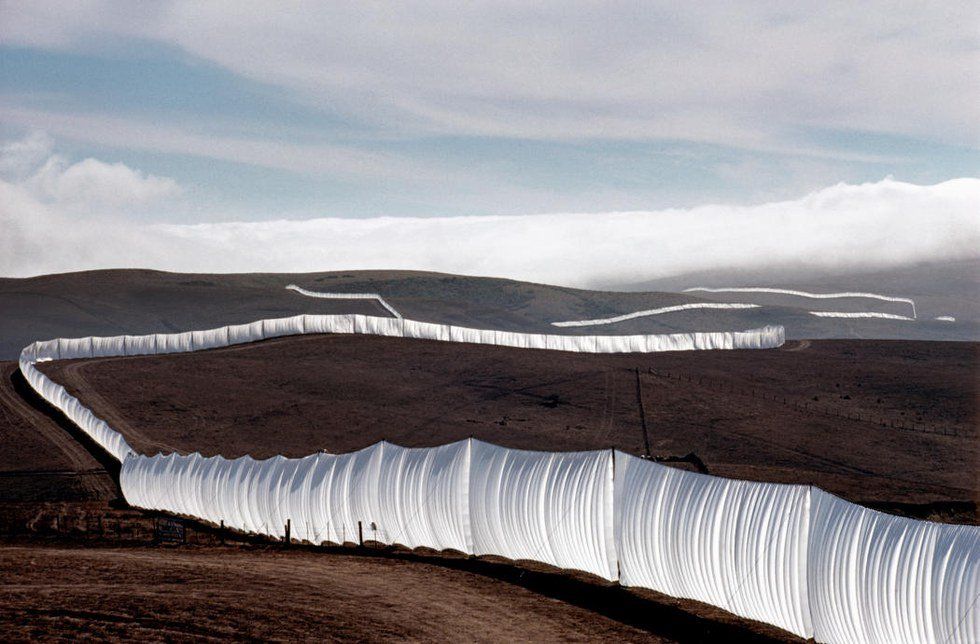
In 1970, Robert Smithson created the massive earthwork, Spiral Jetty; and in 1976, Christo and Jeanne-Claude constructed the 18-foot-high and 24.5-mile-long Running Fence. The Spiral Jetty was installed onto a part of the shore of the Great Salt Lake in Utah, and the Running Fence was installed in the hills of two counties in California, ending its long expanse in the waters of the Pacific Ocean. Two films, "Spiral Jetty" by Robert Smithson and "Running Fence" by Albert Maysles, present the creation and realization of the two artworks in different manners, and construct two different artistic personas for Christo and Smithson throughout the course of the films.
In the two films, there is a large focus on the process of the creation and final form of the earthwork. Both show the entire process in some way. In "Spiral Jetty," you see the artist, Robert Smithson, interpreting the process of the Spiral’s construction. The beginning of the film includes a section where the camera pans over a map of the world, ending on the Great Salt Lake in Utah. The camera focuses in on each word of the Great Salt Lake for at least 5 seconds per word, which seems to imply the beginning of the process in which the artist chooses the location for the earthwork. The film also has a fairly long section where footage of the rocks and sediment being poured to form the jetty alternates with that of rippling water. The end of the process is seen in the footage of Robert Smithson running on the jetty to the center, and then walking back to exit.
In "Running Fence," the entire film is a documentation of the process of building the art piece, briefly touching on design and beginning with the artists, Jeanne-Claude and Christo, trying to get permission from ranchers to build parts of the fence on their land. After they get permission, a majority of the rest of the film chronicles the physical labor of constructing a 24.5-mile, 18-foot fence in the California countryside.
The fact that both films focused on the process of creating the art pieces was a major way that they were similar. A way that the two films differ in the presentation of the creation and realization of the two artworks is that "Running Fence" is portrayed as a temporal and ephemeral piece of art, whereas the Spiral Jetty is portrayed as more permanent. One of the arguments for the installment of the Running Fence is that the piece would only be in place for 14 days and that it had minimal environmental impact, as the fence was simply poles drilled into the ground. The temporal nature of the piece is also seen in the shots of the artwork fluttering in the breeze as wind comes and goes, just like the piece. On the other side of the spectrum, the Spiral Jetty was portrayed as a more permanent fixture. There was a whole section of the film where footage of rocks and sediment being dumped into the Great Salt Lake was shown. The material used for the Spiral Jetty is heavy in contrast with the Running Fence, and was more of an environmental disturbance than the fence. The Spiral Jetty is still there to this day, as opposed to the Running Fence which only stood for two weeks.
Another aspect that is different between the two films is how they portray the artists in relation to their art pieces. In the film "Running Fence," the director, Albert Maysles, portrays Christo as removed from his artwork, more of an overseer than a direct participant. There are many shots of Christo on the Californian landscape, looking onto the sea or the hills or watching the construction of the fence. As far as the film shows, Christo never physically helped to construct his massive art piece: he watched from a distance, and was somewhat isolated from the realization of his work. It is also interesting to note that Christo himself did not create the film about his artwork. In contrast, Smithson was the director of "Spiral Jetty," and from the theatrical choices in the film, was connected to his artwork. For example, there is a long scene in which he runs on the jetty, all the way to the center and stands, looking at the lake around him, eventually walking the spiral again to get back to shore. The portrayal of the construction of the jetty is one bulldozer as opposed to Christo’s team of workers. Even if Smithson himself was not driving the bulldozer, he is still closer to the realization of his piece than Christo was to his.
The two films shared similarities and differences in how the works were created and realized, and in how the artists were portrayed by the film. Both films beautifully depicted the massive undertaking that each work was, and in their own way showed the process of the development of the Running Fence and the Spiral Jetty, respectively. Although one no longer stands, the legacy of the massive pieces still exist, and the Spiral Jetty remains in the Great Salt Lake for any who wish to walk on it like its artist did to the film.

















