
One in four college aged women and one in fourteen college aged men will be sexually assaulted or raped in their lifetime. Even with this staggeringly high statistic, there are still many prevalent misconceptions about both sexual assault survivors and sexual assault itself. Here are the most dangerous ones.
1. Consent is the absence of a no.
Consent is defined as, "permission for something to happen or agreement to do something." (Merriam-Webster). Consent must be given for it to not be considered sexual assault or rape. This means that a "yes" must be given; the absence of a "no" does NOT mean consent. If a person is unconscious, or under the influence of drugs or alcohol, they are unable to consent.
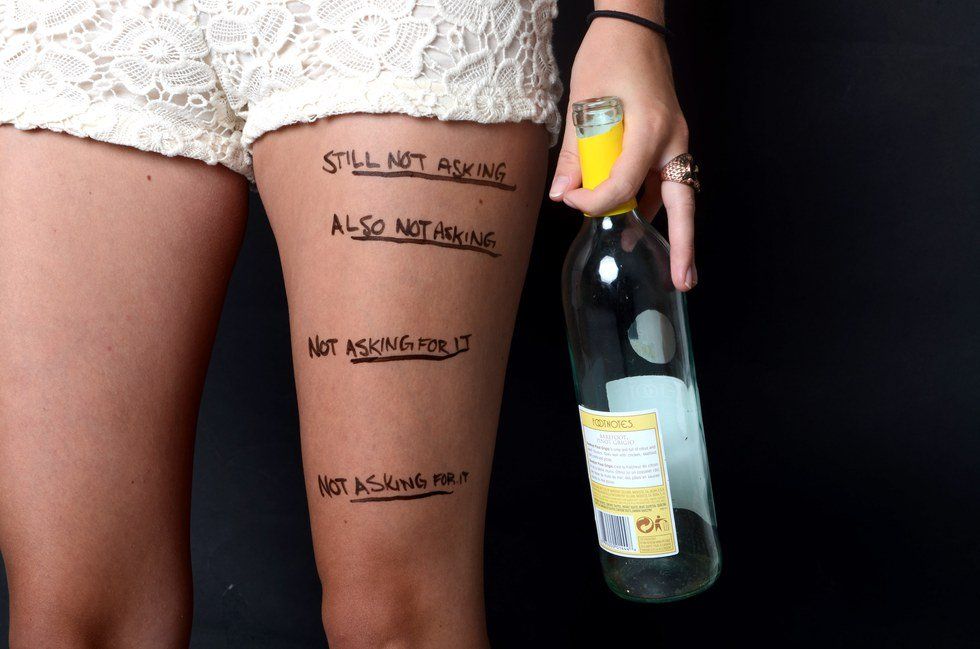
2. If a woman was wearing promiscuous clothing, was intoxicated, or under the influence of drugs, she cannot complain of being raped.
This is often heard as, "she asked for it." This ultimately leads to victim blaming and a perpetuation of rape culture that is so prevalent in society. No women, or man, will ever or has ever "asked" to be violently assaulted or raped. There is nothing that a victim can do that will lead them to be assaulted, and nothing that a victim can do to "ask" to be raped. 100 percent of the responsibility and blame should be placed on the perpetrator, not the victim.
3. Rape is most commonly committed by a stranger.
Only about 10% of rapes are committed by strangers.
4. People often lie about being assaulted or raped because they regret their choices the next morning.
Rape accusations are falsely reported at the same rate as any other crime (approximately 2 percent). Disproportionate media focus on false rape allegations perpetuates the public perception that lying about sexual violence is common when in fact the opposite is true.
The vast majority of survivors choose not to report to the police. One significant reason for this is the fear of not being believed.
5. Women often play hard to get, which sometimes can mean that when they say no, they really mean yes.
Only yes means yes! Someone has been sexually assaulted if they do not give explicit consent for the actions. It is the responsibility of the person initiating sexual contact to receive explicit consent from the other individual. If consent is not given, the other person is not "playing hard to get"; they are just not comfortable to any act further.
6. If there was no struggle there was no assault or rape.
Many victims, especially women, feel they would have been further harmed if they had put up a fight. Fighting during an assault situation can put the victim at a much higher risk of getting severely hurt. Everyone has a fight or flight reaction, which can sometimes lead the victim to freeze. This is very common, and does not negate the fact that they have been assaulted. If no consent was given they were assaulted, whether or not they fought back is irrelevant.
7. Men cannot be raped.
This, again, boils down to consent. If a man did not give consent for the sexual act, they were assaulted. Just because a man may be stronger than a woman does not mean they cannot be sexually assaulted and raped.
8. A person who was sexually assaulted will be hysterical and severely changed as a person.
A victim of sexual assault has experienced a traumatic incident, and victims of trauma react in several different ways. There is no "right way" to react to being assaulted. The U.S. Department of Justice said it best: "Victims of sexual violence exhibit a spectrum of responses to the assault which can include: calm, hysteria, withdrawal, anger, apathy, denial, and shock. Being sexually assaulted is a very traumatic experience. Reactions to the assault and the length of time needed to process through the experience vary with each person. There is no "right way" to react to being sexually assaulted. Assumptions about a way a victim "should act" may be detrimental to the victim because each victim copes with the trauma of the assault in different ways which can also vary over time."
9. If someone was actually assaulted or raped they would report to the police.
There are many deeply personal reasons a survivor may choose not to report their assault. These can include that the retelling of the assault may cause the victim to relive their trauma, they may be afraid of retaliation, they may be afraid of not being believed, they may fear how they would be treated during a trial, that they want to protect their assailant or that they may not even recognize that an assault has happened. Just because an individual chooses not to report to the police does not discredit them and does not mean that an assault did not happen.
If you or someone you know has been sexually assaulted or raped there are many places to receive free services to aid in your recovery.
Services can be found in Logan at the Sexual Assault and Anti-Violence Information (SAAVI) office, located at 850 E. 1200 N., Logan, UT. Their hotline is: (435) 797-RAPE (7273).
Citizens Against Physical and Sexual Abuse (CAPSA) can also offer services for survivors. The CAPSA emergency hotline is: (435)-753-2500.
Just remember you are loved, you are important, and you will get through this. Seek help. You are worth it.