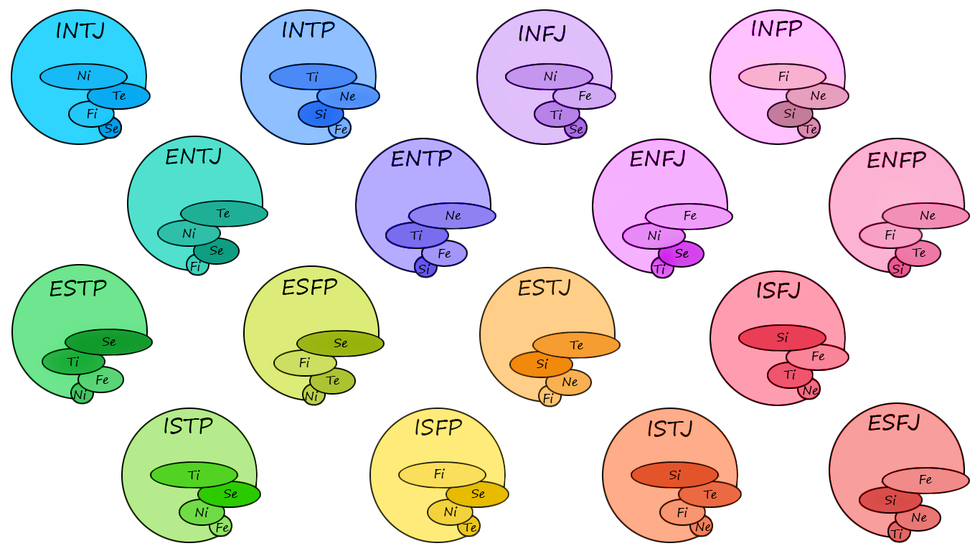
The Myers-Briggs Type Indicator, or MBTI, is a typology theory first developed by Carl Jung and then organized by Katharine Cook Myers and her daughter, Isabel Briggs Myers. The hallmark of this typology is in 16 configurations of letters, but what those letters mean is subject to a lot of confusion and misconception here on the internet. I’m here to, hopefully, lay some of those misconceptions to rest.
1. No, you’re not stuck in a box.
MBTI helps you understand how your brain processes stuff. It does not limit your potential. Learning more about yourself will only help you grow, and being informed about what you're working with is necessary for efficient progress. MBTI can provide that knowledge. What you do with it is up to you.
2. This is not astrology.
Astrology gives you a label and then tells you who you are. MBTI finds out who you are and then gives you a label.
3. Your 4 letters are a map to the heart of MBTI theory: the functions.
When you have four letters, they are really more of a map to your real personality type than they are your type itself. That’s because the E/I and J/P are both there to inform you about certain qualities in your N/S and F/T. If you want to find out more about what your four letter combination means, google your type with the word "functions" for a breakdown on what's really happening.
4. The terms “Introvert” and “Extrovert” mean different things in MBTI than what you’re probably thinking of.
Introversion and Extroversion in MBTI relate to whether you experience a function internally or externally, not whether you gain energy from being alone or talking to other people. In fact, because of this discrepancy, it is possible to be an introvert with an Extroverted MBTI or an extrovert with an Introverted MBTI.
5. All functions are either Perceiving or Judging and Introverted or Extroverted.
All people use both perceiving and judging functions and introverted and extroverted functions. The letters in your type indicate the order in which these functions fall. Stereotypes surrounding "J types" and "P types" and "I types" and "E types" are based in a misunderstanding about how these letters work in the theory.
6. Your inferior function is actually really necessary.
It starts off as your nemesis. You can’t use it well. You kind of hate it. But then, a miracle occurs. As you mature, you develop a love/hate relationship with it, rather than just hate. It’s a pretty useful thing to have, since it’s so different from your primary function. It can round you out as an individual and help you become a full-fledged, happy and healthy MBTI type.
7. Everyone uses all eight functions at some point in their lives.
Your type tells you your preferences. Everyone operates outside of their preferences at some point, and doing so does not nullify your MBTI type.
Hopefully this helped explain the theory behind MBTI and cleared up some of the more common misconceptions surrounding it. Remember: personality typing can help people understand themselves and each other, but it is in no way meant to limit the unique capabilities of each person.