
I want to tell you the story of when I graduated high school and decided to make a documentary about beauty.
I found a problem with our understanding of truth. We often see truth as something that can only be put into two categories: fact or opinion. But simply put, these two categories are not the only way we understand truth. We experience reality in more complex ways than mere fact or opinion. We understand truth in a subjective and objective way and in a relational circumstance. Let me explain by giving a few examples.
I’m going to talk a bit about stories. While it is important to be able to critically explain our thoughts, stories talk about thoughts in a different way. A story doesn’t undergo the process of dialectically explaining itself. They don’t go into a long analysis as to why John tears up every time he sees a red wagon because it reminds him of his childhood. Instead, stories simply demonstrate. In the words of Hannah Arendt, "It is true that storytelling reveals meaning without committing the error of defining it.” Stories are a kind of rhetoric rather than dialect. Stories demonstrate reality rather than arguing it, and our understanding of stories is also our natural understanding of truth.
In "Avatar: The Last Airbender," a main character constantly turns down any opportunity to be a part of the good. He is egotistically focused on his own goals, and when given the opportunity to start over and be a part of redemption, he often makes a fearful or angry choice to work for himself even when it goes against the greater good. It breaks the viewer’s heart to see this character hate himself and the world. But finally, after a painful journey, he decides to be a part of the good, and this choice to join “the good” isn’t some legalistic choice to be a part of a rule. His choice to be a part of the good means accepting all that is good. It means that he finally lets his family love him. It means that he forgives his family for hurting him. It means that he forgives himself. And it means that he cares about others. In his choice, we see redemption and the chaotic process of healing. We see love and beauty. There is a victory of the good that sways those who are a part of it to celebrate in its victory.
This is the power of rhetoric and stories. When talking about the subject of the good, redemption, and beauty, there are no clean-cut facts, nor are these simply mere opinions. It is understood by the relation of characters and of humans interacting with their environment. There are subjective and objective elements brought into play and our understanding of reality takes place in a world that is not quite fact or opinion. Our understanding is instead a persuasion of the good. And this is a brief introduction on another way that there is to understand truth.
As I explored this kind of understanding, it became very apparent that the best way to understand truth was to also understand beauty. And when I say beauty, I don’t mean vanity. I mean its opposite. I am talking about wisdom, a deep understanding of our existence that leads to reverence and awe. As I explored the question of truth, it became very apparent that, in a way, ethics and aesthetics can’t be separated.
The idea of truth going hand-in-hand with beauty is very strange to our culture. So I’m going to explain this a bit more. Again, let’s take the example of stories. Earlier I talked about a character that started off with hatred towards himself and towards the world. His story is heartbreaking. But finally, after a long journey he finds redemption. He chooses the good and finds healing. This allows him to grow into a person who can love himself and love others. The character is now free. Free to love, free to care about those around him, free from hating himself, free from hating others. In this moment, we see the victory of the good; it is a beautiful triumph and we understand it to be good simply because it is beautiful. This is the way that truth and beauty are tied.
So, after high school, I wanted to make a documentary on this way of understanding truth and our reality. I struggled to put these thoughts into words. I found that there was a very intense language barrier between me and those who I tried to explain these thoughts to. It didn’t matter if it was academia, a place for intellectual growth; it was like I grew up in a completely different world. People asked me why I wanted to make a documentary. I told them that society views truth as fact or opinion, but there are other ways of understanding truth and I wanted to talk about those ways. In reality, though, I was making it so I could be understood.
But one afternoon, my high school teacher told me that I wasn’t ready. And he was right. I needed to be more contemplative than active. I was too passionate to “change the world.” I needed to slow down and understand my size. I stopped filming.
Though I stopped, I want to share what I learned from the filming that I had already done. I had the honor of interviewing some amazing people, and I feel the need to share what they had to say.
The plan was to interview people of different kinds of religions and talk about the importance of beauty with regards to God and people. I wanted to explore beauty and religion for many reasons. With religion comes history and culture. Here we can find stories, a way that we can explore and understand truth. Also, in religion, beauty is meant for God and people. There is mystery and awe and it handles life just so. Naturally, I wanted to explore various religions. I had gotten as far as two.
I interviewed Father Chris at the Assumption of the Theotokos. The Assumption is a Greek Orthodox Cathedral in Denver. When you walk into the Cathedral, your eyes are immediately drawn towards the ceiling. It is a dome with countless and colorful icons painted on its walls. Each icon tells a piece of history of the church. It is vibrant and magnificent. In a silent and reverent way, it truly takes your breath away. This is where I interviewed Father Chris. I set up my tripod, and we sat in the pews and talked.
When people picture a church father, there’s a kind of stereotype of a rigid and judgmental priest or the quiet and humbled person; Father Chris is neither of the two. He’s certainly kind, but he’s lively. He’s Greek and proud. When you talk to him, you feel as though you’ve known him your whole life. He laughs easily, and when he smiles you can’t help but smile too.
When we settled in, I asked him about the "Philokalia." The "Philokalia" is a very significant Greek Orthodox text. It’s divided into four volumes and was written over the span of a few hundred years. It played a very important role in shaping the Eastern Orthodox Church’s views. The title "Philokalia" can be translated into "Love of the Good" or "Love of the Beautiful." I asked Father Chris to talk to me about the importance of the text in the Greek Orthodox church.
Father Chris did not talk to me about the Philokalia, almost at all. He instead told me stories, all about love. He told me a story of an old couple that had a party for their 50th anniversary. They had just gotten into a fight, and moments after it was time to give a speech. The husband stood up and tapped his glass. Everyone quieted down and he stated, “My wife and I just got into a fight.” The room became tense. This was going to be one of those speeches. “Ya know 50 years we’ve been married. 50 years! I still can’t figure her out. And she’s never gonna understand me either. But you know, 50 years... Think about that. 50 years and we don’t even understand each other. And yet 50 years, it’s this ultimate adventure. I don’t know what tomorrow’s gonna bring. I have no idea what it’s gonna bring. And everyday, I love her more and more. We come closer and closer together. We still miss the target sometimes. But that’s not what matters. What matters is that we’ve had so many years together. Everyday, I love her more and more. That will never ever stop.” By the end of his speech everyone was crying.
Father Chris went on to tell me another story about love. He told me of when he first became a parent. “We read manuals, we read books, but we brought the kid home and all the sudden there was this, um, I don’t know how to explain it. Like this weight, responsibility, and a little fear that grips you.” His first day as a parent started out terrifying. He realized that a part of his freedom had ended and with it, a new responsibility to a human life. But then he went on to say that he “learned more about life and about myself and about us as a couple raising those kids. It wasn’t what I expected at all. You know, that first moment of fear. 'Oh my gosh, my freedom’s gone!' It wasn’t like that at all. I would do it again. It was the ultimate adventure.”
When I asked Father Chris about the Philokalia," he took the liberty to tell me stories about love. Love is “putting your life down for someone else’s, not even dying for someone necessarily, but giving your life to somebody else, whether it’s your spouse, children, mother, father, or your friends, or whatever it is, this is what gives life value. There’s nothing greater than serving other people.” It wasn’t quite the history lesson I had expected. But perhaps it was the lesson I needed.
Father Chris said that because we are made in the likeness of God, we have the capability to love. And love is infinite. With love, also comes free will. “Because what good is love unless you choose to love and then you renew it. And these two things perfect each other. And this is why we think God made us. This is what our purpose is.”
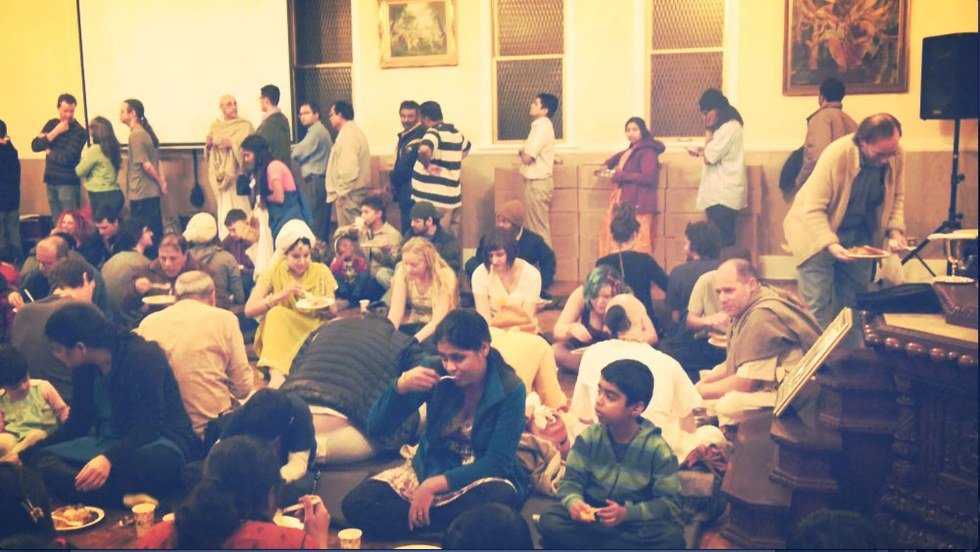
Next, I went to the Radha Krishna temple to ask about beauty. I found some startling similar answers. While there are many differences between Eastern Orthodoxy and Radha Krishna, there are also a lot of similarities. Both demonstrate beauty in different ways. While the Assumption of the Theotokos has a quiet reverent awe, the Radha Krishna temple was like walking into a festival. There were all sorts of people dancing. Monks were playing instruments. People were playing drums. It was beautiful.
I went to the Radha Krishna temple often and simply chatted. I remember asking someone how offering food to Krishna works. He said that, “The idea of offering it with love is what Krishna really likes. It’s not the idea of food, but offering it with devotion.” The more that I talked to people in the Radha Krishna temple, the more that I discovered the theme of love.
One day I sat down to interview Mother Nedra and a female monk named Raven. The two are some of the loveliest people I’ve ever met. Mother Nedra has a calm and peaceful soul and Raven told her stories with passion. I asked them about the story of Radha and Krishna and learned that Radha and Krishna are the female and male embodiment of the godhead. Radha is the female and Krishna is the male. The two are always together and meet up in different pastimes.
Mother Nedra explained to me that in the spiritual world, everything is pure. We live in the physical world, a perverse reflection of the spiritual world. She explained that though Radha and Krishna meet in the physical world, their love for each other is always pure.
Mother Nedra went on to tell me about our souls. “Since time and memorial there’s always been this person called God. Krishna says in the Gita, ‘Never was there a time I did not exist.’ Nor you, we always have spiritually existed.” She told me that we all have a part of Krishna’s soul. And this sounded very similar the Christian view of being created in God’s image. “Love is a dynamic principle. And so it’s always growing. It’s unlimited. And so even though Krishna is unlimited, omnipresent, omnipotent, omnibenevolent, even he himself doesn’t know the limit of the scope of himself.” In the Radha Krishna temple, love too, is recognized an infinite quality. And we have the ability and opportunity to partake in it. Raven explained that “One comes to understand that we’re an eternal soul. A part of God. We have this eternal nature, a loving service nature. And once we recognize that original Dharma or original essence of ourselves, then it’s expressed through loving devotional service, through worship or Bhakti. Trying to serve Krishna and all his devotees with love. In other words, you serve and you worship because that’s your essence. That’s who you are.”
Throughout my journey of talking to Eastern Orthodox Christians and monks of the Radha Krishna temple, I have found that love and thus serving others and God is the purpose of our existence. Through listening to the stories of these wise and wonderful people, I have come to value the importance of love. I know that my learning doesn’t stop here. But I’m thankful to the people who have taken the time to share with me a few stories of their stories so that I might understand truth better.