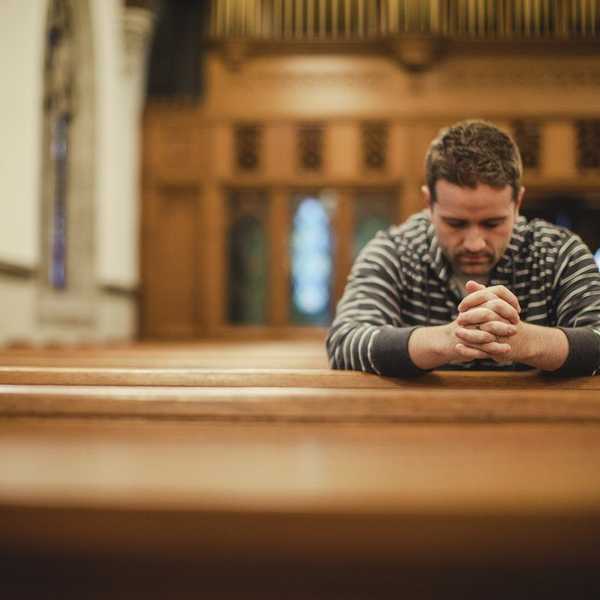


In Matthew chapter five, the Bible describes Christians as a “City on a Hill.” The understanding of this concept is that Christians will stand out from those around them because of the standard of morality that they represent. If you are a Christian in the world today, you must expect that people will react in many different ways to what they see in you. Christ is so radically different from anything on society, that people take notice. Because of this, you can expect questioning about your faith. 1 Peter 3:15 says:
“But in your hearts, honor Christ the Lord as holy, always being prepared to make a defense to anyone who asks you for a reason for the hope that is in you; yet do it with gentleness and respect.”
Christians must be prepared to explain to people what makes them so peculiarly different. If you are a Christian, you can expect to hear any number of these four questions from skeptics, and it is important to know how to answer them.
The fourth question to address is this: “How can Christians act like they worship God while treating others so badly?”
This question is often indicative of an error in thought for those on both sides. The non-Christian looking in asks himself, “How can he tell me to do the right thing while he as a Christian doesn’t?” However, at the same time, the Christian is looking out saying “Why can’t he just understand that I am not perfect?” A misunderstanding such as this stems from the fact that the non-Christian simply does not have the understanding of moral concepts that the Christian does.
The most obvious problem in this scenario is the lack of an understanding of Christianity by the non-Christian. He does not understand that according to Christianity, “all have sinned and fallen short of the glory of God” (Romans 3:23). The fact that all have sinned means that everyone on the planet has done the same thing, and therefore no one is worthy to be a Christian. It is deceptive when a Christian treats his faith like a birthright. In reality, no Christian should ever act like he is above a non-Christian, because if it were not for the prevenient grace of God, he would be just as lost as anyone else.
A non-Christian also doesn’t understand the doctrine of progressive sanctification. Progressive sanctification is the act that God does to make Christians more like Him. Colossians 3:9-10 says: “Do not lie to one another, seeing that you have put off the old self with its practices and have put on the new self, which is being renewed in knowledge after the image of its creator.” According to this verse, the Christian is “renewed” or sanctified to be more like Jesus, but will never be perfect until he gets to heaven. Hence, mistakes made by the Christian are wrong, but expected because he still is not perfect.
While it is obvious that a non-Christian will most often not have an understanding of Christianity, and therefore accuse the Christian of being imperfect, the Christian must be responsible with his reputation. The fact that no one will be perfect until heaven is not a license to sin. A Christian who takes advantage of his positional imperfection and acts as he wants is in sin. The Bible speaks of Christians who become stumbling blocks by acting like Jesus would not as being in the wrong.
In short, it is wrong for a non-Christian to judge Christianity by the behavior of a Christian. Instead, he should judge the quality of Christianity by it’s ultimate moral example: Jesus, who never sinned. Simultaneously, it is wrong for a Christian to take advantage of the imperfection of this earth and rebel by sinning. Christians should act as the example the world needs.