

War is a terrible event for any nation. War is terrible especially for children, the innocent in the global inter-ethnic conflicts. Not many people remember that June 22, 1941, without a declaration of war fascist invaders attacked the Soviet Union. This day of remembrance and mourning is still a pain in the hearts of many people. I would like to share with you my thoughts about two works of art on this topic: the Japanese animation movie "Grave of the Fireflies", and the Russian film "Son of the Regiment ("Syn polka" in Russian)."
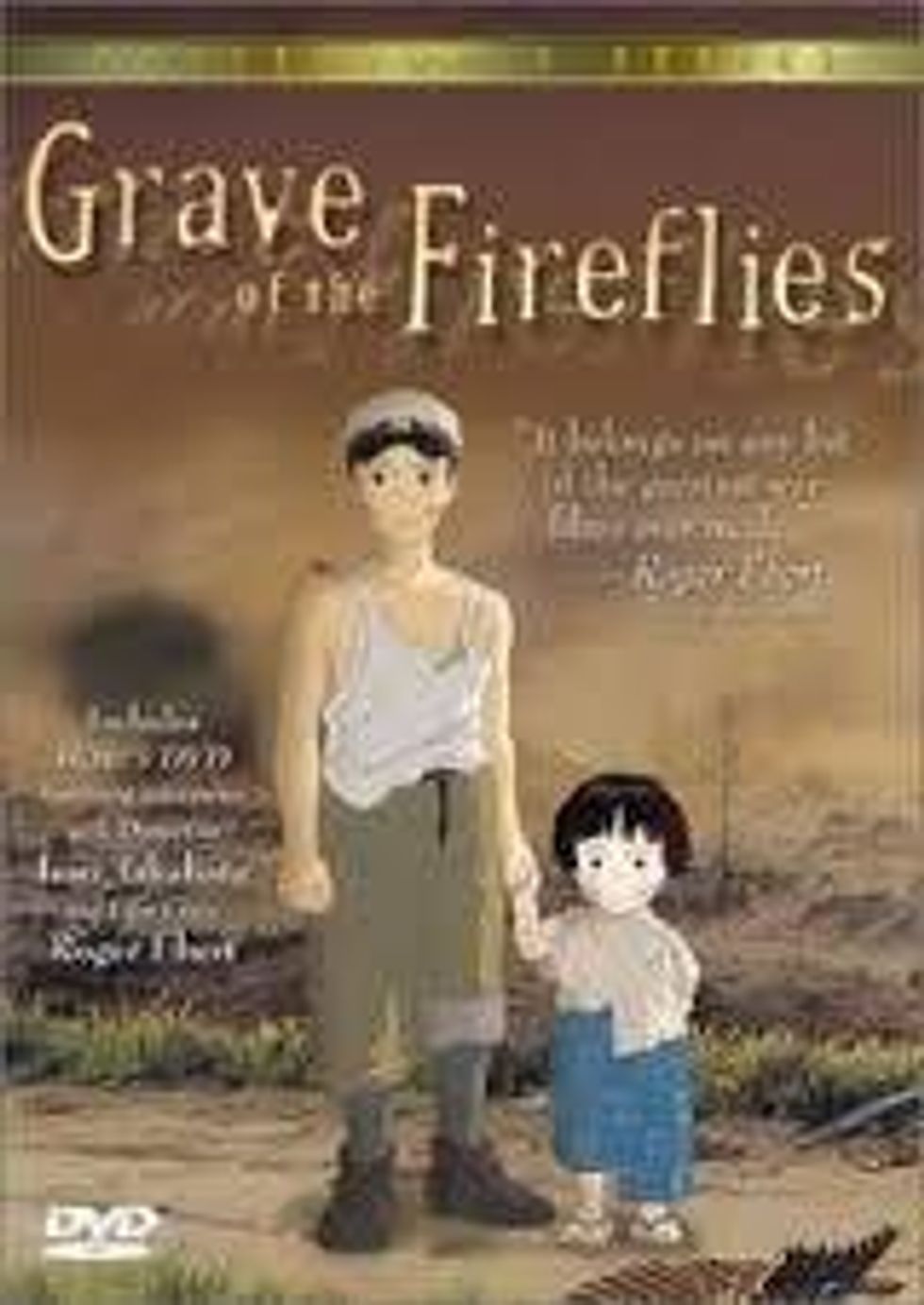
"Grave of the Fireflies" direct by Isao Takahata animated by Studio Ghibli is based on the autobiographical novel by Akiyuki Nosaka, who had lost two sisters and his stepfather during the war. The anime main character lost both parents and must provide sustenance for himself and his younger sister. The girl Setsuko died of starvation after the Japanese surrender. All her life her brother Seita blamed himself for her death, which for him was the feeling of what is inferno.
The effect of the war on Setsuko, like many other people, lasted long after the war was over. This film is often regarded as an anti-war film, but that’s an inaccurate generalization. We don’t witness any battles or soldiers marching into the front lines of combat. The enemy flies above, but they’re not characterized in a villainous manner. War is a mere backdrop in this survival account and the central theme here is how war temporarily changes who we are.
The war turned people into cruel selfish beasts, unsympathetic to the desperate needs of others. The kindness and compassion in human souls evaporates into thin air the second we are communally put in a situation where it’s every man for himself. Priorities eclipse our minds, and the fear of regret blocks our thoughts from the reality that we’re all in this together. It is only together, and with the help of one another, that we can all survive through our darkest chapters without being cursed with future guilt, shame and remorse.
Takahata takes us through the journey, and we understood the sad nature of this destination. We witness the gradual surge of selflessness in the people of a bombed village. It starts with their aunt. At first, she’s welcoming and caring. Soon enough, she is ripping them off, and cursing them. She constantly mocks and humiliates Seita. He should be going to school when the school has been burned down and he should work when he’s only 14 years of age. Eventually, she’s depriving them of food, hiding and saving the food for her own family. We hear whispers of the siblings being a burden in their house, more mouths to feed. Seita, being the son of a general, decides to take his sister and leave their aunt’s house with his pride still intact.
This movie reminds me of the Russian film "Son of the Regiment." It is based on a novel by Valentin Kataev first published in 1945. There are two feature film adaptations of it in 1946 and 1981.
An orphaned Russian boy Vanya Solntsev is adopted by the artillery regiment. Vanya Solntsev found scouts returning from a mission over the damp autumn forest. The boy's father was killed early in the war. Vanya's mother is killed by the Germans because she did not want to give them her cow. When his grandmother and younger sister died of starvation Vanya went begging in the surrounding villages. He was seized by gendarmes and sent to a children's center where Vanya nearly died of typhoid and scabies. Vanya escaped from the detention center and hid in the woods for two years, hoping to cross the front line and to get to the Soviet army. To scouts, Solntsev said that he was 12 years old, but the boy was so exhausted that looked no older than nine. He was cleaned up, got a hair cut, given a uniforms and "put on the full allowance." Captain Enakiev named the boy his liaison. Meanwhile, Enakiev's division was preparing for battle.
Captain Enakiev tried to send the boy to the rear, but Ivan refused. Then the captain tricked him. He wrote something on a piece of paper, put a note in an envelope and told Vanya to carry a message to the Chief of Staff, the command post of the division.
After delivering a package, Vanya came back. He discovered that captain Enakiev had started the stack at his division's coordinates to destroy German forces and killed his whole division, including himself. Before his death, Enakiev managed to write a letter in which he arranged the care of Vanya Solntsev and let him go study in the Suvorov Military School in a Russian city.
The fact that it’s all based on a true story makes it all the more harrowing and disturbing. But in the same moment "Grave of the Fireflies" encapsulates so much humanity and beauty. I’m certain that if you can make it all the way to the end, it will make you a better person.
The film opens with a slap in the face. You see our main character sitting against a pillar in a train station. His clothes are torn, his body is covered in dirt, his frail arms rest flimsily next to him, his face lifeless against his chest. “September 21, 1945… that was the night I died.” How often does a film start with such a powerful declaration? Everything about this masterpiece is a rarity.
But what makes this film stand tall above anything remotely similar is the shocking subject matter. Grave of the Fireflies is set during the World War II when the U.S. was firebombing Japan in a desperate attempt to end the war.
The idea is a unique case to make an animated film based on such a dramatic stories. Takahata is very attentive to detail: shows to us explosions of incendiary projectiles, burning houses, people rushing in panic, worms crawling from the corpse of the main character's mother, ulcers which cover the back of a girl who suffers from malnutrition.
I want to draw your attention, that this animated film was intended primarily for children and has been recommended for viewing in high schools. In Japan care about the children's feelings a lot less than we do. They are taken care of, but in another way, without excessive sentimentality.
There are many haunting images in this film, one of the hardest to watch ones is Setsuko sucking on marbles like they’re candy or playing with bowls of dirt like its rice. What follows next is perhaps the most heartbreaking scene in the film. The war has ended and Seita has managed to get his hands on some real food. He tries to feed his sister a watermelon, but she’s too tired to quench her thirst. Setsuko sleeps and we learn that she never woke up. Setsuko’s last words are, “Seita, thank you.” Even in her last moments, she shows the kindness, innocence, and gratitude absent in adults during those hard times.