"How does this one look?"
We were in the dressing room at Walmart. Swimsuit shopping.
"Turn around."
It had just been getting warm out recently, and about a week prior we had all been swimming at his best friend's pool. I was 17 at the time, and until recently had been living under the "modesty" rules of my family, which meant no bikinis.
Once I had gotten old enough to make my own decisions about my clothing (y'know, something everyone should be able to do at every age), I chose to buy a new swimsuit. Only to find out soon after that I, in fact, still was not in charge of what I'd be wearing. I had someone new to answer to.
"Your butt's hanging out. Everyone's going to be looking at it."
My boyfriend and I dated for almost two years, until a very tumultuous and dramatic breakup. However, looking back, our relationship had red flags from the very beginning. One of those red flags being his extreme insecurity and another being his need for control to attempt to keep that insecurity at bay.
"I'm taking you swimsuit shopping. I'm going to buy you a new one."
While I remember being a bit frustrated, I also remember being much more compliant with his wishes than I ever would be now if this was happening today. I went to Walmart with him. I tried on different suits. I let him see each one, hoping to gain his approval and hoping I'd also like whichever one he agreed to.
He was buying me a new swimsuit; I couldn't complain, right?
That's what I thought at the time, but at the time I also thought abuse was only when your boyfriend hit you. And he'd never do that. I was fine. I was happy. I was loved.
But in reality, I was controlled. And I didn't remember many of the unhealthy and unloving aspects of my former relationship until the hashtag #maybehedoesnthityou made its rounds through social media last week. The hashtag highlighted abusive behaviors from significant others that were not physically violent and are therefore often ignored or forgotten.
I began to remember that being told to change my clothes was not the only instance in which he attempted to control my actions, either, as is often the case.
According to New Choices, Inc., making your partner change clothes is one of many warning signs of an abusive relationship. Although this may seem obvious to some, it was not obvious to me at the time. Partially, because I was so used to someone telling me all of my life what I could and could not wear. And along with that, I had developed the idea that in relationships, women were supposed to "listen" to their partners. But my idea of "listen" had been twisted into meaning "obey," "submit," and any other biblical buzzword you can think of.
I've grown up in the church, am still part of the church and love the church. But there is a serious problem with what we teach our girls and women.
We are allowing abuse to slip through the cracks under the guise of honoring a "biblical marriage."
This attitude may seem archaic, but it still very much permeates our society, especially in Christian circles.
Recent controversial remarks from Kirk Cameron revealed this attitude further.
"Wives are to honor and respect and follow their husband's lead, not to tell their husband how he ought to be a better husband. When each person gets their part right, regardless of how their spouse is treating them, there is hope for real change in their marriage." -- Kirk Cameron
Cameron's younger sister, Candace Cameron Bure, more well-known as D.J. from "Full House," also made similar remarks in an interview about being submissive in her marriage and leaving the final say on decisions up to her husband.
People also reported,
"In the interview, he added that "a lot of people don't know that marriage comes with instructions," and "we find them right there in God's word."
While I can appreciate Cameron's desire to help other's honor their commitments, frankly, his advice is dangerous, and so is the general idea that in order to be in a godly relationship a wife can't tell her husband how he could improve and love her better, or that if you could just "get your part right, regardless of how your spouse is treating you," there would be "hope."
Not only is this advice completely unfounded and going against the advisory of domestic abuse aid centers, but it's not even accurate in a biblical sense.
Conservatives love spouting off the verse about wives submitting to their husbands and letting their husbands take the lead, but what they conveniently don't mention are the following verses:
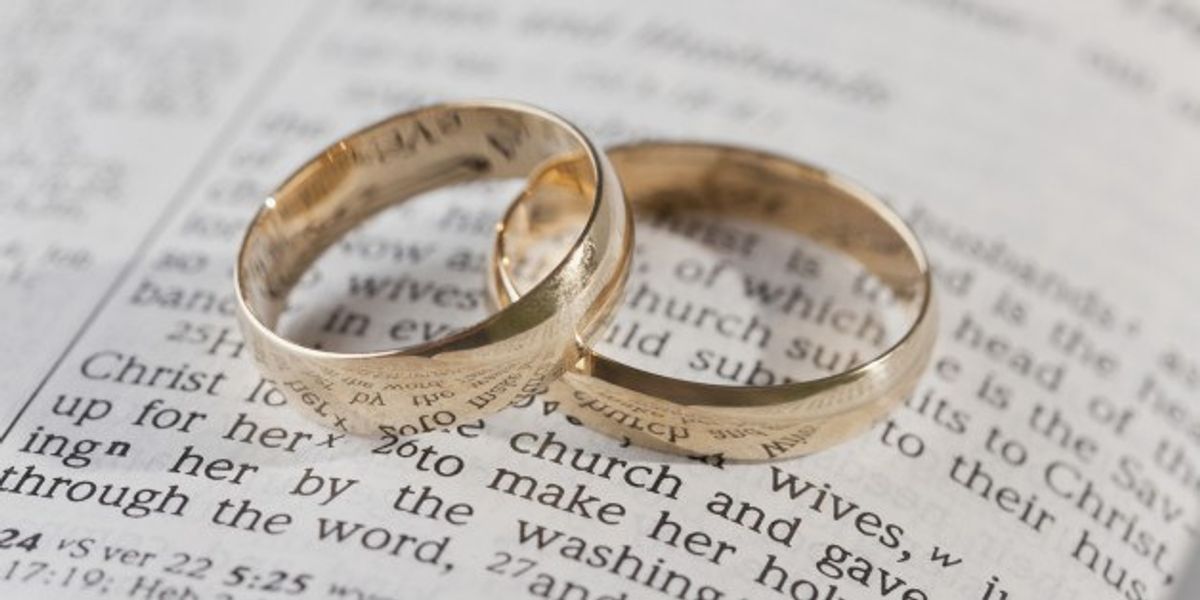
"Husbands, love your wives, just as Christ loved the church and gave himself up for her to make her holy, cleansing her by the washing with water through the word, and to present her to himself as a radiant church, without stain or wrinkle or any other blemish, but holy and blameless. In this same way, husbands ought to love their wives as their own bodies. He who loves his wife loves himself." -- Ephesians 5: 25-28
Hm. This is interesting. Contrary to Cameron's comments, it seems that biblical marriage does, in fact, care how spouses are treating each other. In fact, the Bible calls husbands to love their wives as if they were "their own bodies." It calls husbands to love their wives "just as Christ loved the church."
It seems to me that if a godly husband were more focused on these verses, they would get far less hung up on whether or not their wives were honoring or respecting them by letting them "take the lead."
I would not only say that husbands who define the end-all-be-all of a biblical marriage as having a submissive wife are cherry-picking from the Bible, but I would go so far as to say that these men are being abusive under the guise of being religious.
The near-obsession with having dominance over your partner is a controlling behavior and a slippery-slope to an abusive relationship. Married or unmarried. Religious or non-religious.
When a man begins thinking that he is entitled to dominance over his partner, making her change her outfit is second nature, because after all, he has the final say.
And when a woman grows up thinking that her opinions don't matter and that dominance and control is how love and concern are shown, she lets him have the final say. Even when it's about her outfit, or a piercing she can get, or where she can go, or who she can talk to. After all, he hasn't hit her.
I was not married to him. I was not in a biblical relationship whatsoever. But biblical ideals had permeated my thinking so much that I didn't even recognize control as abuse.
Now that I'm in a loving and healthy relationship, where neither party attempts to force one another to do anything, I finally understand how unhealthy the reverse is.
In less than two months, we will be getting married in the church. We will be entering a biblical marriage.
I will respect him, as I do, but we both get the final say.
And he will love me, as he does so wonderfully, by returning the same respect, as he also does. Because love is respect.
And love is so much more than not hitting.