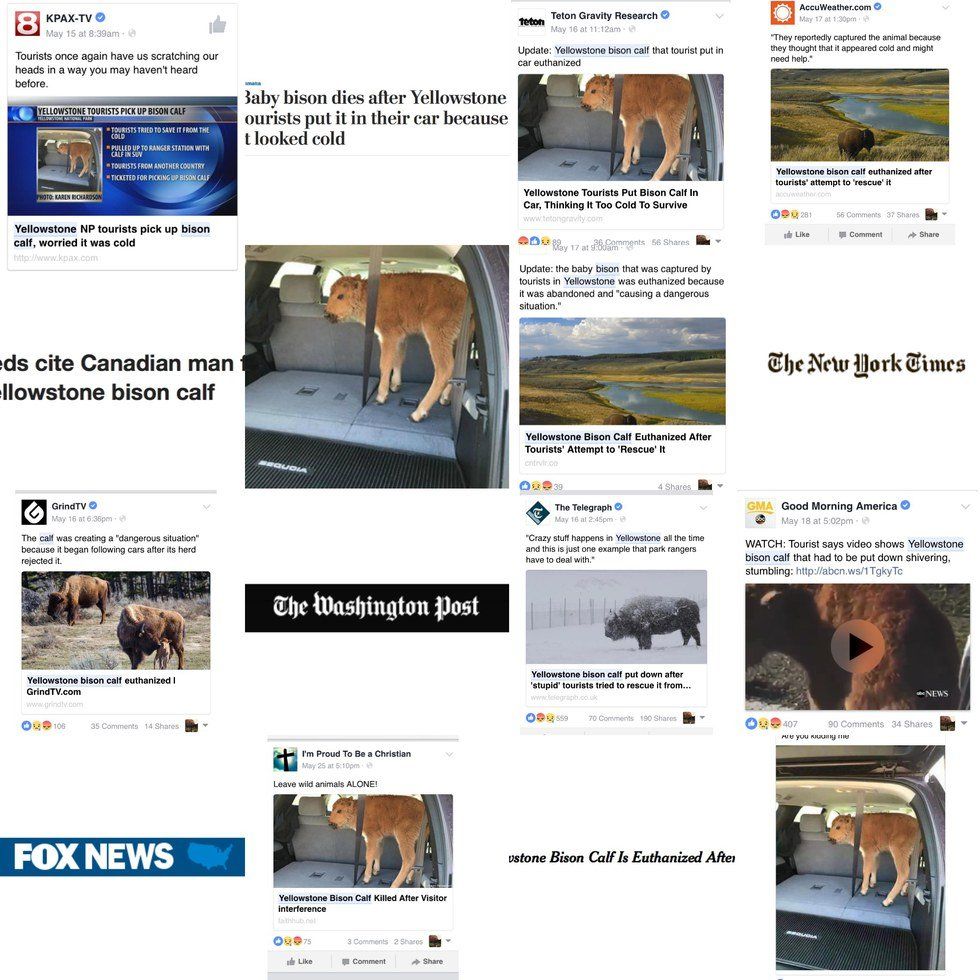
Lately, you’ve probably been hearing a constant stream of chatter about the now infamous bison calf incident that occurred in Yellowstone early this May: a Canadian tourist and his son put a bison calf in their SUV and hauled it to a nearby ranger station. It’s nonstop on your social media streams. You see the photo of the calf in the back of the Toyota Sequoia all over the place, and you see story after story on the headlines of newspaper after newspaper nationwide. Everybody seems to have their own take on it, but has the entire situation really been put together?
As for me, I’m native to Yellowstone. I’ve spent my entire life adoring the park and everything about it. Everything about it. I know the rules, I follow the rules, I respect the rules, and I understand why the rules are in place. The National Parks are federally protected areas, yet they are public lands, and their natural resources are owned by the public as a whole. What this entails is that the greater public puts a great amount of trust in individuals to know, follow, respect, and understand the regulations that protect our Parks. That being said, individuals must put trust in family and friends, but ultimately, strangers, to do the same.
Natalie Kinzel, a woman from Utah, was visiting Yellowstone in early May on the day that fellow tourists picked up a bison calf and put it in their car. Kinzel and her visiting family had parked their car on the side of the road, and they watched as a baby bison was swept away by a river and separated from its herd, and consequently, its mother. The calf was able to escape from the water, but it was left alone, shivering, and separated from its means of survival. Without its mother, a bison calf has little to likely no chance of surviving. The calf approached the road, and Kinzel videoed the calf struggling on its own, leaning up against her car, already far within the 25-yard distance of safe wildlife viewing by its own doing. Kinzel reported that she left the site in tears.
Not much later that afternoon came the report that created enormous outrage among lovers of Yellowstone far and wide: a tourist had put a bison calf into his car. However, it is incredibly likely that the calf that Kinzel videoed was the same calf that was later brought to rangers. The calf was euthanized a few days after the incident because it was unable to be reunited with its herd, supposedly because of the calf’s contact with humans. But, would the calf have survived anyway, shivering by the roadside, awaiting its mother’s return? And even if the herd came back for the calf, would the herd have rejected the calf anyway, because the calf already sought shelter by coming in close contact with humans at its own discretion?
Several different emotional reactions have arisen in spite of the incident. First, and probably foremost, people are angry at the tourist for putting the calf in the car. People are angry that the Park Service didn’t send the calf to a sanctuary. People are mad that the calf was euthanized. Not only are people mad, though, they’re sad and hurt and confused and exasperated. But, the bottom line is: this wasn’t first-degree murder. The tourists who put the calf in their car had the best intentions for the calf. In their minds, instead of watching the calf die after it had been separated from its mother and moving toward the roadside, they were going to save its life. The calf was cold. They were going to warm it up.
Now, looking at it from an ultra-caring and motherly perspective, what those tourists did that day sounds far less harsh. Imogene Davis, a wildlife biologist and writer at The Outbound, says it best: “As a compassionate human being, I admire his concern for animal welfare,” however, by no means am I declaring incidents like this acceptable. And, obviously, the tourists didn’t read the handout that the gate rangers gave to them. But, I think it’s time we stop calling this Yellowstone tourist an “idiot” and “stupid” and “dumb” and an “asshole.” Because if you can’t decipher good intentions from bad, and you propagate that on social media using blatant, condescending insults, or propagate that on social media regardless, then you probably shouldn’t be visiting our parks, either. Let the tourist get a ticket. Let the rangers do their jobs. Things like this have been happening in Yellowstone for years, so skip the wide and massive outbreak of social media sharing. Skip the name calling. Try looking at things from other people’s perspective, and please, I beg you, lay the hatred to rest.