

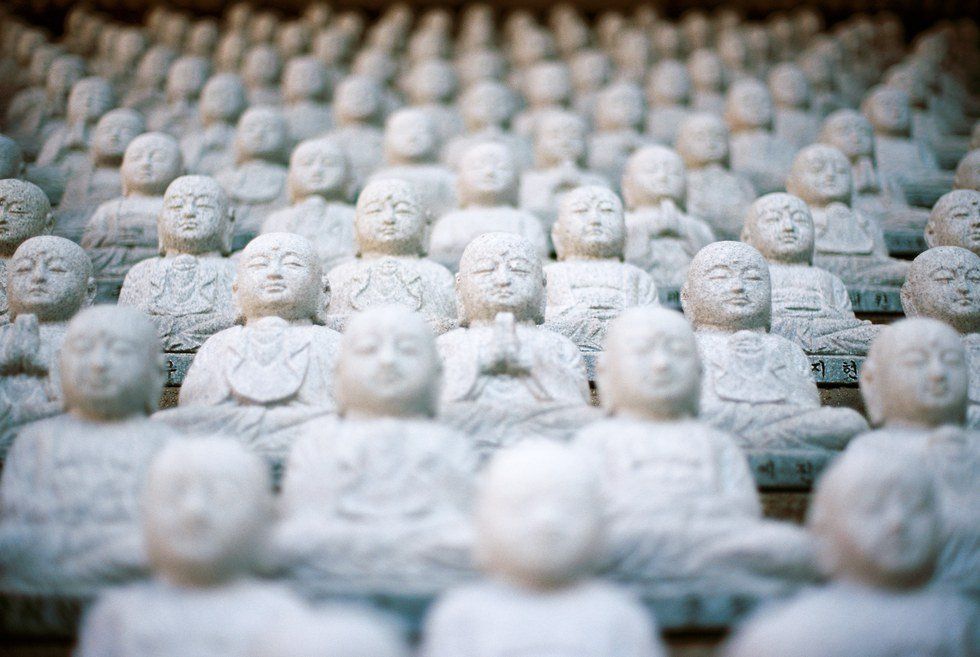
Buddhism started in India and migrated all over the world, and the major symbol of Buddhism is the image of the Buddha. Buddha is not God or a philosopher... he is the role model for Buddhism who set the road for people to follow in order to become enlightened. Buddha led the life that all Buddhists aspire to live.
I am Catholic, but I interviewed a friend, Deirdre, from Hamburg, PA, on what it means to be a Buddhist for one of my religion projects. Deirdre was raised a Roman Catholic but converted to Buddhism when she realized that her “higher power” is more abstract than the idea of a God. Don’t think that this means she looks down on people who follow other religions. Buddhists respect everyone’s choices, which is why they embrace all religions.
Whether you follow the Ten Commandments or the teachings of Jesus, it is all about living a good life and sacrificing yourself for the greater good and for others. You can practice Buddhism in a secular way and still have a belief in other religions.
Retreats are a big part of any Buddhist’s life, especially those isolated from a community of Buddhists. At a retreat, you can expect to find a greater depth and intensity of spiritual practice than you are likely to have experienced before. Deirdre tries to go to retreats and seminars as often as she can throughout the year. It is important in Buddhism to offer your perspective to others who practice the same lifestyle and get feedback from them. When she is not at these retreats, she mostly relies on the teachings and readings of the Dalai Lama, and she attends his lectures once or twice a year when he is in the Eastern region of the U.S.
She then began to talk to about me what it really means to be a Buddhist. She explained to me that Buddhism is a religion based on thought, logic, and cause and effect…it’s not a faith, and it’s not all meditation and singing Kum-ba-yah. It is focused on living a lifestyle in which you are living in the present moment while at the same time being able to measure your actions. This lifestyle takes a lot of focus and concentration, which is why Buddhists meditate. Buddhists tend to be calmer and less reactive than other people. Deirdre told me that her co-workers have already joked with her to be more emotional, but emotions are not always the best indicator of what people’s actions should be. I know we’ve all had the experience where we want to take back what we said in the heat of the moment. It is easier to be less reactive when you are free and unattached from other people’s judgments of you. Buddhists try to free themselves of how they think things should be and just accept things as they are.
Buddhism does not just say “live a good life” and leave it at that, it is about how to live a good life. Living a good life means learning how to diminish our own suffering and the suffering of others. In order to understand how to live a good life, you need to understand the fundamental aspects of this religion. Deirdre told me that she believes the four noble truths and the eightfold path are extremely fundamental to Buddhism.

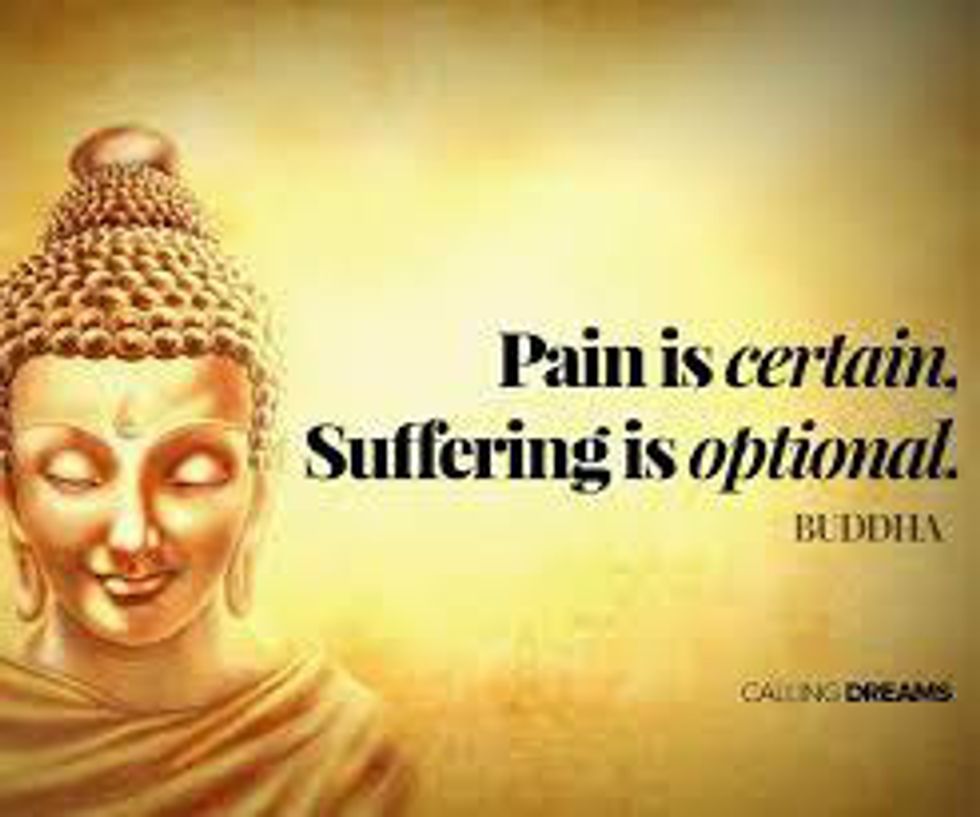
When Deirdre talked about the four noble truths, she focused on the fact that, even though life includes suffering, we are not put on this planet to suffer, and suffering is not a punishment, but Buddhists accept that it is going to happen in life. Deirdre was able to understand this the most when she lost her only child. People say that children aren’t supposed to die before their parents or that parents shouldn’t outlive their kids, but we know that life does not always work out the way we want it to. Deirdre said that being able to accept the four noble truths did not take away the pain from her son’s death, but it took away the suffering.
The eightfold path, according to Deirdre, is not a set of concrete rules like some people think. It deals with “right speech” and “right action.” Right speech doesn’t mean that you don’t curse or that you always know what to say; it means that you are conscious of what you are saying and are conscious that words are powerful and can hurt people. If someone asks her for her opinion, she is not going to just say what she thinks they want to hear. Right action means living your life in a way that is not hurting anyone else. Deirdre encourages people to consider the consequences of their actions. If someone makes a choice based on selfish tendencies, they will receive negative karma. Right action also means being selfless. Buddhists tend to ask themselves, “How can my actions and words be beneficial to everyone involved?”
There is a story of a ferry captain whose boat was carrying 500 bodhisattvas. The captain had a dream that a man was going to kill a bunch of them and then take his own life. When the captain woke up, he went to talk to the man and could tell the man was upset about something. Buddha tried to talk to him about his dream and explained to the man that he would have extremely negative Karma if he went through with the plan that the captain had dreamed about. In the story, the captain kills the man in order to save the lives of the people and to save the man from negative karma in his next life. On a side note, Buddhists believe in reincarnation and believe that heaven and hell are a state of mind, not a place. The point of this story is that someone’s actions can be considered “good” or “bad” depending on the circumstances.
There is a strong commitment that you develop to the practice of Buddhism and you see how it can change your life. Deirdre practiced Buddhism for a long time before she actually “got it.” She spoke to an older man on a ventilator who was the happiest guy in the world. Who would want to live like that? On a ventilator for the rest of your life? So Deirdre asked him his secret to being so happy in that situation. He looked somewhat confused for a moment, and then he told her how he used to be the worst father in the world. He was a miserable, drunk, awful person who was never there for his family…and then he broke his neck in a DUI accident, which he took as a gift. It made him sober. It made him a better father and friend. He said he wouldn’t trade his accident for anything. So that’s when Deirdre really got it.
Buddhism is not about what you are experiencing…it is how you are dealing with your experience. Accept the world not for what you want it to be…but for what it IS.