
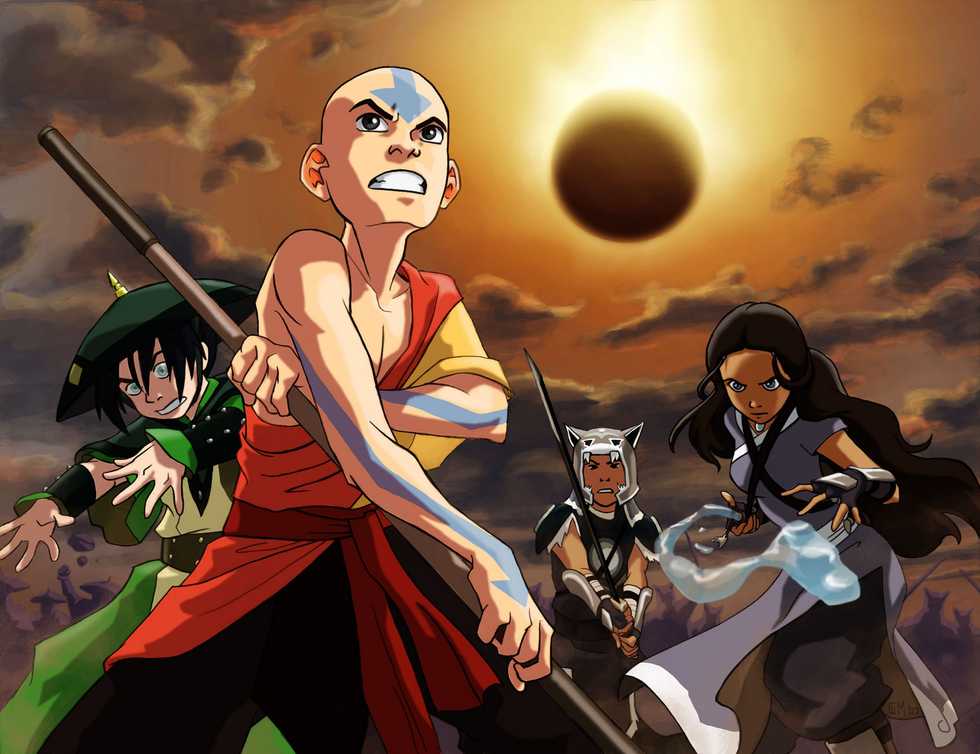
Growing up, I remember watching Avatar: The Last Airbender on my TV. At that time, I was fascinated with the idea of being able to bend the elements and that kids had the power to change the world. It wasn’t until recent years that I started to rewatch that kid’s show with more critical eyes and realized that Avatar: The Last Airbender is a gem waiting to be rediscovered.
Fast forward to the present, I’m now a college student and a member of my school’s ROTC program. Last week, after having a class discussion about the Core Values of the U.S. Air Force, I arrived at the conclusion that most of the characters in my beloved series exemplify the values of integrity first, service before self, and excellence in all we do.
1. Integrity first.
This value refers to the willingness to do what’s right, even when nobody's around. In the show, there are multiple circumstances in which the viewer is able to appreciate a characters’ natural disposition to do the right thing.
First, we discovered Zuko, the bitter Fire Nation prince, that was on an eternal quest to gain back his honor. At first, we couldn’t understand why he was so fixated on capturing the Avatar; after all, the Avatar disappeared 100 years ago, and at the time it didn’t represent a direct threat to the Fire Nation. It wasn’t until a couple of more episodes that we discovered the real meaning behind Zuko’s irrationality. Zuko was banished from his homeland by his own father, the Fire Lord Ozai, for speaking out of turn and refusing to wage a battle against him. What really compelled me was that since a young age, Zuko was brave enough to stand up for himself and point out what was morally wrong.
Zuko demonstrated that he was able to distinguish right from wrong and that his sympathy laid with his people. After that unfortunate encounter with his father, Zuko was punished and forever marked with a scar as a reminder of his disobedience. He was outcasted and labeled as a dishonor to his nation; but little did everyone knew, that he was disfigured for defending those who at that time, were unable to defend themselves.
Then, we must also consider Aang’s battle against everyone to do what’s right. The Avatar Aang’s main priority was to restore the balance across all four nations. In order to do so, he was supposed to fight against the Fire Lord and put end to an era of tyranny. For Aang, this wasn’t an easy thing to do – not because he was unprepared for the battle, but because he feared the outcome. He didn’t want to kill Ozai because he considered all forms of life sacred. That was what the monks taught him, and now that he was the last Airbender remaining, it was more important than ever to live by their teachings. Aang couldn’t just succumb to others' pressure because they were against what he considered to be right. For Aang, there weren’t any exceptions and the fact that everyone, even his past lives, believed that he must kill the Fire Lord was hard for him to accept. But he took his time and looked for a solution that aligned with his moral values. In the end, he decided not to kill the Fire Lord Ozai, not because it was the easiest thing to do or because he wanted to be remembered as a forgiving Avatar, but because it was the right thing to do, and therefore proving that he was “unbendable.”
2. Service before self.
This show did a great job of showing the importance of sacrifice and the consequences of selfish decisions. In Aang's case, he must live knowing that one time, he not only turned his back to the world, but also to his people. If I'm being honest, this part is quite debatable. After all, Aang was just a child, overwhelmed by the number of responsibilities that his new job required. However, that doesn't change the fact that he ran away, putting himself first. As a result, the Avatar cycle was not able to continue, leaving the world with no means to stop the Fire Nation. His inability to accept his destiny at the beginning cost other nations 100 years of misery and unrest. Even though the 100-year war was meant to happen, the show constantly pointed out our ability to choose our own destiny, and in Aang’s case, his initial indisposition to accept the destiny he ironically had chosen by selecting the toys that belonged to past Avatars, had terrible consequences.
But service before self also highlights the importance of selfless decisions and sacrifice. And through more than 60 episodes, the viewers were able to witness multiple sacrifices. Beginning with Katara’s mother, Kya, who die in order to save the life of her daughter, the last Waterbender of her tribe; and Yue, the princess of the Northern Water Tribe, how gave her life to save the Moon Spirit. Both of these sacrifices portray the compassionate nature of these characters, and their disposition to give up their own lives for a greater good.
3. Excellence in all we do.
One of the best examples of this value lies in Azula, the Fire Nation princess, and Zuko's younger sister. Since she was a kid, she demonstrated that she was cruel and willing to do anything to achieve her goals. She was a prodigy, capable of taking anyone down at her young age. She was a force to be reckoned with and a nightmare to many – including her older brother. Everything about her reflected what appeared to be a natural inclination to perfection, from the way she shaped her nails to the ways she spoke. Her technique was flawless, and the color of her flames was a constant reminder of her superiority. Almost at all times next to Azula were her friends, Mai and Ty Lee, that, in spite of not being benders themselves, demonstrated their capacity of inspiring fear on anyone, including benders. Finally, we also encounter benders like Katara, with a desire to learn greater than her lack of an instructor. For the most part, she had to train herself and acquire knowledge from everyone she encountered.
Again these are just a few examples of how certain characters in Avatar: The Last Airbender symbolize the core values of the U.S. Air Force. After all, some of this characters, at some point or another, demonstrated their capacity of exemplifying multiple values, like Katara, and her unwillingness to Bloodbend, or Aang, that became an Air master at age 12, and eventually accepted his role as the Avatar.
For those who have seen the show already, I hope that you enjoyed it as much as I did, and appreciated the values that it was trying to transmit. And for those who haven’t even heard about it, I can only say that you’re missing out of one of the greatest animated shows of all times. Despite being advertised as a kid’s show, Avatar: The Last Airbender, is filled with emotions and the essence of the human spirit. You don’t have to be a kid to enjoy it and value the themes that it was trying to convey.
















