


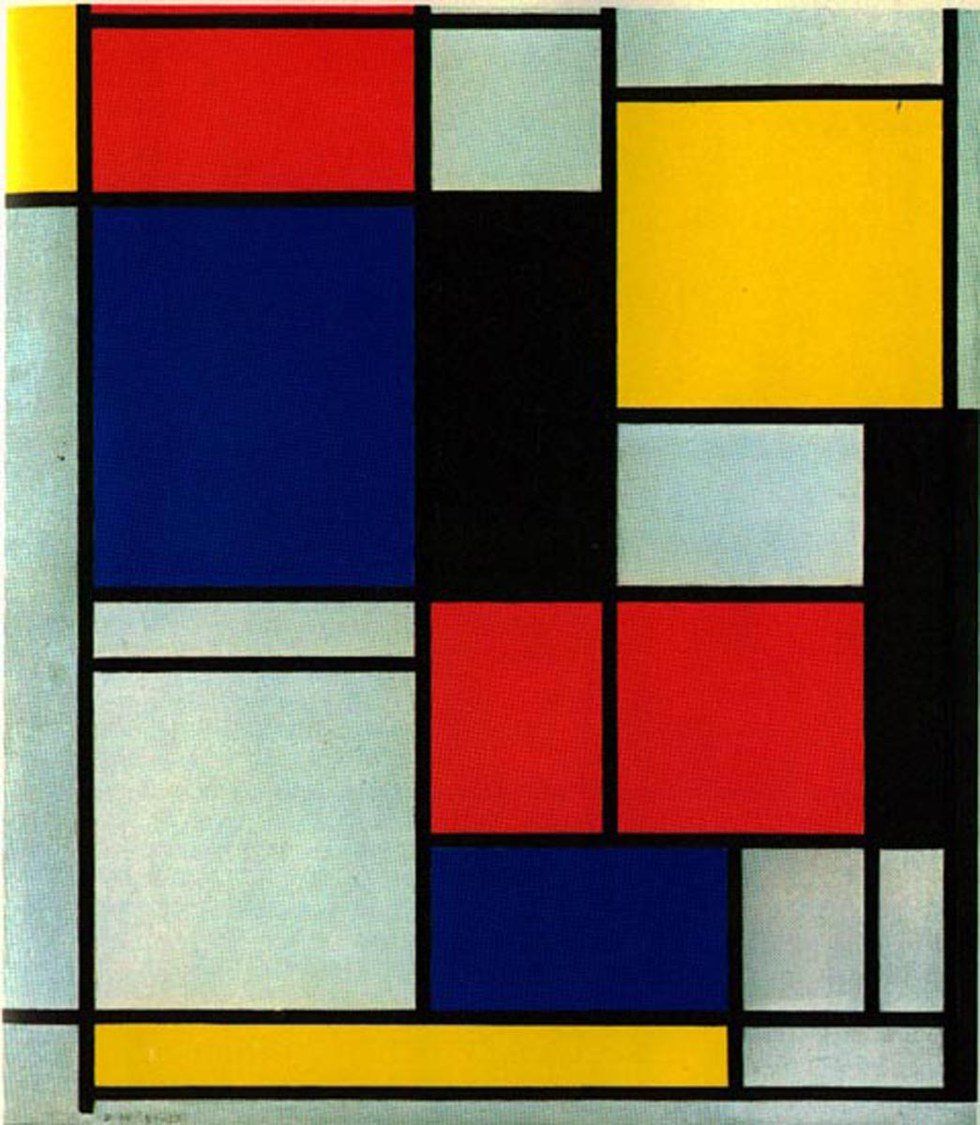
In the early 1920s, a group of architects and artists, influenced by some of the ideas of DaDa, formed a movement called de Stijl. They had a utopian philosophical approach to aesthetics, centered on a publication called de Stijl, which presented their ideas and designs. The founder of the publication and leader of the group was Theo van Doesburg, an architect. Other important people were Gerrit Rietveld and Piet Mondrian.
Their philosophy was based on functionalism, with a “severe and doctrinaire insistence on the rectilinearity of the planes, which seem to slide across one another like sliding panels.” All surface decoration except color was to be eliminated, and only pure primary hues, plus black and white, were to be allowed. The most important thing about this group was their ideas, since they managed to build very few of their designs. One important exception is Gerrit Rietveld's Schroeder House, which is the most complete realization of the de Stijl aesthetic. Not only the house, but also the furnishings and decoration were planned by Rietveld.
In spite of the apparently small output of this group, they would be very influential on subsequent design styles. The initial source of their ideas came from DaDa notions about dispensing with the pretentious elitist design aesthetics of the pre war era. Some of the early work of Frank Lloyd Wright, which had been published in Europe in 1910, influenced their notions about form. Japanese sources were also of significance, though these ideas may have been derived through the work of Wright. This group, De Stijl, came about after World War I where there was a turning away from old forms and philosophies among architects and designers, in the same way there was among artists and writers.
Many of the same abstract ideas came into play, as did ideas that incorporated the "machine" aesthetics of the new industrial age. In fact, one of the important trends of the 20th century would be the increasing parallels between — even merging of — art and design, which had been separated since the end of the Renaissance.
“As a movement, De Stijl influenced painting, decorative arts (including furniture design), typography and architecture, but it was principally architecture that realized both De Stijl’s stylistic aims and its goal of close collaboration among the arts. The Worker’s Housing Estate in Hoek van Holland (1924–27), designed by Oud, expresses the same clarity, austerity and order found in a Mondrian painting. Gerrit Rietveld, another architect associated with De Stijl, also applied its stylistic principles in his work; the Schröder House in Utrecht (1924), for example, resembles a Mondrian painting in the severe purity of its facade and in its interior plan. Beyond the Netherlands, the De Stijl aesthetic found expression at the Bauhaus in Germany during the 1920s and in the International Style.”















