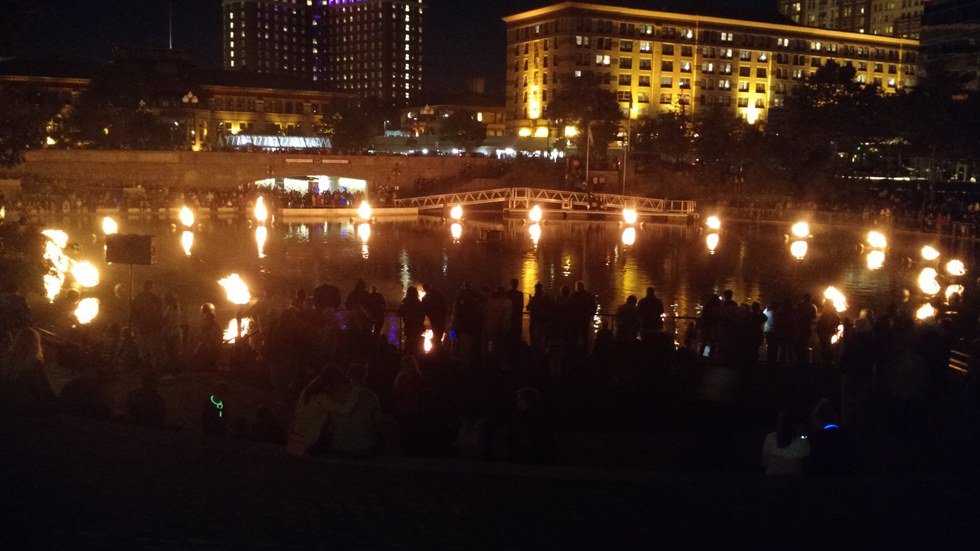
In the year 64, Rome burned. The capital city of the great empire was very nearly destroyed. As it happened, the emperor Nero was said to have sung and played the fiddle, the ashes swirling around him.
Years later, in Milwaukee, in Houston, in Atlanta, in Baltimore, there is a conflagration of a different type. In each of these cities, and in many more across the country, violent crime has escalated far beyond what has been deemed “acceptable,” ending a decades long downward trend and ripping the fragile urban fabric.
A week ago, a Russian passenger jet fell out of the sky; over Egypt’s Sinai Peninsula, if it matters. 224 people were killed. It is widely held that a bomb was stashed on the plane before takeoff.
Mere days ago, in Louisiana, police pursued a SUV. At the completion of a dead-end street, the officers fired five shots into the vehicle, each hitting, and killing, a six-year-old boy sitting in the front seat. The cause of the chase remains under investigation, though it was not a result of a warrant nor firearms possession.
If I did not read the news every day, if I dismissed breaking news notifications before glancing at them or unsubscribed from daily emails, I wouldn’t have the slightest inkling of what is going on outside my immediate and constant relationships. A college campus is supposed to be a hotbed of cultural observance and societal critique, yet I get all my news, all my op-eds, from New York, Washington, and Boston.
There is an evident disconnect. Society is burning, and no one is even acknowledging it, never mind bothering to fiddle in the midst of the wreckage.
Perhaps it is overload. Watching the same grainy footage on repeat, the same breaking news alerts with the locations and number of causalities tweaked, begins to desensitize. Just another day, another CNN segment muted over tables and waiting areas. The fad for some time has been to swear off the news because it is too depressing, another reminder of all that is wrong in the world. As if ignoring the problems will make them go away. Plug our ears with our fingers, pull the blanket over our heads, and wait for it all to be over.
Even closer to the truth -- until the bad affects us, it doesn’t affect us. We care about terrible events from a policy perspective, paying enough attention to argue for stricter laws, looser laws, less guns, more guns, walls, and decriminalizations. This is not the same type of feeling one gets when it is his brother on the street, mother on the plane, or child in the passenger seat.
Nor should it be. Being personally impacted is not the same as reading about a tragedy. But now the distance between the two is unnavigable. It has led us to a place of tuning out what we would rather not know, and chalking up the things that do skirt the filter to a snapshot of “the way the world is.” As if we don’t have a say. As if we don’t have a choice. As if we aren’t “the world.” As if that attitude isn’t a self-fulfilling prophecy.
The alternative is recognizing that shootings, killings, preventable accidents, and deaths of all kinds matter. They matter regardless of relationship to the victim, to the family, to the city, or even to the culture. They matter for moral reasons, certainly, as we should strive to treat others the way that we want to be treated and because every life matters. But they also matter for very practical reasons -- because creating and sanctioning a society in which violence reigns almost unchecked makes us all less safe. Complacence sets a precedent, inspires future unsavory actions, and allows the creation of policies that may ultimately harm more than help.
This is not a call for more empathy. It is a call for awareness, for participation, for getting our act together because this is getting out of hand and we should be better.
Many children are scared of the dark. At a young age, it is within the absence of light that the unknown lays, the monsters, the murderers. As adults, there appears to be a widespread fear, instead, of the light. It turns out that what we know, what is real and in front of us and what we deal with every day, is far scarier than what might be hiding around the corner. Reality is worse than fantasy. The danger is not under the bed at night but outside the window at high-noon. So we shut the curtains tight, hoping the shadows will protect us.