
Everyone know that water is the world’s most precious natural resource and that we need to conserve as much of it as we can. Unfortunately, many governments don’t recognize this and squander precious water resources on costly irrigation projects in an attempt to provide short-term solutions to shortages elsewhere. As a result of these decisions, the water levels in wetlands, lakes, rivers and reservoirs fall extensively and damage entire ecosystems. One notable example is the Soviet Union’s draining of the Aral Sea in Kazakhstan.
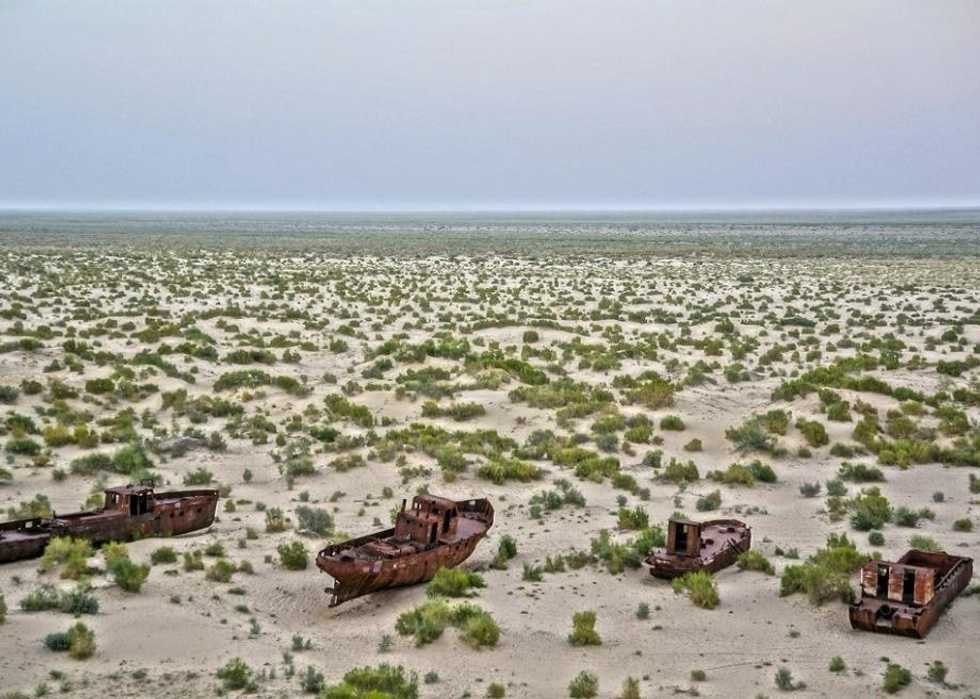
The Aral Sea was once the fourth largest lake in the world, a vital watering hole for ancient civilizations and the site of a fragile and diverse ecosystem. Today, the sea has collapsed into a vast, barren plain of salt with a few shallow puddles. Gone are the fisheries that local residents depended on for food. Gone too is a great water source in a semi-desert area.
How did the once great inland sea become the sight of one of the worst environmental disasters recorded? It was the work of the former Soviet Union and its unsustainable plans for agricultural and economic development in the 1960s. The Aral Sea is located in Kazakhstan and Uzbekistan, two Soviet satellite states that the Communist regime sought to make more economically productive. They noticed that the climate and the soil could support an expansion of the agricultural industry in the area, especially rice and cotton cultivation; this would have been very beneficial to the economy because the regime would not have to import these commodities.
There were problems with this concept: rainfall was extremely limited in that steppe, very few sources of groundwater existed and the water from the Aral Sea itself could not be used due to its saline content. The regime responded by diverting the two main rivers that feed into the sea, the Amu Darya and Syr Darya, to provide for extensive flood irrigation projects.
Initially the project was a success. By 1992, 18.5 million hectares of land were in use and cotton production soared, making the region the world's fourth largest producer.
But by diverting the Amu Darya and Syr Darya rivers, the Aral Sea became what scientists call a terminal lake; with no outflow and very few regeneration sources, the sea began to shrink at an alarming rate, leaving behind large piles of salt. The environmental journalist, Iskandar Abdulaev, notes “Salt from the dry sea basin is carried for long distances by the wind and deposited on cultivated areas causing crop failure.” In this case, the Soviet government’s initiative to make the Aral region more agriculturally friendly has resulted in the area becoming hostile towards development.
The Aral Sea ecological disaster happened as a result of human error induced by the promise of economical growth. But that promise never outweighed the program’s cost, as Walter Cunningham noted: “The economic value of the cotton and rice probably never equaled the cost of the lost fisheries, villages and health of the local residents.”
This ecological tragedy has also harmed the health of local residents. Rudolf Slooff of the World Health Organization has argued that since the draining, “The Aral Sea region is characterized by a low life-expectancy, high maternal and infant mortality rates, and high rates of infectious diseases, congenital diseases and cancer.”
Since the Soviet Union fell, more attention has been given to the Aral Sea disaster. In 1993, Kazakhstan and Uzbekistan took part in the founding of the International Aral Sea Rehabilitation Fund, an organization sanctioned by the UN to help bring back the sea while developing sustainable irrigation practices.
Progress on the initiative has been painfully slow due to political strife, a lack of sufficient funds and broken promises. Currently, the Uzbekistan government is in dispute with Kazakhstan over the handling of the little water that remains, more specifically for the construction of a dam that would keep water in the northern part of the sea owned by Kazakhstan. The Uzbeks believe that this is a way for the Kazakhs to keep all of the water for themselves, even though the south Aral shore belongs to Uzbekistan.
One plan for the restoration of the sea could be effective. The northern lobe of the sea is the healthiest part and environmental scientists are slowly working to restore it. The Kazakh government has constructed a dam of sand to keep water from flowing into the south part of the sea. The water level in this area has recently risen by three meters for the first time in 30 years, bringing back nature to the zone. With the larger amount of freshwater flowing in, the salinity levels have dropped in the northern Aral, making it a more livable habitat. There have also been attempts to reintroduce native fish to the small lake.
In addition to replenishing the Aral Sea bed, the farmers in the region must practice more sustainable water usage. They should cultivate drought-tolerant crops, use night irrigation, which saves water from evaporation and deploy recycled drainage water.
There is no question that the draining of the Aral Sea ranks as one of the worst ecological disasters in modern history. The Soviet government initiated it in the hopes that it would turn the region into an agricultural and economic powerhouse. It achieved that goal but destroyed a crucial desert biome. As such, it is a perfect example of how governments mistakenly pursue supposedly positive economic projects without weighing their enormously destructive cost.