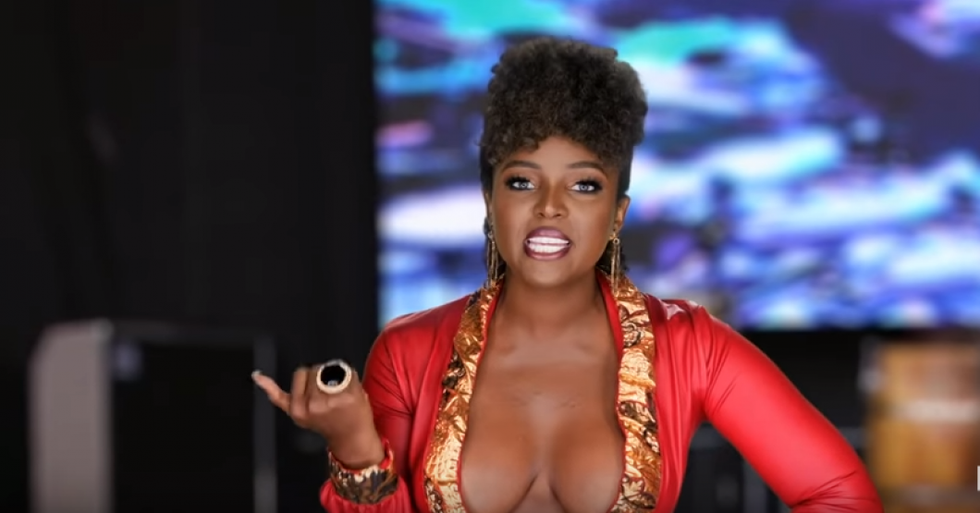
A few weeks ago a scene from "Love and Hip Hop: Miami" went viral. Record producer Young Hollywood completely showed his ass in a meeting with Dominican singer and actress, Amara La Negra. Basically, the two scheduled a meeting to discuss Amara's crossover into the American hip hop market, but seemingly unknown to her, Young Hollywood's focus was not going on her singing, but instead on her hair.

In the clip that lasts about 2:17, Young Hollywood is seen grilling Amara about her hair, and suggests that in order for her records to sell in English, she may need to tone down her "blackness." He mentions that she should try something different with her hair and later elaborates by suggesting braids or straightening it. Then when Amara goes on to say that as an Afro-Latina, she embraces her natural hair and see's no issue with continuing to wear her Afro, the producer, clearly confused, asks if she refers to herself as an Afro-Latina because she is African or because she has an Afro. According to Amara, before the scene was edited for television, the producer went as far as to tell her that her hair was too "nappy," and not "elegant" and asked why it was "like that." He then called her a "nutella queen," and told her that if she wanted to be successful she needed to be less "Macy Gray" and more "Beyonce."
More recently Amara La Negra appeared on "The Breakfast Club" where she was asked about her conversation with Young Hollywood, and complete madness ensued. Moments after the show went live, Charlamagne Tha God popped off his first question. "What are you?" And I just knew the interview was headed downhill from there. The second question came from DJ Envy. "What is an Afro-Latina?" To which Amara had to explain, probably for the a-millionth time, an Afro-Latinx is a Latinx of African decent. Now, for a small second after that, Angela Yee actually said and did something that didn't play into the complacent stance she always takes on touchy subjects and reminded the men that when Dascha Polanco, who is also Dominican, was on the show, all of this was explained to them.
Angela Yee then brought up the issue of people thinking that Amara was in black-face. After addressing the rumors that her skin color wasn't actually her skin color, Amara then went into speaking about her experience as an Afro-Latina in the entertainment industry, both in the Latin market and the American market and how a lot of people in the U.S aren't used to hearing people of darker complexions or who appear African American speak Spanish. She likened the ignorance to the lack of Afro-Latinx in mainstream media.
From there the interview went fine until Charlamagne then asked Amara to describe what "exactly" her struggle is. She explained the issue of colorism and how the lighter Latinx are usually the ones we see in the media and the darker Latinx, like herself, have a hard time getting into the business because of the way they look. This is when the interview took a left. DJ Envy interrupted by saying that, he simply didn't see what she was talking about, and Charlamagne went on to ask if she thought this was all in her head. He then brought up the success of Cardi B, and this is where Afro Latina's and Black women raised their eyebrows in unison.

So, for anyone who needs clarification on what Amara was saying, here you go. The main subject of this interview was the color of her skin and its connection to her Latin heritage. The first point she was trying to make is that there aren't a lot of dark-skinned Latinx in the Latin market and because of that, it was harder for her to become successful. In 2018, she is probably one of few (if not the only) entertainer of her caliber and success that looks the way she looks IN THE LATIN MARKET. When you turn on Latin channels, watch Latin movies or read Latin magazines, there aren't too many people of her skin tone. This is due to the issue of colorism in Latin America and the Latin parts of the Caribbean.
The second point that she made, is that now trying to cross over into the American market, many are confused by her look, so she faces a different manifestation of the same issue. While it's easier for her to be accepted (by Black people, at least) most Americans simply aren't used to seeing dark-skinned entertainers who speak or entertain in Spanish. And therefore, she was told to "unblacken" her look as a way to resemble more of the cookie-cutter Hispanic entertainer...i.e Jennifer Lopez, or Sofia Vergara. Basically, Afro-Latinx are told, if you're gonna be Black, be Black, and if you're gonna be Hispanic, be Hispanic, but that thing in the middle? Nah.
Somehow Cardi B's name got thrown in as Charlamagne insisted that her issue wasn't a real issue because Cardi is also now famous. Whether or not you like Cardi B and her music is a non-issue in this conversation about colorism. Here are the two things that Charlamagne and DJ Envy would have understood had they not consistently interrupted Amara. A. Cardi B became famous in the American market BEFORE the Latin market accepted her. Which proves the point Amara was trying to make. While Cardi is not considered "dark" for American standards, she is for Latin standards especially being as that she is bi-racial with a Trinidadian mother. And though she embraces her Dominican roots and is fluent in Spanish, she had to prove her monetary value in America, before the Latin music scene would touch her. Amara's second point is that Cardi B is a LOT lighter than her. Both are Dominican, but Cardi B's image (despite her previous set of teeth) falls much more easily into America's beauty standards. Her skin is fairer and she doesn't wear an Afro. Had Cardi been the one in the room with Young Hollywood, she probably wouldn't have been referred to as a "nutella queen."
From there the situation got messy and unfortunately Cardi B's, younger sister felt as if her big sis needed some sort of defending in this non-attack. Hennessy Carolina posted this underneath a clip of Amara's interview on "The Breakfast Club's" Instagram page, and then later deleted it (after a sea of people explaining to her the concept of colorism and that Amara said nothing to discredit Cardi, no doubt.)
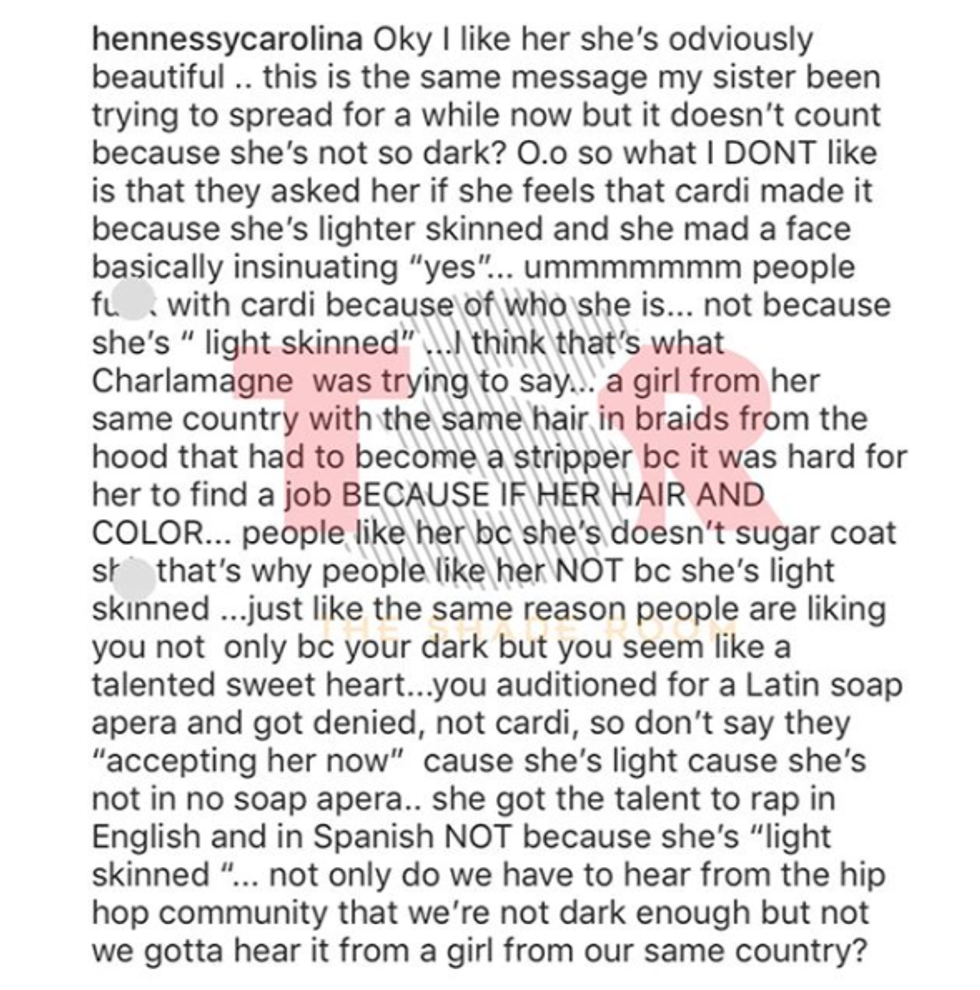

A lot of people on Instagram were quick to point out to Hennessy Carolina that not only did she falsely accused Amara of coming for her sister, but she had completely missed the point, and that it was actually Charlamange who brought Cardi B's name into the conversation.
And she must of felt schooled on the subject as her post came down pretty quickly.
Here's the thing. There are Latinx who are also part of the African Diaspora and they are everywhere. The lack of diversity in Hollywood is far from new and Afro-Latinx entertainers have been speaking on their struggles for a very long time. But this recent conversation is proof that we have gotten nowhere and stereotypes prejudiced are still keeping our Afro-Latinx in the shadows.
“We come is so many different shades that it’s like why is it so hard for people to understand or accept me? … There isn’t a Latin country that doesn’t have people that look like me.” - Amara La Negra