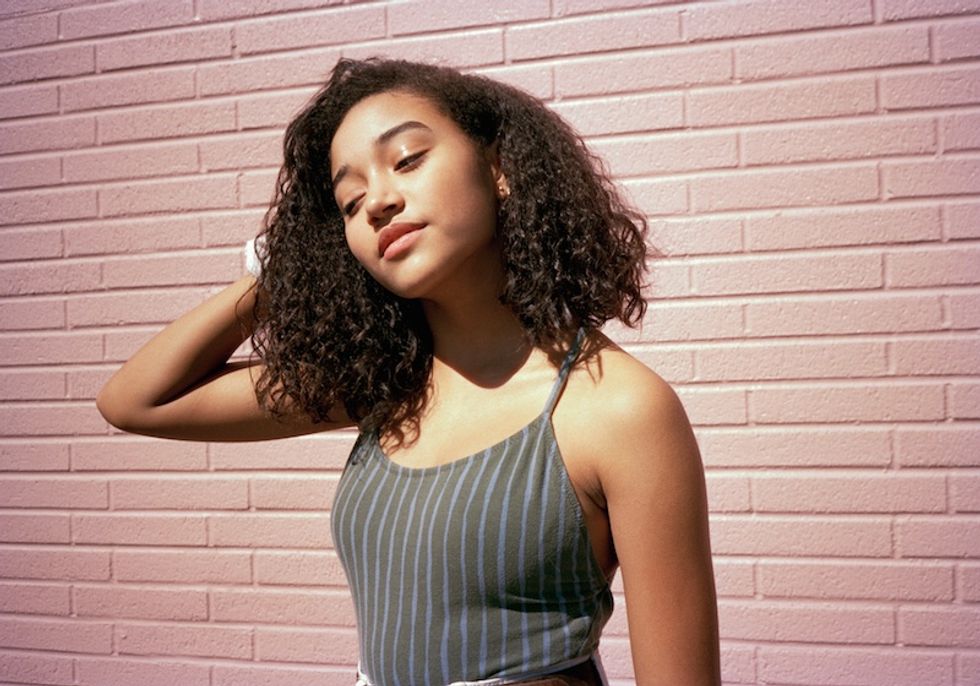
Amandla Stenberg has always been powerful. From her name - which means "power" in Zulu - to her moving performance as Rue in the highly praised trilogy, The Hunger Games, Stenberg has created a platform for herself to speak about cultural and racial issues that need more attention. Her Twitter and her Tumblr accounts are both social media outlets that allow her to voice her opinions and be the voice for thousands of young people who feel like their voices have been suppressed and/or unheard.
Despite her young age of 16, her fight for racial equality does not go unnoticed. The April 2015 Baltimore riots, which stemmed from the injustice following the death of Freddie Gray, were a pinnacle of frustration for many individuals. The racism and violent backlash seemed to highlight the huge issue of equality and double standards in America. Along with the thousands of protesters who took to social media to voice their chagrin in the attempt to raise awareness about this issue, Stenberg responded fittingly with conviction:
"Don't condemn our anger. Don't denounce our pain as savage. What's savage is the cruel inhumanity and brutality of the police. Condemn that."
–Amandla Stenberg (@amandlastenberg) April 27, 2015And it doesn't stop there. She also advocates for intersectional feminism. This is the idea that women experience oppression in varying configurations and varying degrees of intensity. Coined by American professor Kimberlé Crenshaw in 1989, this perspective of feminism is very important but rarely talked about in mainstream feminism. Most often, this is used to express the struggles women of color experience because women with privilege abuse the word "feminism."
Stenberg fights for the idea that society needs to stop appropriating the cultures of people of color (POC) while tearing down the cultures themselves. She actively addresses these acts of appropriation that openly offend the public in order to educate. In answering a message via Tumblr post, she writes, "there is no way we can make progress without conversation."
Recently, she commented on an Instagram post of Kylie Jenner, who had styled her hair into cornrows, saying, "When [you] appropriate black features and culture but fail to use [your] position of power to help black Americans by directing attention towards [your] wigs instead of police brutality or racism #whitegirlsdoitbetter." She received severe backlash from the media, which pinned Jenner as the victim. Stenberg was bashed for her sense of wit, repeatedly being associated negatively in the situation. She asserted that the public needed to understand this was a problem:
"End the 'angry black girl' narrative. It's just another attempt to undermine certain perspectives. I have strong opinions. I am not angry."
–Amandla Stenberg (@amandlastenberg) July 13, 2015While this all may seem like a small social media outburst between two teenage celebrities, we need to realize the bigger picture of the issue at hand. Again and again, we see different cultures being pushed around by Western/European cultures and justly offending POC — cornrows, bindis, and Native American headdresses all used as style accessories. She asserts the idea of why cultural appropriation needs to be dismantled in this passionate and brilliant video, "Amandla Stenberg: Don't Cash Crop On My Cornrows."
All of these issues are becoming increasingly important for the younger generations. Cultural appropriation needs to turn into cultural appreciation, racism into racial equality, and feminism into intersectional feminism. It's our future, and we need to learn how to change the world for ourselves. It's time to find our voice. It's time to educate those who are unaware and learn what is right and wrong. It's time to start a movement for justice.
And Amandla Stenberg is the perfect face of this revolution.