
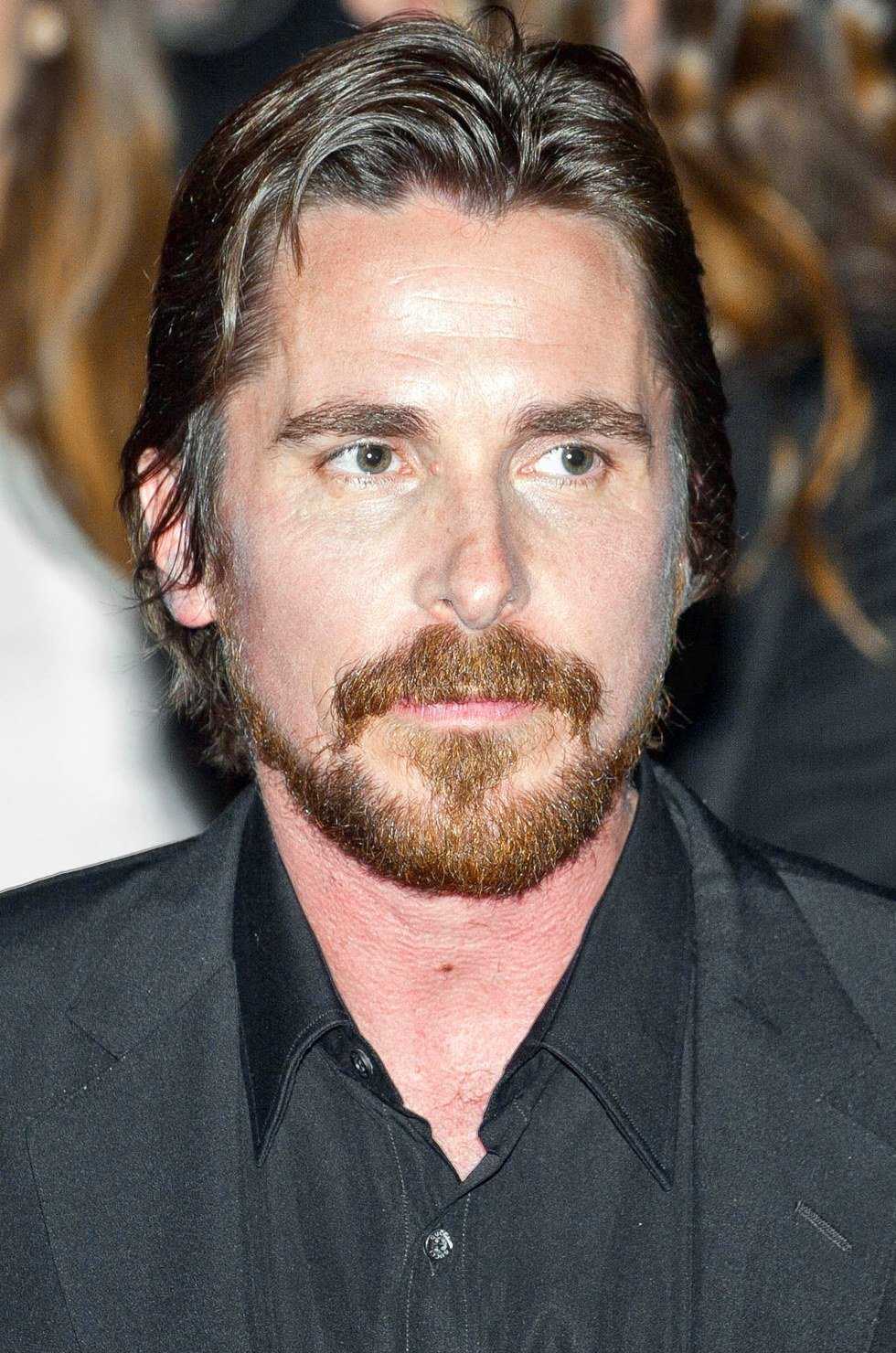
Why do people cling to actors and celebrities? Western and particularly millennial culture seems drawn like a beggar to the exploding fountain of wealth that celebrities personify. Ironically, it is those very people that give celebrities this wealth. American moviegoers throw money at Christian Bale because he so vividly portrays a superhero ("The Dark Knight" trilogy), a psycho murderer ( "American Psycho"), a fat conman ("American Hustle"), or a starving child ("Empire of the Sun"). He expands the singularity of one person into a seemingly infinite continuum of characters and personalities, all while trapped within the fleshy confines of one body.
Perhaps we adore actors for this multiplicative power, an uncanny gift at showing us the full breadth of human experience using their limited range of movements, expressions, and articulations. In reality, an actor could not live as many lives as he portrays, but that’s movie magic. We like actors because, for a moment, they stop time and can be anyone or anything, anywhere at any time. They offer an infinity of experience that is impossible for anyone to actually achieve.
Many have written on the subject of time; it’s the jail we all share. Albert Camus, a 20th century French philosopher and author, wrote extensively on time and acting. In his essay "The Myth of Sisyphus," he writes of Hamlet’s actor, “He will die in three hours under the mask he has assumed today. Within three hours he must experience and express a whole exceptional life... In those three hours he travels the whole course of the dead-end path that the man in the audience takes a lifetime to cover.”
To see the majesty of life, all joy, misery, boredom, ecstasy, passion, pain, and death splayed out like a dead thing on the observation table: That is why we go to the movies. That is why we prize actors, those who are good at fooling, good at pretending. From one body comes many visages, all staring at you, the viewer. We enjoy the rush of absurdity in seeing one person that we know is really just one person pretend to be so many things he is not. It cheats time and death, cheats the harsh reality of impermanence that we all must eventually confront. It eases the sheer pain of existing and knowing.
Camus and many other philosophers focused on the absurd, the existence of limitless information (because the universe is constantly expanding) and the narrow, biased existence of humanity. Most of them agree that life is meaningless because our world is just one outcome of infinitely many, equally trivial collisions of space rocks in the early infancy of our solar system. If science is to be solely trusted, there exists no evidence for inherent meaning or morality in our lives. Just because humanity exists on Earth doesn’t de facto mean that stealing is wrong or that fried chicken is obviously the best food in the universe. Everything is nothing and life is pointless.
Camus unabashedly confronts the reader with this realization: “From the point of view of Sirius, Goethe’s works in 10,000 years will be dust and his name forgotten. Perhaps a handful of archaeologists will look for ‘evidence’ as to our era…. Hence the actor has chosen multiple fame… from the fact that everything is to die someday.” He spills the ephemeral blood of reality all over the page, ripping all sense of hope from his reader.
The part I hate the most is thinking he’s right.
In the Shadow of the Stars
By Burke Garza
In the sway of the trees, something is said,
The tales of the ancients, the gone and the dead.
But here there are none, no songs to be heard.
The closest, the calling: the sound of a bird,
Drudgingly given, without any care.
But none of it’s known, as if nothing was there.
Not a soul in the streets nor a head in the window,
No one exists in this meaningless limbo.
Though a breath you may draw, a step you can take,
Thoughtfully pondered, without a mistake,
That something is nothing, compared to the sun,
That bright, shining orb, of plasma it’s spun.
In the fire so hot, existence is not.
Where chemistry fails, and bonding is naught,
Our world of the web, our tiny green sphere,
Would disappear in an instant, and no one would hear.
Willful emotions and passionate love,
Really are nothing to the sun up above.
Comments and likes, posts and retweets,
All human trappings the black vacuum eats.
Wars and explosions, Bin Ladens in lairs
Debates and politicians with funny fake hair:
Perturbations of spacetime, a dot on a map.
Nothing you do will ever mean crap.
As a reward for making it through that poem, here’s some good news from Camus about the actor: “He abundantly illustrates every month or every day that so suggestive truth that there is no frontier between what a man wants to be and what he is…. He is at that point where body and mind converge, where the mind, tired of its defeats, turns towards its most faithful ally.”
So, is he telling us all to become actors? No, rather to become like them. Why do we like actors? Because they so sharply pierce the dark night of our existence, cutting through the seeming meaninglessness of life. They live infinity, singing existence in multitudes. Actors carry life with them, not just their own, but many lives. Their art, though it may fade with time, is timeless to them and to us, permanently burned into the here and now.
Why is a line like “I’m king of the world!” so memorable? Leonardo DiCaprio lives that single, short moment in front of the camera, but its meaning to us, the viewers, is immense. From poverty comes a king, and from the brutish shortness of life come endless waves of experience lapping in from a limitless ocean, brushing the coarse sand from the soul’s beach and pulling us out into that greater majesty.

Push On! Brave Wanderer!
By Burke Garza
Counting the flitting seconds of temporal life
As I peer into that horrible abyss above,
I hear Time whispering “death” as it peers ‘round the corner,
His obliterating indifference to an inconsequential us.
His one weapon, his patience,
On the battlefield of our endless universe,
That darkling plain of ignorant gravity and headlong hurtling
Which spaghettifies our sad souls and ages us to dust.
Boosting through the black night of this existence,
Bending to oppressive gravity and its constant demand,
Burning with the intense blaze of trillion-fold elementality:
Nothing escapes the clock.
Look back on our little heavenly sphere,
The dimmest light in the darkest night,
All humanity perched on the head of a pin,
Piercing through that indifference.
The tremolo of a million saintly violins
Beneath a bellowing organ,
Reaching into the Over-soul of the planet,
Push on! Brave Wanderer!
Ride the cosmic sway into that silvery night,
Ride the sky for us, for that heavenly little sphere
And all its tiny inhabitants
They scream We Are Here! We Are Here!
For man so loved the world,
That he gave his only begotten breath,
That the Earth might live,
That the Universe might know.
Standing stark against the sky
With a smile stretching through the distance,
Middle fingers raised,
He howls in Epicurean ataraxia.
Ataraxia (n.): For Epicureanism, ataraxia was synonymous with the only true happiness possible for a person. It signifies the state of robust tranquility that derives from eschewing faith in an afterlife, not fearing the gods because they are distant and unconcerned with us, avoiding politics and vexatious people, surrounding oneself with trustworthy and affectionate friends and, most importantly, being an affectionate, virtuous person, worthy of trust.