


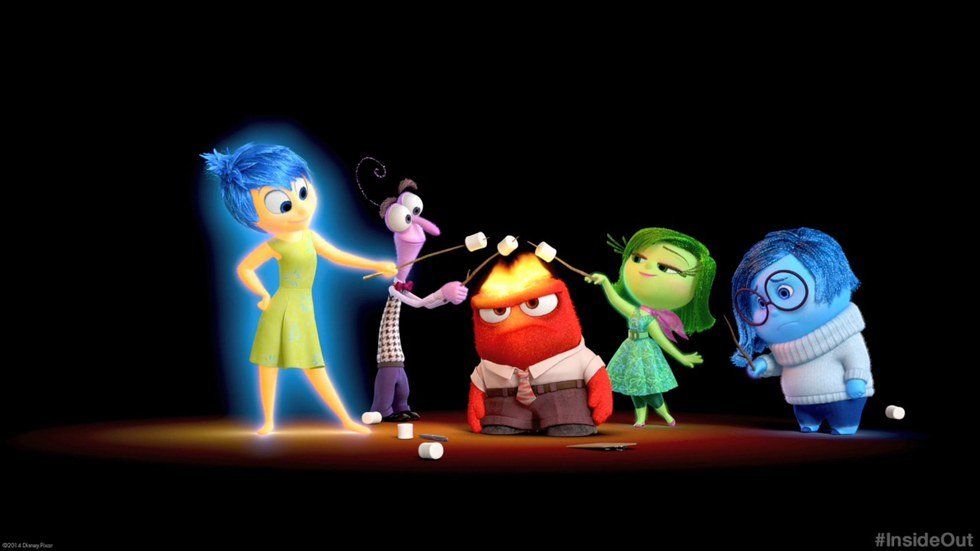
First there was "Toy Story 3," about Andy leaving for college. Then there was "Monsters University," literally detailing the entire rush process for nervous freshman (erhm.. sort of).
And while it may not be quite as direct this time, Pixar’s done it again with "Inside Out." It’s like they’ve somehow detected the growing pains of their earliest fans, struggling with adulthood now, and they’ve elected to give us some advice. And conveniently, it's in exactly the form we like it: entertainment technically geared toward 8-year-olds. It’s as though they also know how we’re desperately seeking salvation from reality via nostalgic throwbacks toward simpler days.
The Pixar crew’s emotional savviness doesn’t stop there because the advice they’re giving is spot on. Some highlights:
- It’s okay to be sad sometimes. Joy’s efforts to suppress and hold back Sadness persist throughout the entire movie, and it’s only in a burst of insight that she realizes that Sadness is a useful emotion, too. In a world so hyped on “achieving Happiness” and constantly implying the purpose of life is simply to “Be Happy,” we forget that other emotions are a natural part of life. Being gloriously, ceaselessly, and blindly happy 24/7 is a terribly unrealistic expectation to put on ourselves—and also not a desirable one. To really live is to experience life in all its forms, and not to try to force your human experience into a limited emotional range.
- It’s time to let some things go. In one of the most poignant parts of the movie, Bing Bong jumps off his rocket so he can help Joy get back to HQ. As he starts to disintegrate away, his adorable dreams of reliving his adventures with Riley disappear, as well. It’s an amazing metaphor for the childish joy and naivety we’re leaving behind as we grow up. It may be sad, but these things are meant to propel us forward to our futures. Not to tempt us back into retrospective rumination and developmental stagnancy.
- Who you are is not only your traits, but also your values. Riley’s islands of personality aren’t just a collection of characteristics (like goofball island); they’re also the things she values—like family, friendship, and hockey. We live in the Age of Personality, rife with glorification of people not for their character, but for their charisma, humor, and likeableness. We take classes on how to present ourselves professionally and get lost in the bizarre pleasures of online personality quizzes. Yet, while the cosmetic, external aspects of identity are often the most visible and easily attainable, we shouldn’t forget what’s most important: the larger values that underpin it all.
- It’s okay to feel a lot of emotions at the same time, and even conflicting ones. At the end of the movie, the memories being created aren’t just one color; they’re lots of them. Yellow and blue make bittersweet. Purple and Yellow make teen-vampire-love-triangle-angst. The pretty color mixes serve to remind us that emotions aren’t tidy or clear-cut. Taylor Swift wasn’t just laundry-listing when she said “We’re happy, free, confused, and lonely at the same time. It’s miserable and magical.” Yes, you’re a hot, emotional mess. Enjoy it. Experience it.
- Sometimes, you just have to laugh at your emotions. Is the loss of that Brazilian helicopter pilot boyfriend of yours still nagging you? Because, surprise! In all likelihood, this regretfulness isn’t some deep, dark sign that you’ve forever lost the One you’ve been destined for since birth. You probably just need some time. And an ego boost. And to enjoy his excessive romantic flourishes one more time via daydream. The movie is full of hilarious banter between the emotions, and all of it is extreme, absurd, and hilarious. It raises a question: why do we take fleeting emotions and impulses so seriously?
- Ask for help. In the final scene, the Emotions allow Riley to finally come clean to her parents about how the Move has negatively affected each of the things that define her. Doing so requires that Sadness turn all the core memories blue. It’s the unfortunate downside to admitting that you aren’t okay; sacrificing your happiness illusion makes the sadness all the more real and permanent. Still, it’s also the only long-term fix. Being sad and vulnerable for a moment pays off in the long run because it ensures that next time we’re happy, it’s genuine.
So, voilá! Not only did you leave the theater having sufficiently dusted off all that old Psych 101 vocab from semesters ago, but you’ve also had a nice dose of perspective.
Thanks Pixar, you’ve done it again. And damn, am I ready to find Dory.

















