

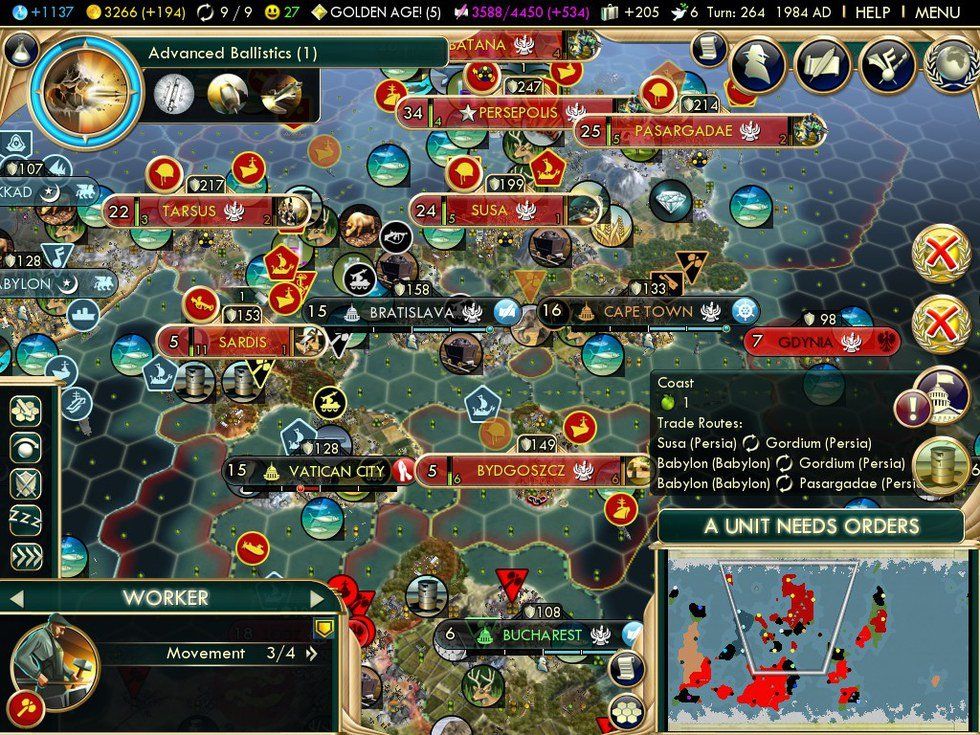
Sid Meier’s, "Civilization," has long been my favorite turn-based strategy game. When "Civilization V" came out in 2010, I was instantly hooked and have since spent way too much time building video game civilizations. To me, this game is like long term version chess; you must take into account diplomacy, religion, trade routes, resource control, money, city placement, culture, science, happiness, military, building world wonders, ideologies (such as freedom, order, and autocracy) and many other factors that make this game so entertaining to me. A move you make on turn 10 can sometimes have consequences for the rest of the game.
On top of loving games like "Civilization," I would also describe myself as a lightweight sci-fi geek, so when I heard that Sid Meier’s was releasing "Civilization: Beyond Earth" (BE), I was extremely excited. "Civilization: BE" is very similar to "Civilization V" except the player is building their civilization on a different planet after launching from Earth in a spacecraft. However, "Beyond Earth" did not live up to my expectations. I did not have as much fun playing "BE" as I did "Civilization V" and it took me some time to figure out why, but here are the reasons.
Historical connection
The historical connection in "Civilization V" is extremely strong. The player can play as 43 different types of civilizations such as: Rome, Shoshone, Inca, America, Persia, Poland, Babylon, Zulu, Britain, and Russia. However, in "Civilization: BE," there are only 12 leaders which are based on current civilizations. A few leaders are the American Reclamation Corporation (ARC), the People’s Union of Africa (PUA), and the Slavic Federation. While I initially liked the idea of placing the game in the future, the historical connection I get when playing "Civilization V" makes the game so much more fun for me.
Uniqueness of leaders
In "Civilization V," each civilization has a unique unit and usually a building. For example, the Persian’s unique unit is the Immortal and their unique building is the Satrap’s Court. The American’s unique units are the Minutemen and B17 bomber. Each civilization has a building or unit that was specific to them in history. On top of that, there are little features, such as each civilization has different in-game music that is specific to their culture. All of this makes playing as different civilizations a somewhat unique and different experience in "Civilization V." In "Civilization: BE," while there are unique powers for each leader, there are no unique units or buildings. Thus, playing as different leaders does not provide as much of a diversified experience in "BE" as in "Civilization V."
Sense of accomplishment
When you complete a game of "Civilization V," you feel as though you have actually accomplished and built something great. The player starts in 5000 BC with one city, libraries, and monuments and finishes with potentially dozens of cities, research labs, and broadcast towers. You start with warriors and archers and end with mechanized infantry and stealth bombers. You start alone, with no contact with the outside world, and end up having to interact or go to war with dozens of other civilizations. In "BE," the game starts in the future, with marines, and a city/spaceship that has flown across the galaxy and landed on a new planet that the player colonizes. While there is still the sense of progression, by the end of the game in "BE," I do not get the same sense of pride I did in "Civilization V" that came with building a civilization from the ground up.
While there are many factors that I like about "BE," such as the ability to build cities in the ocean, orbital units, and the new technology tree, "Civilization V" provides much more entertainment for me, mainly because of its roots in history.