
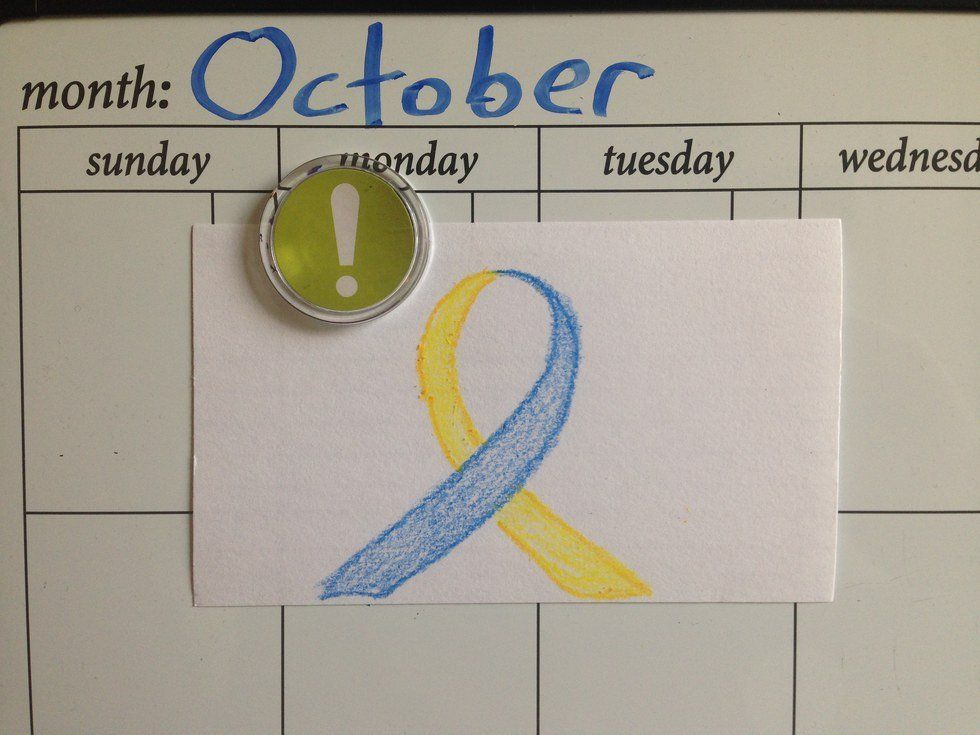
October: it's that time of the year when leaves turn various shades of orange, red, and gold. When the weather shifts from sweltering, to cold. Where everything is pumpkin-flavored, where skeletons and werewolves dance freely. And when the world becomes a little more aware of Down Syndrome. Yes, October is Down Syndrome Awareness month. Being aware of Down Syndrome and the beautiful, amazing people that this community includes, can fill one with awe and amazement ... both during the most amazing month of the year and beyond.
1. Myth: There is only one "Down Syndrome."
Truth: Many people know the basic cause of Down Syndrome: a third copy of the 21st chromosome, which makes a person have 47 chromosomes instead of the more common 46. This type of Down Syndrome is sometimes called trisomy 21, and it accounts for about 95 percent of all cases of Down Syndrome according to the National Down Syndrome Society, or NDSS (fun fact: the "Down" in Down Syndrome comes from the surname of one of the first physicians to describe Down Syndrome, John Langdon Down). Of the remaining 5 percent, 4 percent are cased by translocation, or the attachment of a full or partial copy of the 21st chromosome to, in most cases, chromosome 14 (thus, the person will have the characteristics of Down Syndrome while having 46 chromosomes), and 1 percent are what is known as mosaic Down Syndrome in which the mis-division and, thus, replication of the 21st chromosome occurs later in development and, thus, some cells have 46 chromosomes with two copies of chromosome 21, while some have 47 chromosomes with three copies of 21. In some cases, this results in fewer symptoms of Down Syndrome and/or a less severe presentation, though people with all types of Down Syndrome are so diverse that it's hard to generalize between the types.
Additionally, while there are certain facial and physical features (such short stature, small nose, slanted eyes, single fold across palm, and low muscle tone) that accompany many presentations of Down Syndrome, people with Down Syndrome vary as much in their appearance as in their genetics. As the Global Down Syndrome Foundation puts it:
"Like typical people who share similar features, [people with Down Syndrome] look more like their families than each other."
2. Myth: People with Down Syndrome are all born to older mothers.
Truth: It is true that increased maternal age is correlated with an increase in the chances of developing Down Syndrome: by age 35, the chances of having a child with Down Syndrome is one in 350, and, by 45, one in 30. However, many people with Down Syndrome are born to mothers under the age of 35 - between just under 50 percent and over 80 percent, depending on the study. Thus, mothers of all ages, from young teenagers to grandmas and everyone in between, have children with Down Syndrome.
3. Myth: Down Syndrome is rare.
Truth: You may well know (or at least have met) somebody with Down Syndrome! The National Down Syndrome Society (NDSS) states that one in every 691 people in the U.S. are born with Down Syndrome; there are currently about 400 thousand people in the U.S. with Down Syndrome at this moment. This makes Down Syndrome the single most common genetic condition in the U.S. and about twice as common as the U.S. cutoff for a "rare condition." So if you haven't met someone with Down Syndrome yet, the chances are good that you will (especially since it is estimated that you will meet about 80 thousand people in your lifetime!).
4. Myth: People with Down Syndrome can't really learn.
Truth: People with Down Syndrome are a lot smarter than you may have given them credit for. While it's true that many people with Down Syndrome have intellectual disabilities and may have some difficulty with standardized education, there is much that can be done, such as treating co-morbid hearing and visual difficulties, teaching sign-language when that may prove useful (even for hearing individuals with Down Syndrome, some find it easier to sign than to speak due to a difficulty in controlling the muscles of the mouth that some may have), allowing the student to take breaks, using assistive technology such as computers as AAC devices, and specialized tutoring, that makes learning and academic achievement not only possible but obtainable and even successful and fun for many people with Down Syndrome. In fact, thanks in part to these advances, the average IQ for people with Down Syndrome has increased 20 points. Many people with Down Syndrome are in the same classes as their peers; some even go to college and graduate with advanced degrees. As Miriam Kauk beautifully illustrates in her article "Einstein Syndrome," the learning potential of people with Down Syndrome often depends on what limits and expectations parents and teachers do or don't place on the person.
5. Myth: People with Down Syndrome will never get a job or live independently.
Truth: Just as people with Down Syndrome are increasingly getting an education, people with Down Syndrome are also increasingly living and working independently. Though some people with Down Syndrome work in sheltered workshops designed specifically for people with disabilities, many work in the same jobs as do many non-disabled people, with or without various types of various types of support. In fact, some people with Down Syndrome, such as the well-known and well-loved Tim Harris, even own and run their own businesses. People with Down Syndrome are even making it as supermodels, such as Madeline Stuart, and as actors and actresses, such as Chris Burke and Lauren Potter. Many people with Down Syndrome live with their parents or in a group-home setting, though many also live in the community and often on their own.
6. Myth: People with Down Syndrome are always happy and are perpetual children.
Truth: People with Down Syndrome are, well, people, and, like all people, vary in their emotional states and expressions of those states. People with Down Syndrome feel the entire spectrum of human emotion-joy, sadness, anger, fear, disgust, love, pride, jealously, amusement, and everything in between. Additionally, people with Down Syndrome vary just as much in their personalities as people without Down Syndrome; some have a happy-go-lucky personality, some have a quiet, contemplative personality, some have a rash, domineering personality, and the like.
Just as people with Down Syndrome are people, teenagers with Down Syndrome are teenagers, and adults with Down Syndrome are adults. As many teens and adults do, most people with Down Syndrome desire to hang out with friends, have relationships, get married, have sex, and, most importantly, make their own decisions about where they live, who they live with (if anyone), where they work, what medical treatments they receive, and what goes on in their lives. What teens and adults with Down Syndrome don't want is to be talked down to like one would a child or "baby" them. It's usually best practice to treat teenagers and adults with Down Syndrome with the same respect, dignity, and assumption of autonomy and competence as you would treat teenagers and adults without Down Syndrome.
7. Myth: We already know everything we need to know about Down Syndrome.
Truth: We may know (most of) the genetic causes of Down Syndrome, but there is still so much to learn! For one, there are a lot of conditions that may accompany Down Syndrome, such as hearing difficulties, heart problems, and leukemia, and finding out why these are more common in people with Down Syndrome and what can be done to treat these will vastly improve the quality of life for many people with Down Syndrome. Dementia tends to occur sooner and more frequently in people with Down Syndrome than in people without-again, figuring out why this is and what can be done about it will vastly improve the quality of life for many people. There is also a lag in research regarding the fertility of people with Down Syndrome; it was once assumed that everyone with Down Syndrome is infertile, but, as time goes on, evidence is mounting to the contrary.
We also don't know what future advances in education, technology, and society will bring in terms of the increasing achievement and autonomy of people with Down Syndrome; we know that the future is looking brighter and brighter for these people each day, but we don't have a clue just how bright and how amazing this future can be.
After all, as you can see in this video from the National Down Syndrome Congress: