
I never knew about Myasthenia Gravis. I figured I had no reason to if it wasn't affecting me. But even when my cousin told me about her experience with it, I didn't notice what she said or how she tried to describe it to me. Now I realize that if my cousin lives with it, it's worth finding out about. If kids are going to encounter people who look or act differently because of it, they should know what's going on. If any of us could find ourselves facing it, we should be familiar with this muscle condition so that it doesn't seem so strange.
Myasthenia Gravis (My-as-theen-ee-a Gra-vis) is a chronic disorder of the autoimmune neuromuscular disorder. This means the natural bad-stuff-fighting system of the body, having to do with nerves and muscles, isn’t working right and can be that way for a long time. It affects the muscles that people are usually able to use only when they decide to, some types being muscles on the skeleton like facial muscles used to smile or make faces.
Whether a man or woman, young or old, Asian, African or Scandinavian, any person can find themselves facing this physical challenge. Encountering such a change in one’s ability to control muscles can become a mental and emotional challenge.
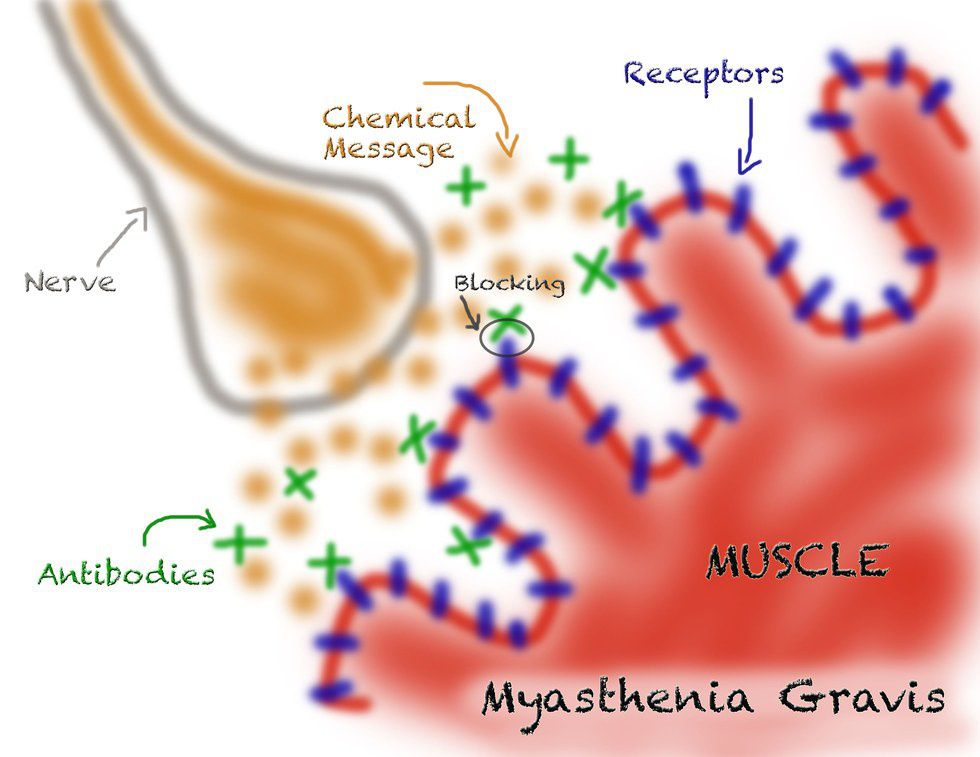
The physical explanation of how Myasthenia Gravis challenges the body includes the process of communication between the brain and muscle. Whenever you want to smile at someone, your brain thinks, “I want to make my face muscles smile,” and that message travels through a nerve fiber to the spot where the smile muscles are.The end of that nerve doesn’t touch the muscle fibers, and normally when the impulse gets to the end of the nerve, it releases something called acetylcholine which works like passing a note from the end of the nerve to the muscle fiber. This message isn’t written or spoken, of course, but is a chemical that has been aimed toward the muscle fiber. The muscle has many little message-takers, or receptors, that read the chemical message and, once enough of the receptors read what the impulse wants, the muscle moves to make a smile.
In an effort to better understand what it means to experience Myasthenia Gravis, I have asked an MG warrior to answer a few questions that are normally awkward to approach.
How do you explain what MG does when someone asks, so that they understand?
I try to keep it simple. The name means: "grave muscle weakness." I tell them it is the autoimmune system attacking the neurotransmitters between the nerve and the muscle. It causes rapid exhaustion of most muscle groups in the body by weakening the muscles through use. Though it seldom seems to affect the heart, there is a theory that some few heart attacks may be caused by the initial onset of MG attacking one's heart. Such occurrences are rare.
How might one recognize someone who lives with MG?
There are few external cues, but unsteady gait, a single drooping eyelid and slurred speech are the most obvious external symptoms. The person may also be unable to smile. The exhaustion of major muscle groups may cause one to seem like they're drunk.
Is a person born with it, or do they get it later in life?
It is a later onset disease, although there are rare childhood cases in an already rare disease.
If it occurs later in life, what is the biggest challenge while coping with its onset?
Myaesthenia crises where the immune system attacks the neurotransmitters to the diaphragm may cause one to struggle to breathe, but again that’s rare. What does happen, is that we all lose the ability to do things we used to be able to do. Dealing with that loss is the biggest challenge.
In addition to dealing with the symptoms of MG, people who have MG also have to deal with many issues caused by the medications and treatments for MG. It is a touchy thing trying to get the right balance, and wrong dosages can cause some of the same symptoms we are trying to prevent, like losing the ability to breathe.
When I was diagnosed with MG, the neurologist wrote out SIX prescriptions for me, two for the MG, and four to counteract the side effects of the first two. I declined, and am, fortunately ,able to manage my symptoms with diet and stress management. Some can't do that.
Also, I have the rarer type of MG that doesn't respond as well to the most popular medicine, Mestinon, or to the surgery where they take out the thymus gland. I, honestly don't understand the differences between the varieties of MG, but that's okay. Though they recognize that they exist, the doctors don't either.
Is Myasthenia Gravis painful?
Doctors and neurologists will tell you that MG is not painful, but everyone I know who has MG, including me, experiences pain -- and a fair amount of it.
Does it affect the brain and thought processes?
Uh, wha... (just joking!) I don't think so, except for the frustrations and the distraction from weakness and pain. It is about the neurotransmitters to the muscles.
If I were to go out with my friend who has MG, are there limitations to what we could do or where we could go because of it?
Yes, but it depends on how your friend is doing that day. Some days are worse than others. One day your friend may be able to handle something like going to the zoo, but another day, he/she may have to call and cancel something as simple as going out for dinner. Whatever you would like to do, I hope it doesn't involve a lot of stairs! To learn more about limitations, you could read about the "Spoon Theory."
What is a good way to spend time with a friend who has MG?
Do activities that don't involve constant action. Go to a movie or to a park. Visit them at home if they don't feel like they should go out. That said, a man with MG felt strong enough to go for a hike with his family last week. He said he felt weak that night, but he would be happy to do it again!
How would you explain to a 12-year-old person what MG is?
MG is a disease that makes your muscles weak when you use them and makes you tired. Some days you may be unable to do things that you were able to do the day before. The spoon theory is a good way to expand on that in order to help a 12-year-old understand.
What do you think is the most common misconception about MG among people who know about it?
One misconception is that if those of us with MG would just exercise and push ourselves, we will get stronger. People with MG want to be able to do what exercise they can, but exercise can really weaken us, especially if it involves a repetitive motion. Just because one person with MG was able to run in a race, doesn't mean another should be able to walk from the parking lot to the store. We call each other "snowflakes" because we are each different. Our symptoms and abilities will be different from each others and will be different from day to day.
What have you learned through your experience as someone living with MG?
Heat and stress are two of the biggest enemies of Myasthenia Gravis! Eating healthily is one of the best things we can do for ourselves -- it makes a difference!
For more information on personal experiences with Myasthenia Gravis, personal stories can be found on the Myasthenia Gravis Foundation of America site here.
While there are treatments and in some cases Myasthenia Gravis can go into remission, the awareness of this challenge can enrich your experience of strength and endurance in people around you. If your face muscles work perfectly, it’s a gift often taken for granted, just like the joy of not being constantly in pain all of the time (Fibromyalgia), or not being constantly being tired (Lupus), among so many others. Not being affected personally by MG is a blessing, but you don’t have to have it in order to offer an encouraging energy to the awareness of this condition.
Displaying your awareness of Myasthenia Gravis will offer a boost of perseverance, like applause, to those affected. If you’ve ever done something for which applause was awarded, you know the uplifting feeling of validation and recognition that comes with it, and this is what people need, who are looking for the strength to conquer this challenge. Since virtually, clapping can’t be heard, a Twibbon for June Myasthenia Gravis is being offered with which to decorate your profile picture in social media. It is the applause you can offer toward MG so that those who see it can feel encouraged. You can find the Twibbon here.
Reading this article took only a few minutes, enough for a break from whatever you were burnt-out doing or for stimulation on a lazy day. Thank you for taking the few minutes to read this. Putting some effort into making your mind a little more knowledgeable is a great way to spend even a few minutes of your day. I hope that those who are dealing with the challenge of Myasthenia Gravis will feel our applause and find strength from it for those days when it’s difficult to smile.