Looks like people have noticed Darren Aronofsky again. What'd he do this time? Was he mistaken for something other than a film director that literally wears a scarf while dating and/or dumping his female leads?
Okay, that's harsh. The guy has some skill. He's capital-A Artistic to a dictionary-definition degree. Most recently, he released "mother!" (lower-cased 'm' and ! required). It has the inassailably-cool Jennifer Lawrence as a put-upon wife of an older man, and folks say it's craaaaaay.
Oh, child. I understand if this is your first time at the Aronofsky rodeo. The fun bit about Aronofsky is that each of his movies has a magic trick that's so fishhook-sharp, you often don't notice the capital-O Obviousness capering around in this Artistic Vision's background. Whether it's the black and white, math + religion = God of "Pi," the whip-fast cello editing of "Requiem For a Dream," the dirt-real documentary style of "The Wrestler," the lesbian eroticism of "Black Swan," or the dang six-armed rock angels of "Noah," Aronofsky films have just enough art-house mysticism to cloud your judgment over whether the movie is good or not.
I'm not going to talk about "mother!" today, because I'll leave that conversation to those who like punching down at obvious biblical retellings (which is all "mother!" is). Instead, I'm going to talk about Aronofsky's best film; "The Fountain."
"The Fountain" is Aronofsky's best film because it's decidedly UN-obvious.
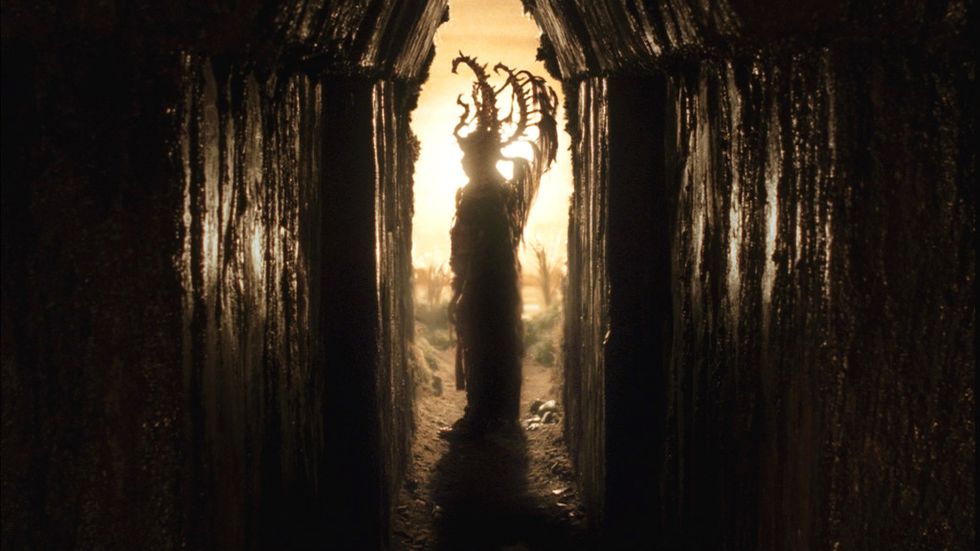
"The Fountain" isn't terribly remarkable the first dozen or so times you watch it. It opens with a badly-lit encounter of a Spanish conquistador in Central America. Is it badly-lit on purpose? Probably. The conquistador battles his way through natives to the foot of a Mayan pyramid. In fact, they crowd-surf him like a prisoner to the steps. The conquistador's friends are killed, but the natives spare this one particular Spaniard. It's clear this pyramid is what the conquistador seeks. Convenient. This is also the last convenient thing to occur in the entire movie. The scraggly conquistador scales the pyramid. There, he unsheathes an ornate, important dagger. The audience has no further details. Inside the pyramid, there's a silhouette of a savage warrior with a flaming sword. There's something gigantic and beautiful growing behind the savage.
It's far off in the background. We can't see it clearly.
The savage warrior stabs the conquistador with a small hidden blade, rather than the book of Revelations-looking God-killing sword. There's a cry of pain, there's a flash, and the Spaniard is somehow no longer the Spaniard.
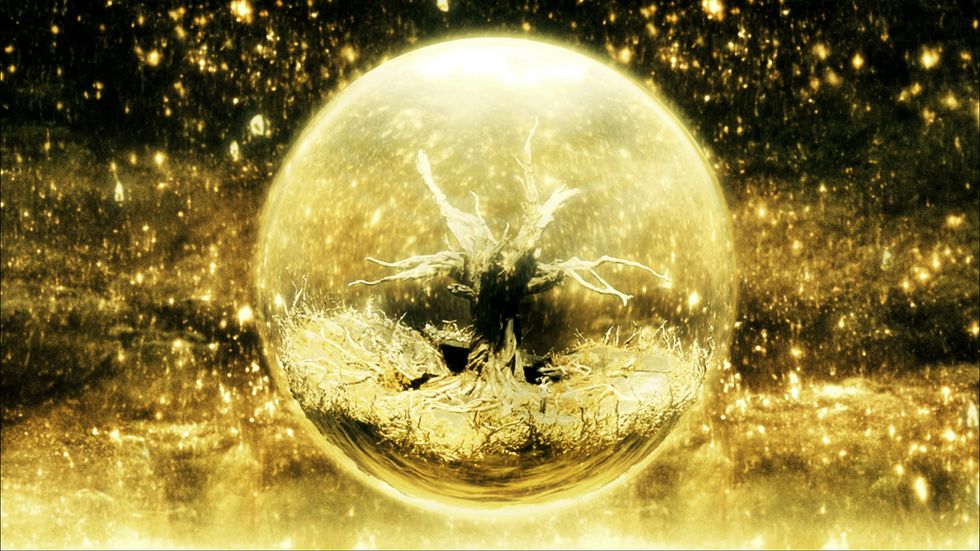
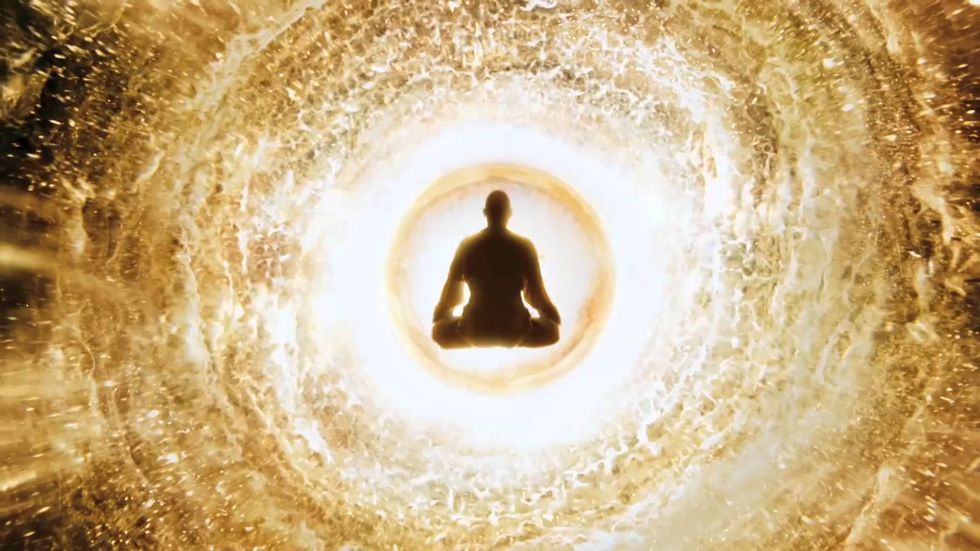
The screen cuts to that same conquistador's face yelling. The acoustics are dampened now, like those of a sound-proof room. His pale head is shaved. A vein on his forehead pulses. He is sitting, floating in a full-lotus position, drifting above an ancient, dying tree. He is calm. He drifts back down into the tree's base through a levitation ability. This tree and its roots visibly maintain an opaque sphere that isn't made of glass. Perhaps it's very thick air? It's not explained and it needn't be. We can deduce that the sphere is traveling relatively fast through outer space where the stars are gold and weep tears of godly dust.
This is not good linear story-structure. I usually hate this. In "The Fountain," I love it. The non-linearity and intercutting between timelines is Aronofsky's gimmick in this film, and for once, it isn't obvious.
Over the course of the film, we learn to understand that elsewhere, our actual main characters are not the conquistador, nor the levitating man in the tree bubble, but a modern couple that are very much in love, living in a house where everything is richly-stained mahogany and expensive ivory and free-standing bathtubs. Nevertheless, the world itself is tinged with that same dreadful, aching, gold-dust aura. Something is irreversibly up, you guys. The couple go to very few locations in the movie, yet each bears that same visible scent: their house, a laboratory, a museum, and eventually, a hospital. The wife is dying of a brain tumor. The husband is a brain surgeon. He is loth to neglect his wife in her final days as he attempts to find a cure.
He is very close to finding the cure.
As time goes by, the movie flicks absent-mindedly between modern times, from the conquistador in 1500s Spain prior to his fight at the pyramid, then to the far-flung-future, where the space-sphere and the ma in the tree are found.
What is happening in "The Fountain?"
Start at the beginning. The couple appear in each of the three stories, playing different characters. The man is the conquistador, the doctor, and the spaceman. The woman is the Queen of Spain, the patient, and, hmm, what is she in the future? Well, she's the tree.
About that...
In the future, the woman is the spaceman's vessel, traveling through the dead, sad infinite. He keeps telling the tree that they're "going to make it," despite her bark crumbling off, which he does occasionally eat to sustain himself. That's an important and weird detail right there. The tree-sphere is traveling towards a nebula, a dead star; an endless death that the space-man insists he wants to reach with her. As we covered before, these details are presented entirely out of order in the movie itself. There's a lot of the spaceman talking to the tree (in space), practicing Tai Chi (in space), and tattooing rings (also in space) around his arm with an eerily-opulent fountain pen, marking how long he's been traveling for. It is clear that he's been jagging around on the sphere-ship for a long time. He bears an entire written tattoo language that the man has developed at this point; big rings, smaller rings, patterns, waving and straight lines, tapped into his inky skin like an alien code. It's not only painful, he's emotionally hurt that he has to track the passing of time.
Contemplate these details, and you will wonder which of the three stories are real. Unlike the woman = tree and the characters analogs across the time periods, the reality behind each timeline is not obvious, and may be the only time an Aronofsky movie is both artful and truly a mystery.
I admire a story that gives you a plot twist that doesn't wave at you as it passes by. Here's how it works:
As the wife is dying, she's been hand-writing the story of a familiar-seeming conquistador traveling under the queen's orders to Central America. His mission: to find the Biblical Tree of Life. Its sap will grant immortality. The conquistador in her book is cagey about his obvious love of the queen, yet the queen recognizes that the conquistador feels that he must wage his campaign to prove his feelings for her. She knows she can't stop him and knows that he'll do this thing.
This is the story the wife is writing, but we are left to ourselves to figure out that like the modern story and the space-man story, all three are the same story from a different point of view.
The conquistador is the story of the wife's approaching death from her perspective. She knows her husband loves her. She knows he would die trying to demonstrate that there is nothing he wouldn't do to save her. Near the end, the wife asks her husband to finish the story she's writing. She gives him her nearly-completed manuscript and an eerily-opulent fountain pen. He says he doesn't know how it ends. He says he can't be trusted to finish it.
Explaining the three timelines in "The Fountain."
Out there in the future, the darkened space is gradually filling with dying golden light as the sphere moves closer to the nebula; the dying star. The spaceman starts seeing visions of his actual wife from the modern storyline. We wonder, did he actually find a way to seal her soul in a tree and travel into space? Could it be that this is indeed the future and he's found a cure?
Sadly, no. Just as the conquistador's storyline is the wife's perspective of her dying days, the spaceman's story is the same timespan, as he sees it. In space, in the sphere with the tree, the spaceman is alone. He can't go to her for support as a loving husband does. As he sees it, he can do little more than mark down the seconds to her passing moment, hoping they can reach the nebula together before she passes. He's been left to literally write the end of his wife's life, the woman that he loves, that pulls him through all the black shit we go through in the world. That's how it has to be. Brilliant dust streams down the side of his sphere-tree-ship, his wife, that carries him. The craft is inching closer to the dead star, and he doesn't want to go there without her.
To him, the cure for death is her. It's a selfish thought from the husband. Her being alive keeps him alive, and without her, the ship will collapse. There's a brutal scene where the tree quite visibly tightens, withers, and dies, changing from rich and living to gray and petrified. Then the musical score, which has been drifting about in the background of every shot, hits its mark, and all you want to do is eat cookies and hug a cat to displace the charcoal-flavored I.E.D. that detonates in your guts.
In the husband's mind, there's nothing left. The tree is dead, and the universe will swallow him. But the book. He can finish the book. The wife trusted him to finish the book. In the past, present, and future, hope comes roaring back. His character in all three eras declares that he trusts her. She knows she's going to die and he finally believes her.
He breaks free from the miasma. He starts to imagine, and he starts to write. He leaves the safety of the tree-sphere in his own meditation bubble in a stunning shot where he ascends the tree, jumps, folds into a cross-legged position, and glides upwards and outwards. Elsewhere, the husband changes the book's ending, bringing the conquistador back to life after being stabbed by the savage warrior. He passes through the corridor to find the Tree of Life at the back of the pyramid. I won't spoil what occurs next, but in all three instances he "dies," is revived, faces and accepts death, and then dies again.
In the greatest moment in the movie, the space-man is absorbed into the singularity at the center of the nebula, the soundtrack erupts, the tree inside the sphere burst into bloom, and we have the epiphany. Or, you would have an epiphany on the twelfth viewing of the damn thing because the first half-dozen times, it's still a mess.
Shortly after that, in the closing moments, we flash back to the first scene where we met the modern couple, having originally been introduced to the other two eras first near the beginning of the movie before encountering the husband and wife.
Something is different. For whatever reason, the scene is altered. The husband chases his wife through the snow instead of going to the lab to try to find a cure, and then the movie ends. There is minimal dialogue. In this version, both the man and the woman are spared from their fears of wondering what the other is thinking in those last few days of the wife's life. They trust what will happen and they trust each other.
Every scene in "The Fountain" has a purpose. Each scene points to another, waiting for you to understand. It's ambiguous to serve the character's confusion. It's no allegory, magic trick, or gimmick. If you felt "mother!" was too obvious, give "The Fountain" a spin.
It's the one nobody remembers.