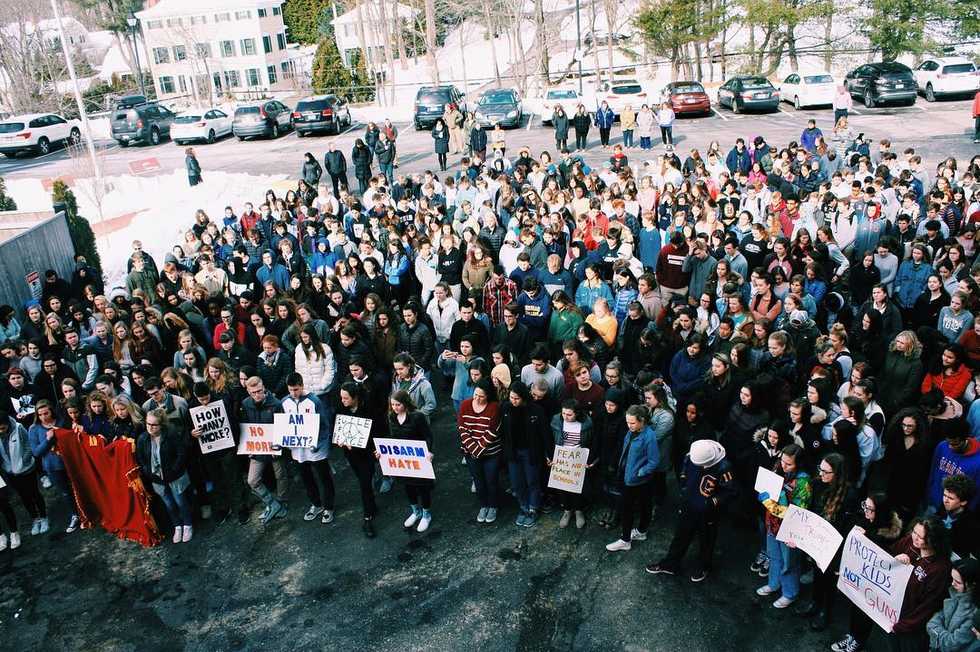
Wednesday, March 14, 2018 marked an absolutely historic day for high school students all around the United States. The National School Walkout, facilitated by students begging for gun control, ushered thousands of students from class to rallies, lasting around 17 minutes each, one minute for every Parkland victim. And you know what? I loved it.
Since Wednesday, however, an alternative movement titled "#WalkUpNotOut" has circulated social media, drawing a great deal of attention. This campaign, much like the name implies, encourages students to "walk up" to other students and faculty and "just be nice," as opposed to participating in walkouts. The idea is that by befriending the "lonely kid," or the "weird kid," or the kid who's "obviously" going to be a future shooter, potential murderers might have a change of heart and decide against slaughtering their classmates.
This counter-demonstration is one of the biggest crocks of crap of the 21st century.
Asking students to act as medical professionals in order to protect and preserve the mental health of their peers is cruel. Pushing the idea that "they wouldn't shoot you if you were nice," especially to students, is cruel. Labeling students, labeling children, as future murderers based on who they do or don't sit by at lunch, how many friends they do or don't have, if they're shy or not, or if they have a mental illness or not, is cruel.
When we ask students to take responsibility for the thoughts, and therefore actions, of others, we rob them of their personal autonomy. We force them to spend too much time on the well-being of others instead of themselves, establishing fickle diagnoses about their peers they are then inclined to believe they need to fix before it gets deadly.
It is not an elementary, middle, or high school student's job to diagnose their classmates and try to treat them. It is not a college student's job to diagnose their classmates and try to treat them.
When we tell students that being "nice" is all they need to do to help stop school shootings, we place the blame for the massacres on students themselves. By standing behind #WalkUpNotOut we tell potential victims, "Hey if you would have just been a little nicer, this might not have happened." Worse, we tell potential murderers, "You know, if somebody isn't nice to you, it's socially acceptable, in fact, it's expected that you kill them."
Students should be cordial to one another because they have a genuine interest in the person they're being kind to, not because they're hoping to be spared if somebody comes to school with a gun.
When we ask students to befriend those they think could be shooters in the future, we perpetuate stereotypes and profiling of the "picture perfect" murderer.
We allow innocent children to be deemed unpredictable and dangerous based on social status: do they have enough friends to keep them sane?
Do they talk to enough people to avoid being a sociopath?
Do they do something in their free time, or is their time preoccupied by thoughts of homicide?
Students then implicate themselves, asking "If I would have talked to them, could this have been avoided?" This idea of "walking up" to potential shooters forces students to judge one another, to make assumptions about one another's mental health, and to decide if they're a risk to their life or not. Learning environments are not the place for this.
No environment should require children to act as adults, and to fend for themselves in the face of life and death situations. It is not a child's responsibility to assess their peers. It is not a child's responsibility to keep their classmates from killing them. It is not a child's responsibility to actively work against being a stereotype of somebody so terrible.
Other student's mental health is not their responsibility.