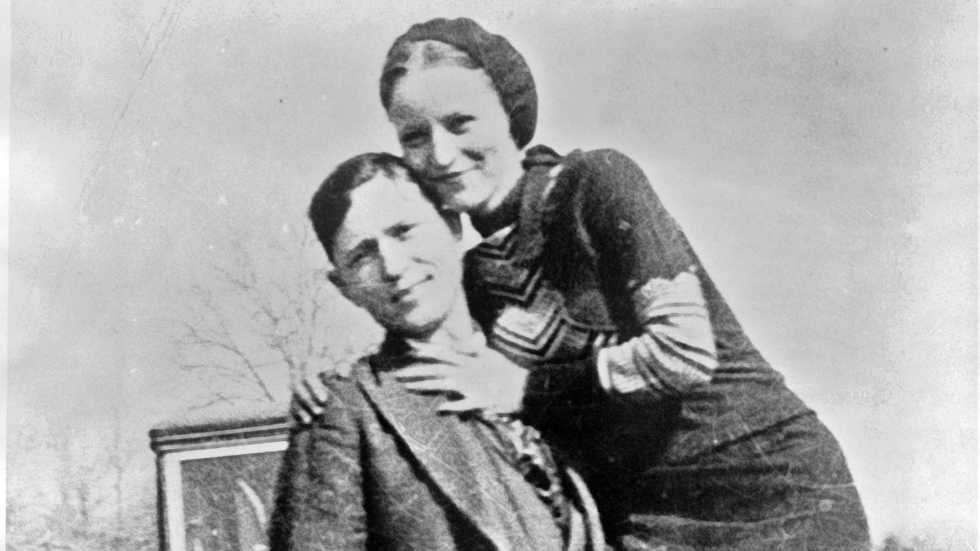
"Someday they'll go down together
They'll bury them side by side
to few, it'll be grief--
to the law, a relief--
But it's death for Bonnie and Clyde."
The legacy of these depression-era gangsters has endured for nearly ninety years, and they're names are familiar to nearly every American-- even if they don't know exactly who Bonnie and Clyde were. These fascinating legends have lived long past their unceremonious execution through songs, movies, books, t-shirts, museums, and poems-- some of which (like the one above) were written by Bonnie Parker herself.
The couple experienced a certain extent of their fame while they were alive -- and that is something that fascinates me. Though they were interesting people who did terrible things, often their legend far exceeds who they actually were and to what extent they actually committed their crimes.
As such, I've decided to list three common myths associated with these real-life American legends, all of which can be easily debunked.
1. They robbed banks.
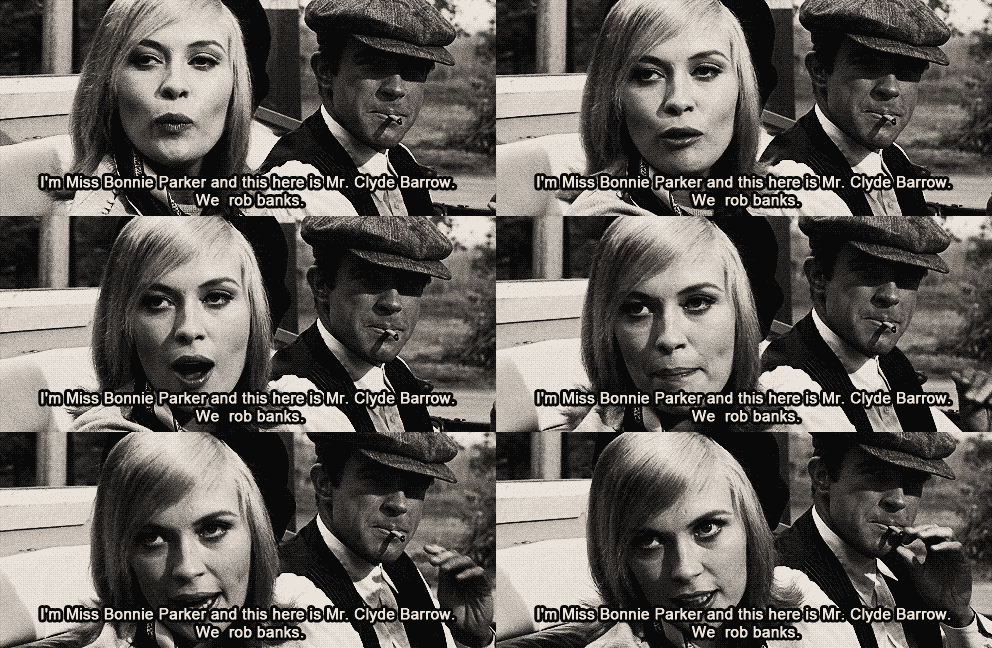
While Bonnie and Clyde are often depicted as rebellious bank-robbers, they actually primarily stole from the "little guys". The Barrow gang focused their crimes on mom-and-pop shops and gas stations all across the American South. While a few banks were among their conquests, the Barrow gang did not tend to target them.
2. Bonnie was a gun-wielding badass.
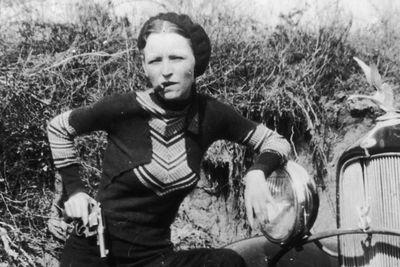
Much of this myth is perpetuated by the famous image included above. In it, Bonnie poses with a cigar in her mouth and a gun in her hand. In the same series of photos, she's also seen holding Clyde at rifle-point. In the latter it's clearly a joke. However, the solo image of Bonnie soon became who she was to the public. To some, it was invigorating to see a criminal woman who embraced her sexuality. To many, it was horrifying.
Movies and songs don't make this much better for the late Bonnie Parker. In the famous 1967 film, Faye Dunaway engages in gun battles alongside her Clyde (Warren Beatty). In the 2013 adaptation, Bonnie is depicted to be the crueler of the two.

Reality is far less tantalizing. Bonnie Parker was an honor student in high school, considered a bright girl by her teachers and peers. Though she eventually dropped out, she worked to support her family as a waitress (pictured above). She had dreams of fame-- but none of them concerned crime. She wanted to be a movie star, a Broadway actress, or a writer. She succeeded a little in the latter, but she has gone down in history as America's Most Wanted rather than America's Sweetheart.
In addition, gang member W.D. Jones said in a Playboy interview that "during the five big gun battles I was with them, [Bonnie] never fired a gun." Of course, many other sources have proven this to be false.
There are at least two known times when it was confirmed that Bonnie Parker fired a gun, or at least held one up at someone. However, given Bonnie's reputation prior to (and even during) the crime spree, it's reasonable to believe that she was not a major player in the gang, despite what legend may have led us to believe.
Unfortunately, the image of a love-struck schoolgirl who cries at the sound of thunder does not have the same appeal as a legendary cigar-smoking gangster-ess.
3. They cared for nothing but each other.

Jay-Z says in a song titled after the legendary crime duo, "All I need in this life of sin is me and my girlfriend."
While Bonnie and Clyde did love each other very much, if they functioned only as a couple they would not have accomplished much, as Clyde was far from a quick-witted mob boss and Bonnie didn't have the heart for crime.
Often, their gang included many other people-- even at the time of their death, they had a third member in the gang (who was not present in the car when they were killed).
Bonnie also was very attached to her family, in particular, her mother. Clyde frequently went out of his way so Bonnie could return home for a visit. Clyde was also very close with his family, though perhaps not to the same extent.
And it wasn't as though crime defined their whole lives. Clyde loved music and actually tried to get the police to return his guitar to his mother after they confiscated it (they said no). In the infamous "death car", Clyde's saxophone was found in the back. Likewise, Bonnie never quite gave up her fascination with entertainment. She continued to read movie magazines while on the run, and she loved to write poetry. Neither of them had sole focus on each other. As a matter of fact, Clyde often prioritized robberies over Bonnie.
While it's fun to entertain the enduring myth of a sexy, gun-wielding couple that rolled around in piles of money and would kill anyone for each other, it's just not the truth. Honestly, though their exploits are interesting to read, I find their lives kind of sad. If you go and read some of Bonnie Parker's poems, I'm sure you will find much more melancholia than you might expect from such a colorful historical figure. Keep in mind that there are truths behind almost every legend, but myths are not always rooted in facts.