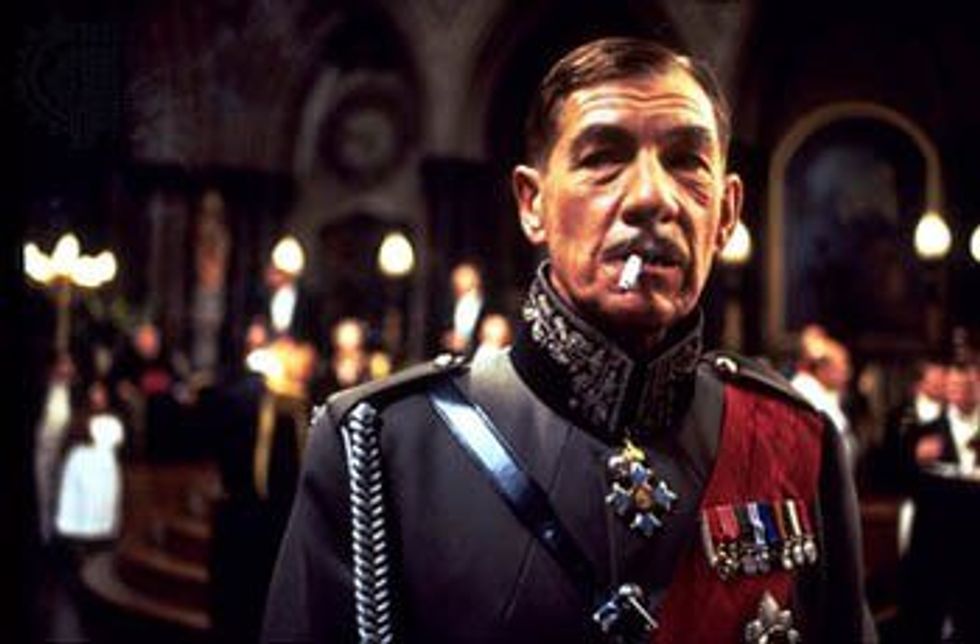
In two of Shakespeare’s histories, "Henry VI, Part 3” and "Richard III," we encounter many deaths at the hands of both kings; though not entirely of the same art and not by the same means. While wars rage on in both plays, and countless soldiers die in the War of the Roses, many central characters that are close to both Henry and Richard are either justly killed or murdered in cold blood out of spiteful vengeance. This essay will procure in combination with comparison and contrast the ways that characters central to the play died either on stage or off.
In “Henry VI,” one of the most pivotal deaths is when Margaret kills the Duke of York on the battlefield in Wakefield after Margaret’s army prevails. Kneeling on a molehill, York receives a paper crown from Margaret’s soldiers, mocking his attempt at kingship. Margaret proceeds to tell York to wipe himself using a handkerchief smeared in York’s dead son, Rutland’s, blood. Rutland, who had been killed earlier in this scene, was stabbed to death (onstage) by Clifford, one of Margaret’s main men.
“Rutland: But ‘twas ere I was born.
Thou hast one son – for his sake pity me,
Lest in revenge thereof, sith God is just,
He be as miserably slain as I.
Ah when I give occasion of offense, then let me die, for now thou hast no cause.
Clifford: No cause? Thy father slew my father, therefore die. He stabs him.
Rutland: Dii faciant laudis summa sit istatuae.
He dies."
Margaret proceeds to stab York to death on the molehill shortly after they’ve informed him of his son’s death. Both York and his son were killed onstage to add to the drama and to allow the audience a glimpse into the character’s moments before passing. Rutland, never having been seen before his death scene, gives us an impression that his murder is somehow unjust as well as preliminary to his father's. Rutland even brings up his innocence, asking what he had done to Clarence to deserve to die. When York is killed onstage, we see his grief before he’s dead as Margaret mocks him with the paper crown and then with the bloody handkerchief. These moments convey strong human feelings to the audience and maybe even makes us sympathize with those characters a little more than we might have otherwise.
In “Richard III,” the killing goes on with fervor. Richard goes on a killing spree of every opposing force until, and after, he is crowned King. First Richard murders his successors by manipulating King Edward’s messages to the Tower. He even murders his own brother for a potential place on the throne. Not only does Richard kill, he does so with such nonchalance that no one is surprised at the end by what he’s doing. Richard even goes as far as wooing Ann, the former wife of Henry VI, at the funeral! Richard not only has the audacity to tempt a dead man’s wife but, a man who he personally killed; not to mention, he only uses Ann in order to dispose of her once she’s of no further merit.
One of the more disdainful murders that Richard commits is the one of his close associate Buckingham. We experience Buckingham throughout the play as helping Richard gain everything he wants. Buckingham was the closest thing Richard had to a friend and that is saying a lot, seeing as Richard betrayed his family and wives on his way to the crown. Ironically enough, though, Buckingham falls out of Richard’s good terms when he refuses to kill the two young sons of Queen Elizabeth. He then flees back to Wales, knowing all too well what happens to anyone opposing Richard in any way. We find out later that Buckingham has been killed like the rest.
A pivotal point towards the end of “Richard III” comes right before the most important battle of the play. While Richard is sleeping, he sees the ghosts of all those he’s killed. Buckingham is among them.
“Ghost: To Richard
The first was I that helped thee to the crown;
The last was I that felt thy tyranny.
O, in the battle think on Buckingham,
And die in Terror of thy guiltiness!
Dream on, dream on, of bloody deeds and death;
Fainting, despair; despairing, yield thy breath."
Though there are similarities in “Richard III” and “Henry VI, Part 3,” there are a few crucial differences between Henry and Richard in terms of killing. In “Henry VI,” there is a war raging on throughout the entirety of the play and hardly any of the killings are done by Henry. We often see main characters, including Henry VI himself being killed onstage, to enhance the dramatic effect and possible empathy (or lack thereof) we might have built up for a particular character. In “Richard III,” no one is seen being killed onstage, except Richard at the end. This brings up an interesting parallel. Richard is killed in battle by his opponent in a seemingly honorable death. Henry was killed at the end of his respective play, but after the fighting had ceased (at least for him) and when he was contained in the Tower of London. Though we despise Richard at this point (we would hope, at least), he lives up to his opposition and takes his death head on. Henry, a king who the people loved, died by assassination while strolling on the Tower wall. What these two might have in common, though, would be an audience response. While we dread seeing Henry get murdered, it creates a rise out of the audience. When we see Richard get killed it solicits a similar response, only this time, we are happy he’s dead and justice has been served. Differences between on and off stage deaths have a lot to do with dramatic effect and the stirring emotions that come with seeing a person “killed” before one’s eyes or simply leaving the gory details to the imagination.