My mom always told me I dislike change. (This is mostly true. Mothers have an annoying tendency to be right.) My dad definitely isn’t a fan of change. And my sister is more than happy to spend days at a time holed up on the couch, watching television until her eyes fall out.
Suffice it to say, my family isn’t really a fan of change. The one exception for my mom and me would be with food. We love trying new foods, we love trying to make new foods (the latter being a far sketchier endeavor than the former), and we love eating. Maybe new food is just a vessel to eat more.
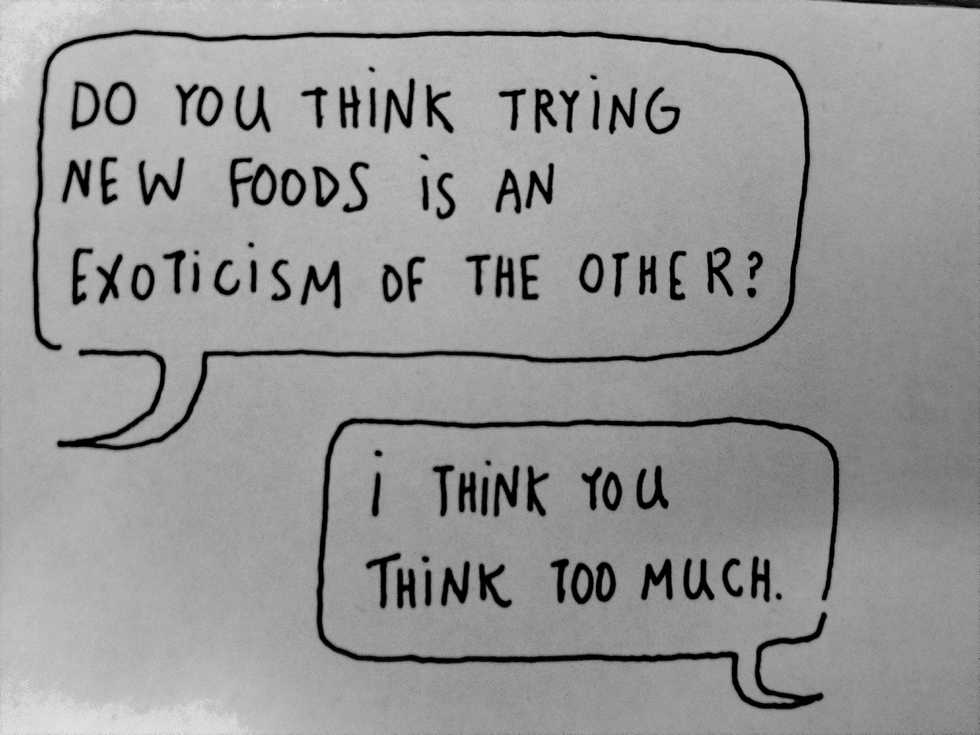
I recently read that many of us, however, love trying new cuisines because it contains an element of exoticism, which holds its roots in novelty. The problem with novelty, of course, is that the very act of experiencing such novelty significantly decreases it.
Which then leads the whole lot of us to be forever searching for something new, unusual, atypical. Unfortunately, this perennial search only leads us inevitable disappointment – there will come a time when the novelty of, well, novelty, wears off.
Is this really the case, though? Are we destined to “run out” of new things to experience, new cuisines to try, new ideas to discover?
I think a lot of intellectuals argue that most people are attracted to novel tastes and experiences because they are attracted to its supposed “strangeness” and unfamiliarity and therefore to its authenticity (and they have a point; they are intellectuals and they usually do).
So by loading a menu with some vegetables most other cultures wouldn’t know what to do with, or by name-dropping special cooking methodology, one can automatically associate themselves with this exotic image, and pass themselves off as authentic, even if they’re not.
And why can they do this? It’s because most of us wouldn’t know the difference, anyway.
This is what confuses me, though – what if some of us aren’t trying new things simply to try new things? What if some of us (*cough I’m over here cough*) want to experience new things in order to see how they measure up to the things we are already familiar with?
Take ice cream, for example. Give it a flavor: butter pecan. Mike’s Ice Cream in Secaucus, New Jersey, undoubtedly makes the world’s best butter pecan ice cream. I started there, and it changed my life. Nothing else I’ve tasted even comes close. (In the same flavor, of course. You really can’t go wrong with a nice Peanut Butter Cup.)
There still exists though, however small, a possibility that Mike does not, in fact, make the world’s most amazing and delicious butter pecan ice cream and that someone, somewhere, be in it Belize or Nepal, makes it better.
So there’s only one way to find out – and that’s to sacrifice a six-pack stomach in exchange for trying every single butter pecan I possibly can.
This is a simple quest, but is also no laughing matter. It is not because I crave the unknown, or wish to associate myself with the exotic, or even to confirm my dislike of the exotic and continue to see them as a truly unknowable “other.” No. It’s a lot less complicated than that.
It is to find the world’s best damn butter pecan ice cream.