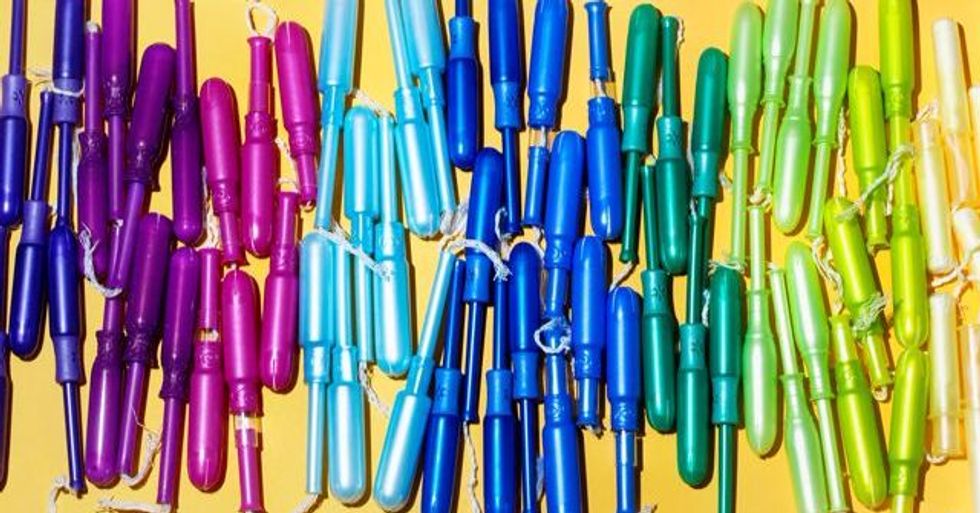
I was officially out of tampons. After a hasty reconnaissance mission in search of tampons hidden in stupid places in my room, I boarded the crowded, humid bus to CVS, head spinning, spots blocking my vision. I stared blankly ahead at the moldy, damp-looking windows of the bus. When the bus stopped, I willed my listless, exhausted legs to stay upright as I slid out of the bus. The pain in my stomach roared, as though the angry demon in my uterus had just clenched its bloody fist. I staggered up the street from the bus stop to the CVS, blood dripping down my leg, my favorite underwear ruined.
As I made my way towards the aisle of the drug store that contained, among other things, condoms, adult diapers, and something euphemistically labeled “feminine hygiene products.” Yes, I thought, my struggle is finally over. I grabbed a box of “super-duper absorbent” tampons “for the active young woman!” and made my way to the checkout. I put my purchase up on the counter. The blank-eyed clerk looked at me as though I was buying a Satanic Bible and muttered, “That’ll be $8.99.”
His words echoed in my ears. Eight dollars, I thought, and ninety-nine cents?! For a glorified blood sponge that gets used once and then thrown into the ever-growing trash heap of America? Surely, I thought, this must be a mistake. But no. My highly necessary, cheaply made, chemically processed sanitary items cost almost ten dollars every month.
Despite women earning on average 80 cents for every dollar that a man makes, women and transgender men are forced to pay so-called luxury taxes on feminine hygiene products. The stigma surrounding periods has silenced the discussion of menstrual health, spreading false facts about menstruation. Aside from the simple fact that tampons cost too much for most reasonable people to afford, tampons are not exempt from sales tax, unlike most other non-gendered toiletries (Hunter, 2016). While there is no specific tax against tampons (Larimer, 2016), pads, and other sanitary items, the sales tax that remains attached to tampons creates an unnecessary price hike on items that are used exclusively by an already marginalized group.
This price hike is usually justified by calling tampons and pads “gendered items,” which are supposed to have a sales tax attached. However, the apparent stigma against gendered items does not, it seems, extend to gendered items for men. Products such as Viagra, for instance, have achieved the coveted tax-exempt status despite being hella gendered and condoms are free at most university health centers (Hunter, 2016). While condoms are very important things to have at colleges for both men and women, condoms are not vitally important to students’ health; men to go without sex for as long as they want, but women can’t just opt out of menstruating. The double standard between gendered items for women and gendered items for men upholds values of institutionalized misogyny and male preference. However, many universities neglect to give out tampons for free, which sends a clear message to women: old men having sex is more important than your health, your basic comfort, and your ability to get through your day without blood dripping down your leg.
This added cost extends beyond the relatively small world of tampons and pads. This seemingly minor price hike has been applied to a majority of women’s products including everything from clothes to razors and even to gendered toys and bikes (Harper, 2017). The “pink tax,” as it is commonly called, refers to the price difference between men’s and women’s products; in other words, a tax on being female. While the products have the same production cost to the manufacturer, women’s clothing, healthcare, and miscellaneous services such as haircuts consistently cost between 4%-45% more than what men’s products do (Harper, 2017). Coupled with the high cost of tampons that only women and transgender men have to pay for, the gap between men’s and women’s consumer costs are creating an imbalance between the genders that gives men even more power than they already have.
The price of tampons is yet another thing that women are told to “deal with” or “get over it,” or, in more extreme cases, that they should “Pay for ur own tampons if u can’t hold it until u get to a toilet,” (Williams, 2016). While the last example is merely a gross misunderstanding of how periods work by a primitive male ignoramus man too lazy to spell out the word “your,” his sentiments are not uncommon. Because of the lack of education and awareness about female anatomy, some people’s opinions on the sales tax can be based on false facts about the female body. Because of poor quality sexual education programs in schools across the country, many people are not adequately able to explain what causes menstruation or why tampons and pads are necessary, not to mention a general lack of sexual health and awareness (Reyes, 2014). Such lack of awareness about the vagina causes negative stigma surrounding periods, despite such backward logic seeming out of place in 2017. Whether people think tampons come with a specific luxury tax or that the price isn't a problem at all, the misunderstanding of the issue, and of periods in general, is likely why the problem persists.
Some people will spend colossal sums of money on sanitary products over the course of their lives. In fact, one estimate showed that by exempting menstrual items from sales tax, consumers on a whole could save a total of about $10m every year (BBC News, 2016). Comparatively, I’m going to share some Period Stats™ about myself. I go through about $7 worth of tampons every month, and I’ve been doing that for the last four years. I’ll most likely be doing that for the next thirty to forty years. That means I could be spending anywhere between $2500 and $3500 on these motherfuckers in my lifetime. That’s probably about as much as it costs to travel to Europe. Hell, that’s probably about as much money as it took for Malian emperor Mansa Musa to completely destroy several ancient economies. And women have to pay that much money just to obtain basic necessities.
Even if we assume that I will die before I get another period, I have already spent more than $300 on pads, tampons, and panty liners. As someone who has never seen that much money in one place, you can only imagine how frustrated I am with that number.
While lower-priced options like the DivaCup, which is like a rubber cup that you fold and insert like a tampon, are available for people like me who never stop bitching about tampon prices, they aren't always practical solutions to menstrual issues. Many people I have talked to about using the DivaCup have had reactions ranging from mildly uncomfortable to all-out disgusted. Besides, the invention of the DivaCup is not meant to be used as an excuse to ignore the injustice of expensive tampons. Rather, it is meant to give women and transgender men an environmentally-friendly, less expensive alternative to tampons (Chambers, n.d.). The main offense is that while many women still want, and indeed, still need, these products, the cost is simply too high for them to continue being affordable.
Even if I had unlimited income and didn't want to spend my money on candy or shoes or literally anything other than tampons, the implications of this tax actually go far beyond me. Like most expensive shit, tampons are quickly becoming luxury goods for homeless and disadvantaged women and transgender men who can't consistently afford other basic needs. For about one week out of every month, they reach a level of discomfort that is almost unfathomable to my fairly privileged self. As much as having a period is sucktastic for me, it's definitely worse when buying tampons means you can't buy food.
I’ll be the first to admit that despite all the “love your period” bullshit ads I’ve seen lately, I’m probably never going to enjoy getting my period. But I can think of three things that would make my period slightly less bad: an assload of chocolate, the satisfaction of making my bathroom look like the battle of fucking Gettysburg, and a lower cost for tampons.