


Hunter Stockton Thompson, Rolling Stone’s dean of Gonzo journalism, died Sunday, February 20th, 2005, due from a self inflicted gunshot wound to the head at Owl Farm, his fortified compound in Colorado.
It was around 5:42 when Thompson shot himself while on the phone with his wife, Anita. "I was on the phone with him, he set the receiver down and he did it. I heard the clicking of the gun." She said she mistook the clicking sound for his typewriter’s keystrokes.
His son Juan, grandson, Will, and daughter-in-law, Jennifer, were visiting him for the weekend. Jennifer and Will were in the room next to him when they heard the gunshot, but didn’t immediately respond. They believed the gunshot to be a book falling.
Juan was the one who eventually discovered the body. According to the police report, Juan called the sheriff’s department an hour and a half after Thompson shot himself, then went into the backyard and fired three shotgun blasts into the air, commemorating his father’s passing.
Thompson was widely known for the role he played in his writing; he was often the subject experiencing the news events around him. He was a testament to the counter of objectivity, not able to “understand this worship of objectivity in journalism.” He rejected reporting as a watching outsider, preferring to become part of--or become the whole part of--the news story.
The compound was well known by friends and associates of Thompson as an armory of sorts. He loved guns; his home was lined with magnums, shotguns, and rifles. It was an inborn realization of his adoration for Red, White, and Blue.
He was born and raised in Louisville, Kentucky to Jack Robert Thompson, a public insurance adjustor, and Virginia Ray Davidson, a Librarian. He had three brothers, but rarely spoke or wrote of them. Despite affording a humble middle class lifestyle, Thompson’s father died when he was 14 years old. Virginia claimed to have become a “heavy drinker” after the death of her husband.
Despite his decent upbringing, Thompson was a maverick before he began to explore the world as a journalist. As a young man, he found himself in his town's jail cell. Thompson was charged as an accessory to robbery, and the week after his release, nearly sunk every boat in the local harbor by shooting holes in them. The day after, he enlisted in the air force.
At some point during his service in 1956, he transferred to Eglin Air Force Base in Florida. It was there he got his first writing job as the sports editor of “The Command Courier.” It was there he covered the Eglin Eagles, the town’s football team, traveling the country with them.
A year later, in 1958, Thompson was discharged from the air force. Col. William S. Evans, chief of informations services, wrote to the base’s personnel office, “In summary, this airman, although talented, will not be guided by policy. Sometimes his rebel and superior attitude seems to rub off on other airmen staff members.”
It was another year later Thompson began working for Time Magazine as a copy boy for only $51 per week. Thompson later recalled copying the books of his favorite authors: F. Scott Fitzgerald’s “The Great Gatsby” and Ernest Hemingway’s “A Farewell To Arms.” He believed by immersing himself in their works he could learn their writing styles. Shortly after, he was fired from Time for insubordination.
Indeed, Thompson could not nominally write--or even function--under bureaucracy. He was a rebel, through and through. Thompson hopped from paper to paper, writing for the the New York Herald Tribune, Rogue Magazine, National Observer, and so on. His work and travels led him to: Puerto Rico, where he wrote on Caribbean issues, and to Brazil as a reporter for the Brazil Herald, the only English language paper in the country at the time.
It was in 1963 when Thompson married his long time girlfriend Sondi Wright, who later met up with him in Brazil. When they returned to Colorado, they got married in May, and had Juan. The couple attempted to conceive five more children, but two of the infants died due to complications shortly after birth, and the other three were miscarriages.
In 1965, Thompson returned to Colorado, and was hired The Nation, a US weekly magazine, to write a story about the Hells Angels’ Motorcycle Club. This planted the seed--the true nature of his character--the doctoring of Gonzo journalism. He spent the next year riding with the club, and soon after published several writings, one including a visceral look into the life of the bikers, Hells Angels’: The Strange and Terrible Saga of the Outlaw Motorcycle Gangs.
His involvement with the biker gang led to their eventually enmity. They believed that his writings were exploiting their lifestyle for cash. They ordered him to cut them a share of the profits. He received a “stomping” from the gang-- a soft term for a hard, brutal beating--for his defiance.
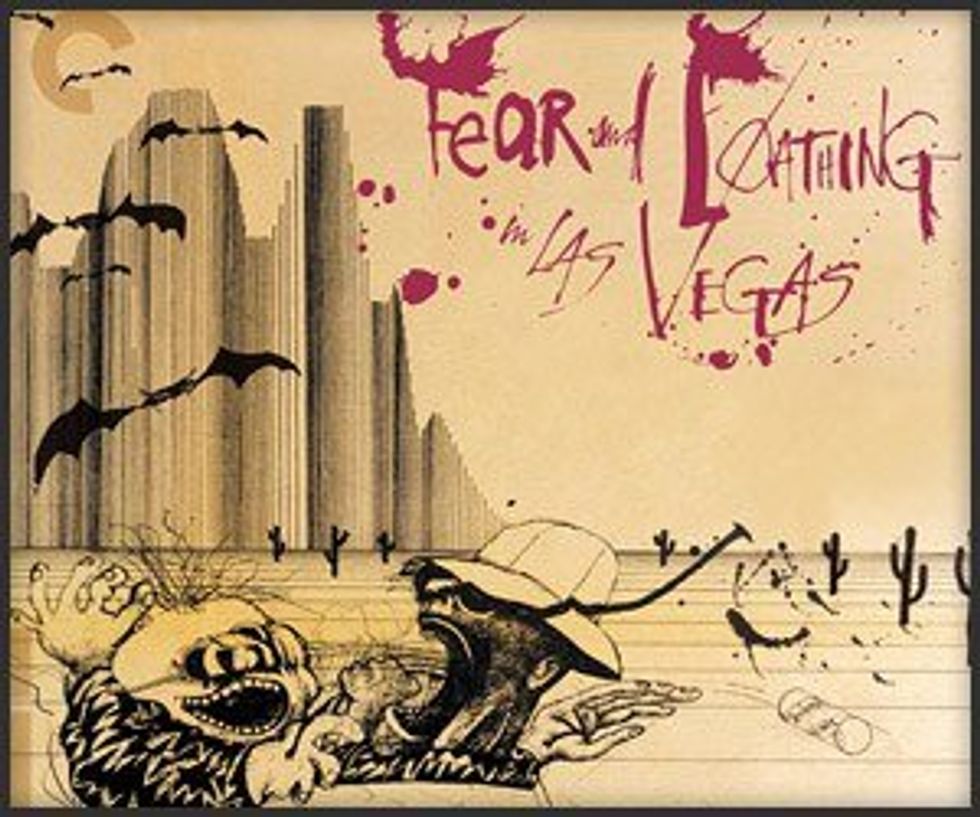
It was from then on Thompson focused on writing novels, the exposure from becoming a Hells Angels causing publishers to flock. Thompson began to plan to write a book about “the death of the American Dream.” He didn’t finish this book until 1972, which was his most popular work, “Fear and Loathing in Las Vegas”.
Gonzo was truly born when Bill Cardoso, the editor of The Boston Globe in 1970, commented on Thompson’s The Kentucky Derby is Decadent and Depraved. The article was a last ditch, rash, determined attempt at satisfying a closing deadline. Partnered with Photographer Ralph Steadman, the two covered the derby indeed, but in a first person frenzy. The enemy of objectivity in journalism. Cardoso commented “This is it, this is pure Gonzo. If this is a start, keep rolling."
Thompson was well known for his belligerent, recreational drug use. He was an uncensored machine gun; loaded and unloading uninhibited. He was a man of sharp word and vivid expression. His profanity was core to his vision; in tongue and on the page, he was honest and abstract.
"Fear and Loathing in Las Vegas: A Savage Journey to the Heart of the American Dream" was his most famous work. What was supposed to be a short photo-paragraph caption on the Mint 400 motorcycle race in Vegas, culminated into the search he began long ago. The article became a novel, based on his experience in Vegas.
It starred the strange, titular journalist Raoul Duke and his “fat, Samoan lawyer” Dr. Gonzo. They were sent to Vegas to cover a narcotics convention and the Mint 400. They were distracted by the American Dream; they journeyed with “two bags of grass, seventy-five pellets of mescaline, five sheets of high-powered blotter acid, a salt shaker half full of cocaine, and a whole galaxy of multi-colored uppers, downers, screamers, laughers... and also a quart of tequila, a quart of rum, a case of Budweiser, a pint of raw ether, and two dozen amyls." It was a rage fueled, drug binge; exploring a similar decadence and depravity Thompson wrote about two years prior.
The book was a commercial success, driving the Gonzo style into the limelight. In 1971, Thompson began his extensive career at Rolling Stone, mostly articles on his musings on politics. In 1972, Thompson published Fear and Loathing on the Campaign Trail ‘72, covering the Democratic primary, following the campaign trail. It was then he took an interest and focus in politics, growing a particular hatred for ex-president Richard Nixon.
Thompson had written of Nixon, “if there were any such thing as true justice in this world, his rancid carcass would be somewhere down around Easter Island right now, in the belly of a hammerhead shark.”
Thompson continued to travel the world: Grenada, Africa, and Vietnam, covering areas of conflict. He contributed to different newspapers for each country. He and the Rolling Stone eventually had a falling out after RS pulled the plug on his assignment in Saigon, when he had only arrived a few hours earlier. RS didn’t publish his article until 10 years, consequently furthering his distance from the magazine.
After his assignment in Africa, Sondi Wright, his first wife and mother of his son Juan, had said of Thompson, "he just couldn't write. He couldn’t piece it together.” He was sent to Africa to cover Rumble in the Jungle, the historic boxing match in Zaire.
“He started to lose it after Africa,” said Jann Wenner, who was his publisher at RS. “He went to Zaire at great expense to cover the Rumble in the Jungle for the magazine, got hopelessly stoned, missed the fight (while reportedly in the hotel pool), and never filed a story.” Roger Ebert commented on a review of Thompson’s documentary, "Gonzo: The Life and Work of Dr. Hunter S. Thompson."
Thompson’s life faded into obscurity after his Africa assignment. He couldn’t convey that visceral outlook as well as he used to. Some tumultuous times with his wife went by, leading to a divorce in 1980. Thompson remarried in 2003 to Anita. They were introduced to each other by a mutual friend. It led to her helping him compile his letters into a novel, the budding emotions and relationship inevitably flowering.
"As soon as I saw him, all that craziness, all the anger and fear, went away," she said. "I held him, kissed his head and rubbed his leg like I always did. Thank God he didn't do much damage. I said it was okay, Hunter; I know what you did. Suddenly, there was nothing but peace." Anita said when she saw her husband’s body.
Thompson was plagued by medical issues during his last days, pained by hip replacement surgery, a lung infection, back surgery, and a broken leg. "He had been looking at his options for a few months. One option was physical rehabilitation. A second option was to stop drinking and move to a warmer climate. The other option was to kill himself. No one knows how long he considered it--he used to say he wasn't afraid to kill himself all the time." Said Douglas Brinkley, a professor of American History at Tulane university.
Brinkley published what he speculated was Thompson’s final words, a suicide note to his wife. Titled Football Season Is Over, “No More Games. No More Bombs. No More Walking. No More Fun. No More Swimming. 67. That is 17 years past 50. 17 more than I needed or wanted. Boring. I am always bitchy. No Fun--for anybody. 67. You are getting Greedy. Act your old age. Relax--this won’t hurt.”
Thompson was friends with many well known actors: Johnny Depp, Benicio Del Toro, Bill Murray and Jack Nicholson are some of the few. Johnny Depp and Bill Murray starred in the film adaptations of Fear and Loathing in Las Vegas and Where the Buffalo Roam, respectively.
“He was not going to be the guy to melt into a bowl of clam chowder. He was going to dictate the way he lived, the way he died,” said Depp. “But all of us are beat up about it.”
Thompson is survived by his wife, son, daughter-in-law, his grandson, and his brother Davison. He was one of journalism’s most involved men. To Thompson, the only story worth publishing was the story that exposed the condition of fear and loathing.
Thompson gave a perfect description of himself in an interview of The Atlantic in 1997. He was asked about his health:
“I haven't started any savings accounts.... I tell you, you'd act differently if you thought you were going to die at noon tomorrow. You probably wouldn't be here doing this. I just figured, 'Bye, bye, Miss American Pie, good old boys drinkin' whiskey and rye, singin' this'll be the day that I die.' Yeah, I just felt that all along.”

















