Falstaff is one of the quintessential characters from the Shakespeare folio: he is comic and tragic, and he is the embodiment of several key concepts in Shakespeare studies: the fetishism of dress and the paradox of identity. Although in I Henry IV, Falstaff is considered by much criticism as one of Prince Hal’s “divided selves,” Falstaff is a dynamic, standalone character that acts a foil to Prince Hal: Falstaff is the opposite of Hal in many ways, but the primary difference is that Falstaff is free, whereas Hal’s identity will always be inextricably tied to the crown. At certain moments, we see Falstaff’s tensions with his identity and the fetishism of dress at play. Falstaff is a man of noble status (he is, after all, Sir John Falstaff), yet he rejects certain trappings of 13th century courtly culture. Falstaff lives on his own terms: he cons “draft dodgers” out of their money to turn a profit, he fakes his death in a refusal to die for the abstract notion of honour, and he holds Hal in high esteem as one of his true friends, even after Hal is cruel to him. Falstaff is therefore not one of Hal’s “divided selves,” but instead acts as a foil to Hal: where Falstaff’s outward identity is certainly a performative construct, it is constructed on his own terms to his advantage; as opposed to Hal, who performs identity, but out of obligation rather than choice.
Hal’s identity is constructed and performed strategically. He chooses Falstaff as a partner in his debauchery because Falstaff has social status. Hal’s other compadres, such as Poins, a “second brother,” also have some sort of social standing, even if it’s vague and minor. Because Hal will eventually inherit the throne, he will stoop only so low as to be friendly with the likes of Falstaff and Poins, but never with a common peasant. Hal is actively working to construct the right identity: “Yet herein will I imitate the Sun,/Who doth permit the base contagious clouds/To smother up his beauty from the world” (1.2.187-189). These clouds, his lousy friends, are smothering his beauty and potential - for a time. They are merely clouds that will eventually part and make way for the sun to beam down upon the earth; they are not volcanic ash that could potentially block out the sun and send the world into a nuclear winter. Hal has allowed himself companionship with Falstaff because he views Falstaff as expendable and when the time is right Hal will redeem himself when “men least think I will” (1.2.207). Hal will have his redemption arch because it is expected and demanded of him.
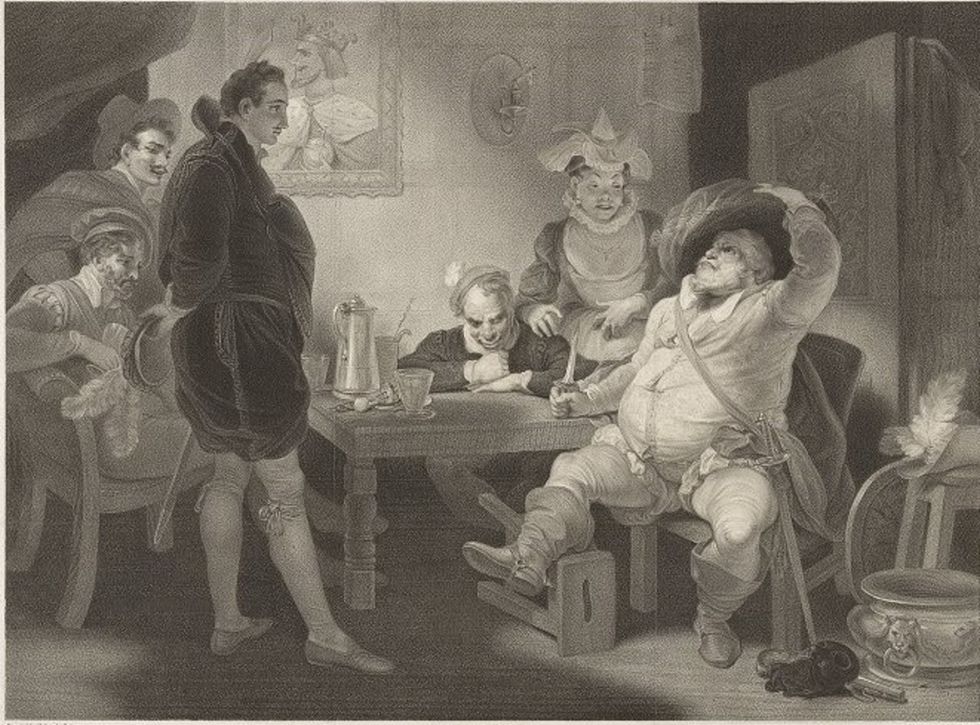
While Hal’s paradox of identity comes from preparing for a specific and ultimate role, Falstaff code switches quickly and easily: he is always playing a different role, depending on who is near to witness his performance. The performance is not necessarily for political or personal gain, but as a way of exercising free will. Falstaff is not stupid; one key element of his character is his tendency to tell loud, exaggerated tales of his supposed feats of bravery. During a scene in the tavern, he relates to Hal: “These four came all afront and mainly thrust at me. I made me no more ado, but took all their seven points in my target, thus” (2.4.193-195) “Seven?” Hal responds, “Why, there were but four even now.” (2.4.196). This intentional self-division is what makes him a comic character. While the situation portrays Falstaff as a bumbling, lying fool, this performative self-division is actually an act of inward expansion. He makes his choices of his own free will; his fantastical stories are his and his alone. We see this agency is exerted again in act five when he refuses to die for honour and subsequently fakes his death so he may live to see another day.
It is in Falstaff’s soliloquies grappling with honour and death that we see the feteshism of dress at play. To Falstaff, honour is a “scutcheon” (5.1.140) a pretty cover, a concept invented to make men feel better about dying. Honour has no tangible or practical use; it cannot “set a leg … or an arm … or take away the grief of a wound” (5.1.131-132). Honour is only valuable as a tool for the living to mourn the dead, because even he who has died honourable cannot feel nor hear it. In this way, the concept of honour represents the fetishism of dress: honour is essentially useless, but what it symbolizes and how it can manipulate people is what is important. This will later be relevant when Falstaff soliloquizes about his counterfeit death.
The act of playing dead is “the true and perfect image of life indeed” (5.4.118). To actually die would be counterfeit firstly because the dead body appears alive, but isn’t really. Death is a counterfeit because it reflects the image of life in a lifeless body. Secondly, Falstaff believes that playing dead was no counterfeit because “the better part of valour is in discretion” (5.4.118-119). For Falstaff, it would have been foolish and dishonourable to attempt to fight and consequently die in such an unfair matchup. It would be counterfeit for Falstaff to fake his honour and attempt to slay the adversary; similarly, it would be dishonourable for the adversary to engage in a fight with Falstaff, someone much below his station. A faked death is then a way for Falstaff to preserve the honour of both himself and his adversary, even after he condemns the trappings of such “honourable” actions.
Ultimately, Falstaff is proven the more honourable of the two, which solidifies his role as Hal’s foil, rather than one of Hal’s divided selves. Falstaff is comic: his bumbling ways, his outlandish tales, even his stature make him the butt of jokes. However, nobody is actually harmed by any of Falstaff’s actions. When he tells his boastful tales, everybody knows he’s lying, the victims of his poorly planned heist get their money back, he kills nobody, and he forgives and loves Hal, even after all of Hal’s cruel jokes. Falstaff, even in his less admirable moments, acts autonomously; nobody is forcing his hand. Yet Hal, our supposedly “honourable” protagonist is a master manipulator, people die at his hand, and he is intentionally cruel to Falstaff and will ultimately abandon him to ascend the throne. Hal is performing in his pre-scripted role; the only free will it could be argued he has is his engagement in petty theft and vague debauchery, but even that serves a very distinct purpose. While Falstaff could be understood as one half of Hal’s divided selves, taken in his own right, Falstaff seems to act as a foil rather than a competing half. Falstaff is what Hal longs to be: autonomous. Falstaff freely exercises his will in the construct of his identity. He answers to no one. Hal is duty bound to uphold his obligation to the crown and therefore has no true autonomy.