I'm white - sufficiently so. Not in the way of paleness, but in that I am one of those European concoctions of random percentages people like to bring up at parties. Most people I have met don't believe this to be true.
It's not like I walk around yelling "I'm Caucasian!" and people exclaim with incredulity. Most often, it's my tendency to discuss social issues that leads to my race coming into question. Suddenly, it is revealed that I am neither Hispanic nor Latina as they had presumed throughout our relationship thus far.
My name is Maria and I'm Sicilian enough to be ethnically ambiguous to the untrained eye.
When I was younger, I believed myself to be the Latina everyone thought I was, still naive to the definition of "race." Watching cable with my parents before my bedtime, I felt for the Latina actresses who seemed destined to play only maids in their sky-blue dresses and white aprons. I would sit on the rug, hear my name, and open my eyes wide, drawn to a woman in the corner who looked like me.
Looking up at the bright screen, I would see the woman quickly dismissed by a main character saying "Thank you, Maria", always leaving with a cleaning instrument in hand. This was the extent of the power of my name, their uniforms representing the limit to what Marias could be. I saw my future self as one of these women, restricted by an industry I knew nothing of and a race that was not my own.
I didn't fully understand the underlying complexities of this trend until I watched West Side Story onscreen for the first time. I was astounded at the loveliness of the romantic female lead, Maria, excited by my connection to her. Her sky-blue dress was transformed into a sign of beauty and importance in my eyes.
However, this seemingly groundbreaking female Latina role was played by a white woman. Upon learning that simple fact, I felt oddly betrayed. I quickly lost the naivete I occasionally long for; it certainly made watching West Side Story more fun.
Still, colorblindness is ignorant.
I am also a white Maria, mistaken for something I'm not. I am not one of their Marias and I don't have the right to call myself one, as the experience of Latinas is one I can never fully understand, undergo, or appreciate the gravity of. I can, however, stand beside these women. I did not lose my empathy for Latinas when I lost my ignorance.
When Marias left the room with barely an acknowledgment sent their way, I stopped simply wincing. I began researching, debating, and sharing the stories of Latina women as much as I could from the sidelines of this fight.
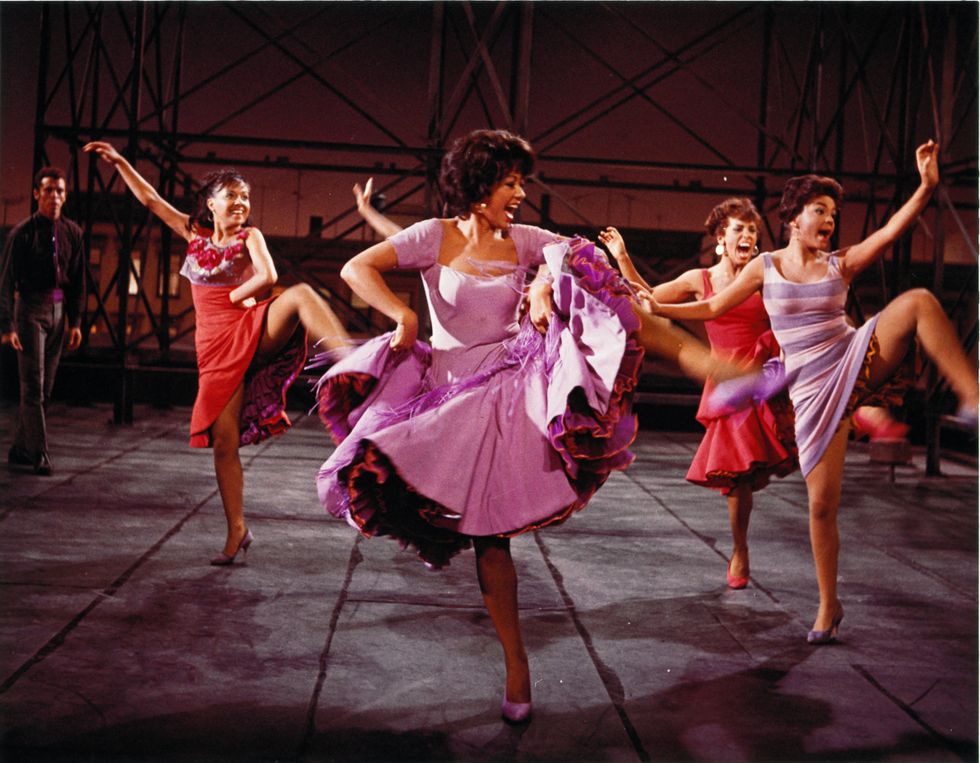
A favorite of mine is that of Anita, another female lead in West Side Story. In the film, Latina women are stuck in the jobs the world always assigns them - cleaning, sewing, and fixing other people's messes. Anita prominently suffers under these stereotypes.
Rita Moreno, a native Puerto Rican born to a seamstress and a farmer, originated the role on film and would go on to become an EGOT (Emmy, Grammy, Oscar, Tony) winner. In Moreno's hands, Anita inspires magnificently despite her metaphorical sky-blues.
So, I will keep correcting people when they mistakenly think I am anything other than white and continue advocating for women of color at any chance I get. My name and genetic predisposition to tanning well connected me to Latina women early on and I wouldn't have it any other way. My name is not the limit I once thought it was.
I'm proud to share the name of many women, past and present, Latina or not. Marias are more than sky-blues on cable TV. Marias have stories to tell.