I know, this title is odd. But bear with me.
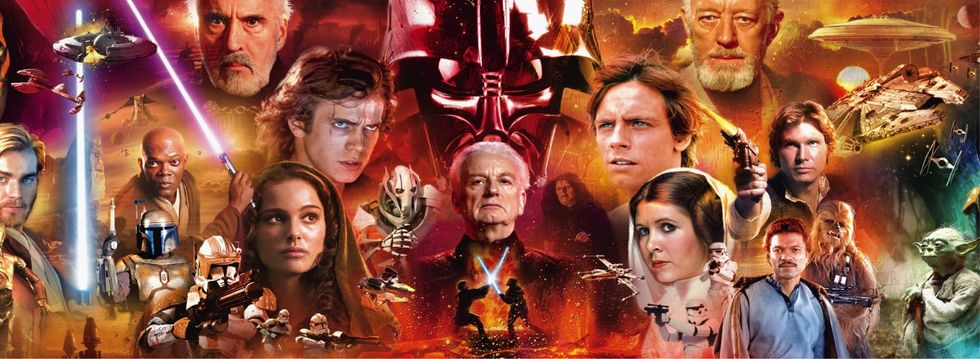
As I was watching Revenge of the Sith (2005) for the approximately 4967th time this past week, I started to notice some of the deeper political messages. Out of all the eight films so far, this one is definitely the most politically charged. Palpatine's extension of emergency powers, the conflict between the Senate and the Council, the loosening political grip of the Separatist Alliance: for someone who loves Star Wars and politics, this movie is cloud nine.
So, how is Star Wars’ plot libertarian?
Think about the saga’s premise as a whole. The first three chronological movies are about an orchestrated, lengthy war that not only pits normally peaceful civilizations against one another, ravaging them in the process but also provides the Republic’s executive office with an extended term and prolonged emergency powers.
Then the next four chronological movies are about the Empire that blossoms out the aforementioned Republic with an even more distilled center of power. For example, the first look we get at the Imperial think tank is in A New Hope (1977), when Grand Moff Tarkin cavalierly mentions to his top brass that the remains of the senate have just been dissolved, relocating power to Emperor Palpatine.
And lastly, in The Force Awakens (2015), we see yet another totalitarian regime stretching its military reach across the galaxy, from the ashes of the Empire, and in a similar fashion: Snoke is Palpatine’s parallel, Hux is Tarkin’s parallel, Kylo Ren is Vader’s parallel, etc.
All in all, the Star Wars saga is about a democratic government that has its legislative and executive power carefully centralized under the guise of war, and then retains said power for decades, until their forced military collapse and eventual rebirth through the First Order. This is the type of narrative that certainly doesn’t advocate bigger, more centralized government.
But here’s where this anti-centralization point of view really becomes apparent: Palpatine.
To understand this significance, however, we have to go back not a long time ago, not in a galaxy far away, but approximately seventy years and right here in the United States.
Frankin Delano Roosevelt is famous for many things, and to small government advocates, what unfortunately sticks out like a sore thumb is his advancement of big government and his three-term holding of the presidency. During his tenure, there were many who were cautious of his repeated attempts to fill the supreme court and centralize government power.
This sounds familiar. I have no doubt that the writers of Star Wars intentionally depicted Palpatine in this light because they were familiar with many Americans’ suspicion toward FDR’s pro-big government policies, a form of government that we now partially take for granted.
Revenge of the Sith provides the clearest examples of this. For instance, with regards to the extended term in office, Obi Wan Kenobi clearly says that he and the other Jedi have had suspicions about Palpatine’s lengthy term in office, too long to be just coincidence.
And with regards to the control of the judiciary, when Mace Windu nearly has Palpatine defeated, Anakin arrives and Mace explains that Palpatine is too powerful to be left alive because he controls the Senate and the courts. This is to say nothing of the giant war present in both Roosevelt and Palpatine’s tenures.
Now, thank god FDR didn’t have an attempt made on his life by space Buddhists, but there’s a reason this is fiction. It’s a story, it’s supposed to be entertaining. But you can still see the parallels.
So I’m not trying to ruin Star Wars for you, and it doesn’t seem like the writers were trying to politically charge their story. I just like politics and science fiction, and this happens to fall in between.