Imagine if we took every event that contributed to the development of the world as we know it, and then we chronologically organized the significant information to fit within one calendar year.
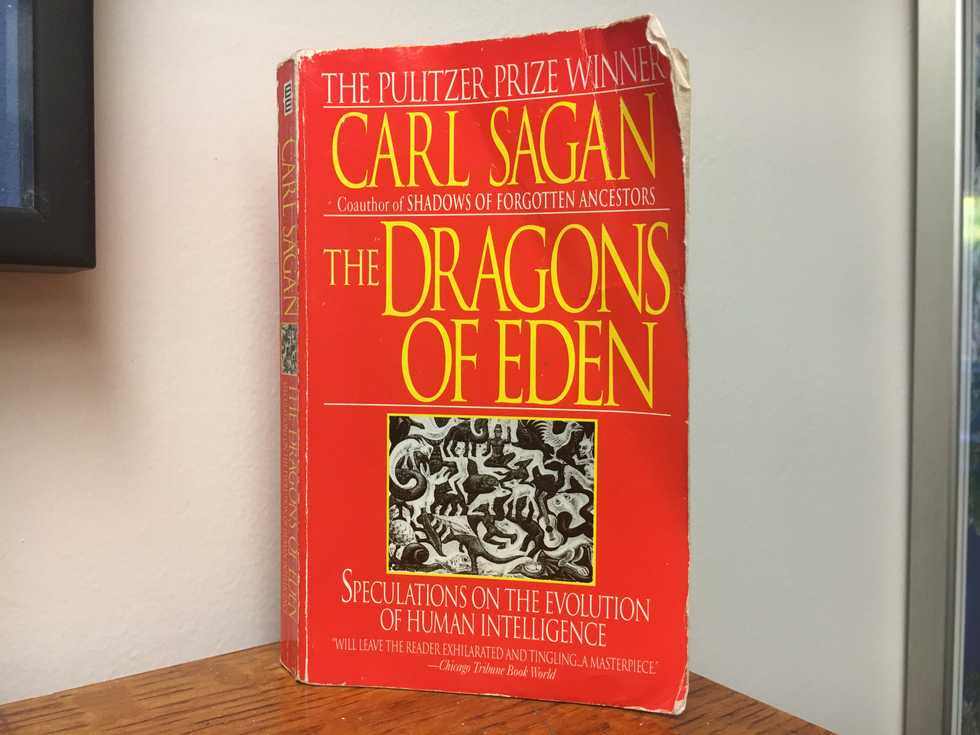
Carl Sagan has done that. It’s called "The Cosmic Calendar," and it is a brilliant visual for understanding the length of time required for even the simplest form of life to emerge. Sagan compiled his reasoning into his book "The Dragons of Eden: Speculations on the Evolution of Human Intelligence."
We have 365 days in a year. Sagan was able to establish specific dates that major events would have occurred. Take a look below to see everything that happened for the first 11 months.
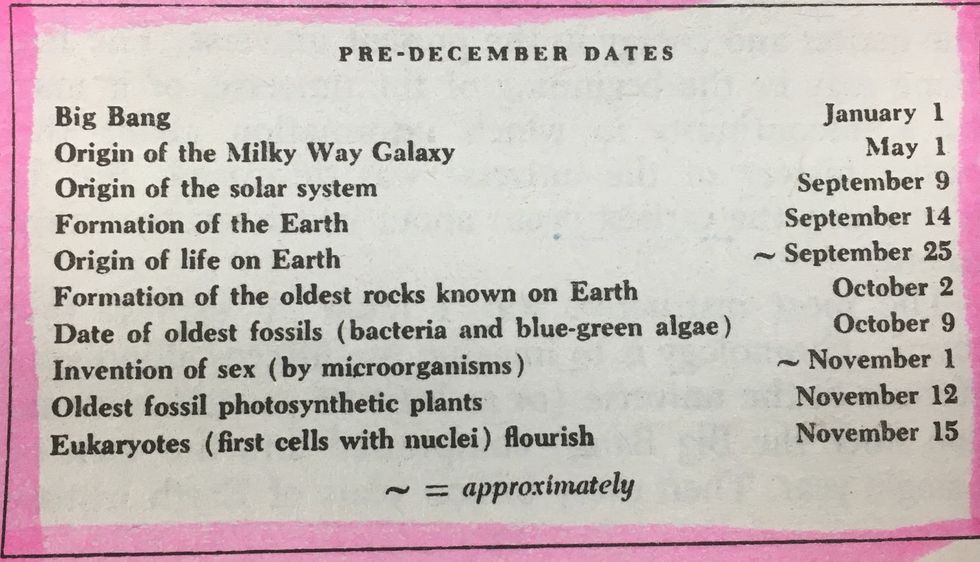
Notice that humans aren’t listed?
Take a look at the December calendar, and you’ll see the day we were created. Which day is it?
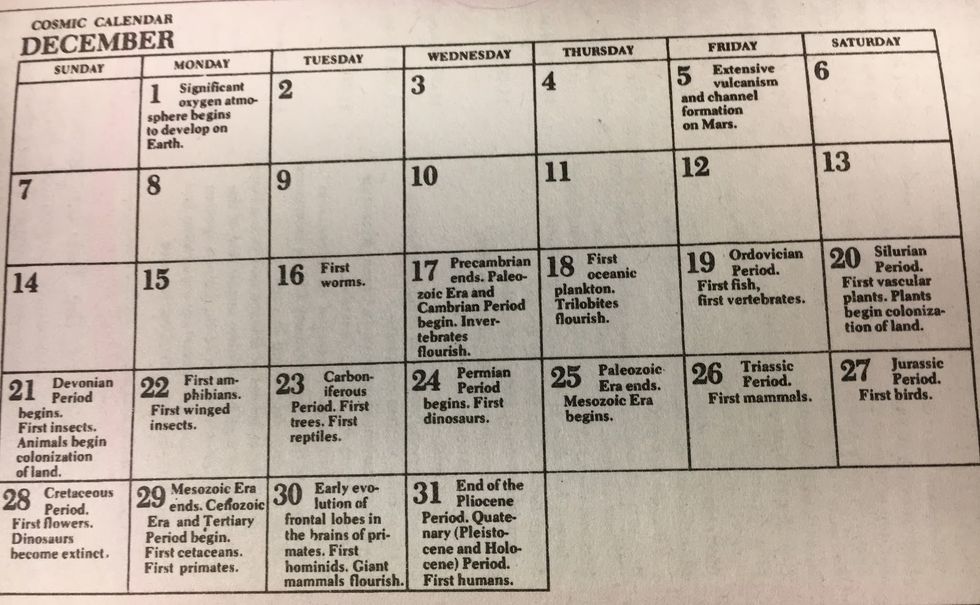
The very last day possible.
On day 365 out of 365, the world finally evolved to include humans. We were at last thought in whoever or whatever decided the Big Bang should occur. Imagine if we accidentally hadn’t happened, and to this day, the world contained animals and plants, but no true way of recording events or having an established language.
If you want to narrow down the time humans were created, have no worries: Sagan figured that out also. Humans would emerge at 10:30 p.m. on the last day of the year, further demonstrating their newness to the world and suggesting we make up approximately 0.01% of the universe’s development (365 days per year X 24 hours per day = 8760 hours per year; 1.5 hours of human existence ÷ the 8760 hours that year = 0.000171; 0.000171 X 100 = 0.1 %).
Obviously, there are major differences between how Adam and Eve were created and how the first humans evolved to the way we are today. Oddly enough, however, Sagan’s hypothesis that humans were formed on the last day of year is not that dissimilar to the creation story from the Bible, referencing that God created Adam and Eve on the 6th day of the 7 day week. He put the creation of humans at the tail end of His journey of creating the world.
It’s almost as if in both situations, the world wanted to be prepared for the arrival of humans and perhaps enjoy the peace of not having. Both situations truly are theories: we never will really know if the Big Bang is responsible for the universe’s creation and the resulting evolution of life, nor if God placing Adam and Eve in his newly formed planet is the reason we have humans today. There is no proof that either occurred. Yes, we have fossil remains, and we have the Bible, but are either from Day 1 of the Universe? No.
A combination of the two theories is the most probable. Adam and Eve were likely not the first people. There is no way that the first form of humans–completely able to walk upright, communicate and procreate–are the exact same people that we see today. Evolution had to have occurred.
But when it comes to the Big Bang, there are some doubts associated with that theory as well. The Merriam-Webster Dictionary says the big bang is a “cosmic explosion.” So an explosion randomly occurred because the density was right? Where was this located? It had to be located somewhere, even if the universe didn’t exist yet. So was God the reason the Big Bang occurred? A higher power decided it was time for the world and life to begin?
The universe was formed, with or without a reason. Humans came along, possibly as a way to finish off the creation of what we know today.