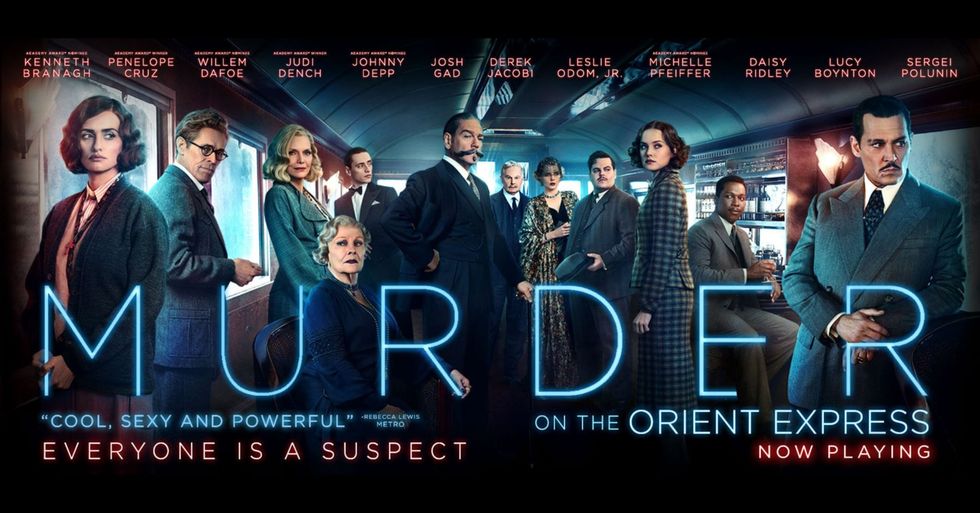
When detective fiction combines with cinema, Agatha Christie’s famous work is re-imagined to viewers on the big screen. This year, renowned detective Hercules Poirot solved a murder mystery on a train in the mountains while trapped by an avalanche. Although familiar with Christie’s style and having read her novels such as And Then There Were None, I have (unfortunately) not yet read Murder on the Orient Express nor have I seen the 1974 film. Thus, I cannot provide insight or analysis with regards to the disparity between the original novel and the film adaptations. Nevertheless, the 2017 film had interesting points – both positive and negative – that contributed to the overall message of the story. Using a postmodern and Marxist perspective for a comprehensive analysis of the film, the director used characterization and symbolism to develop the central themes of moral ambiguity, justice, and truth: that despite our differences, we are all sinners. Because of this, we cannot always view the world as black and white and draw a definitive line between good and evil; rather we must learn to iron the ruffles of adversity and move on with healing, forgiveness, and peace – striving for better.
Starting off with a scenic statement in Jerusalem, Poirot is immediately introduced to the audience as a perfectionist with all things in order. The obsessive-compulsive detective measured the sizes of two seemingly perfect white eggs and also accidentally stepped into a pile of feces, only to put in his other foot to restore “balance.” Small details and actions like these examples are significant because it contributes to the characterization of Poirot and sets the stage for the director’s intended project about moral ambiguity and justice. Dialogue was also used to communicate Poirot’s distinct philosophy on how he sees good and evil, saying that he can determine the culpable by seeing the imbalance of the world like the nose on a person’s face. Hence, he viewed morality with definitive lines. During his investigation of the murder of Ratchett (that resulted from a dozen stabs by the knife), he realized Ratchett’s true identity as John Cassetti, the kidnapper and murderer of a child, Daisy Armstrong. Following the Armstrong case, there was a trial for Suzanne, the maid, who was innocent but committed suicide due to the fear of losing her job and the stress from the constant questioning and blame. Each of the passengers aboard were suspects of crime because they had close connections to the Armstrongs and the victims of the tragedy. It is worth noting the ripple effect that demonstrates the weight of consequences. When Poirot figures out that all of them conspired to kill Ratchett, he is shocked by the imbalance of the world, knowing that they are good people who have voluntarily committed crime.
Continuing on, the film focuses on the identity and background of the characters rather than the actual clues left behind at the crime scene. By murdering the murderer, the intention of the passengers was to bring justice to the table because they were all painfully involved with the Armstrong case. This alludes to the postmodern concept of moral ambiguity; people are disillusioned by the truth. How can we determine right or wrong? The film shows the agony that people feel in the split between these choices, and the necessity to reconcile our mistakes. Linda Arden was in pain over the loss of her grandchild; the governess was consumed with guilt because the murderer intruded when the child was under her supervision; the doctor was close friends with Mr. Armstrong; the conductor lost his sister Suzanne, etc. There is internal turmoil that results due to the complexity of intentions translating into consequences. Nothing is ever so simple. Despite their wholesome intentions to establish justice, they failed to alleviate their pain and only added more sin on sin, putting the detective in the position as the agent of judgment. However, Poirot released the passengers and let them go despite their culpability because he wanted them to find peace and have a chance at restoration. There is a fine line between revenge and justice, and the film explores the extent of that. It shows that there is no justice that comes with revenge; in fact, there is only more affliction.
Furthermore, the Marxist perspective shows that this story is one of class struggle. Each of the characters are clearly defined based on their morality, socio-economic status as well as their race. For example, the engineering professor is white and refused to sit in the same table as the black doctor because of his prejudiced, racist beliefs. During this time period, judgment was also distorted by class discrimination; the word of the rich was considered more reliable than that of the poor. Suzanne’s suicide would also be an example of how social class provokes conflict. In such a way, the film explores the divisions amongst the characters, and how their universal human emotions and shared goal united them. Under a Marxist lens, the characters can be dissected into two categories: the perpetrator Ratchett (resembling the bourgeoisie) and the victims (proletariat). It is a revolutionary moment when the passengers conspire to kill the one man that caused a great deal of pain for others around him. Thus, the victims eradicated the perpetrator with the belief that when the system is overthrown, the case would be resolved and they could restore a utopian society.
Symbolism was also prominent throughout the film, and provoked the essential questions of the film’s ideology. I especially liked how the director played with images and angles to convey the fragmentation and disillusionment that was going on. When Ratchett was killed, his dead body was not revealed until later; the director used a bird’s eye-view of the three men looking into the compartment, building a disturbed sense of tension and speaking more to the story by showing less. The watch that was found in Ratchett’s room was interesting because the time was stopped, manipulated by the passengers. This caused me to question the truth about his murder. The skepticism and unreliability of the clues were reminiscent of Christopher Nolan’s Memento, as Leonard was manipulated into thinking he had to kill his wife’s murderer. The picture of Poirot’s deceased wife Katherine was a reoccurrence that represented the voice of reason and love, and the blood-stained handkerchief was the loss of innocence and the symbol of guilt. Conclusively, I thought these elements were woven seamlessly to convey the mystery.
Coming into the movie, my expectations did not align with the reality that the film presented. Because it is a murder mystery, I thought that it would be whipped with more tension and gripping fear. However, it was rather anticlimactic and disappointing when looking for a thrill-seeking adventure. The supposed plot twist was confusing due to the rapid successions of clues and conclusions that Poirot comes to without the audience understanding how or why. For example, he somehow deduced that Hubbard was Linda Arden, former actress and grandmother of Daisy. It was a little baffling to discover that the audience had to assume and trust that the detective was just pure genius. Even so, I enjoyed the cinematography and appreciated the humanistic approach of the film that tied morality and justice together. With traces of postmodernism and elements of Marxism, the story can be analyzed in multiple literary perspectives and theories. At the end, Poirot is able to walk away from the train, with the camera zooming out from the beautiful sunset in the midst of the snowy mountains. Perhaps it was to conclude with the notion of hope; despite it all – the pain, the suffering, and the sin – we can start anew and strive to shape a better version of the world.