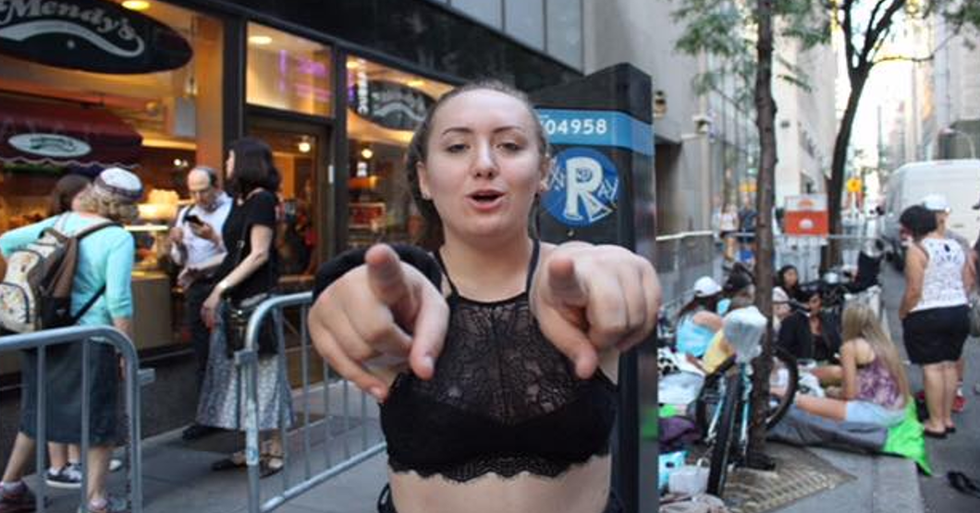
My alma mater high school liked to tell me that their dress code was for my benefit.
What I knew then, and now know even better, is that the dress code was truly in place for the benefit of the continuation of a divisive patriarchal system of oppression that spreads beyond my isolated school.
And if that phraseology sounds a bit too “feminist extremist” and intimidating for you, I’ll break it down a bit more.
There are thousands of articles and think pieces about the dangers of school dress codes and the chaos they cause. It’s a long argued and hotly debated topic that has gained attention in both local and national news outlets. While I could recap every single part of the debate, I’ll stick to specifically my experience and what I know.
Late into my senior year of high school, I, Student Council president, Youth and Government president, Mock Trial co-captain, National Honors Society member, National Girl Scout delegate, and overall self-starting leader, was dress coded for tears in my jeans that I had received for free from the part-time job that I juggled among all of these other things. Jeans that I was perfectly permitted to wear to work because my workplace acknowledged that women had… skin.
However, my school had a major issue with my “look” and deemed me unsuitable to allow to receive an education. Since, like most students, I didn’t have other clothing choices to change into and since my family worked and couldn’t drop their life to bring me clothes, I was sent home and not allowed back until I changed clothing. As a conscientious student, this caused me to have an extremely bad anxiety attack, so I did what my therapists had taught me: I wrote to calm down. I didn’t stop there, though.
I had always been livid about school dress codes and had previously had a Twitter battle with my school about it, pleaded with my principals to change the policy, and kept pushing. At this moment, I realized that it had all until then been for naught. So, I published my writing: an open letter to my school district. It blew up locally a little. I was called to the principal’s office about it… the whole thing was quite the scene. I was a very angry high schooler who had felt she had been ignored. I was a very angry activist who just wanted my school to be a better place.
That, though, was just my initial reaction. I should have calmed down. Truly, it doesn’t seem like it should have been that big of a deal when I talk about it now, but that’s where we have to realize that this is not an isolated incident, but instead, as I mentioned, it is a “divisive patriarchal system of oppression”. Small moments and events like this add up to create a culture meant to demean, oppress, and pit the oppressed against each other.
So, for awhile I didn’t think about that incident. In fact, my school changed the dress code (albeit only slightly and it's still a hot mess). For a while, I was satisfied. Until the other day when I nearly had a panic attack because I couldn’t find a cardigan to match and cover up my “spaghetti strapped” shirt, rendering me late for class.
It reminded me of an argument repeated to me time and time again by students, staff, and administration anytime I brought up the issue. “Once you’re out of here, you can dress how you want and it won’t even matter.” It was something said to try to calm me down as I argued my stance. At the time, I couldn’t find a way to combat this. It was kind of a stump. Usually, I would admit that they were correct but reiterate that it matters because it was happening at the moment.
Now, though, I realize the long-term effects something typically regarded as so silly has actually had on me. Most days, I, in some way break, my high school’s dress codes and smile to myself as I do because I know I can finally dress how I want. The thing is, though, I’m only ever breaking it in small ways. Maybe I’ll wear those ripped jeans to class or the leggings that were banned from my school for so long. I don’t work out in my school issued gym class uniform (that was uncomfortable and made to be “unisex” as to avoid any “inappropriate display”) and I might wear shorts on a hot day.
But every time I hear someone (typically girls even) comment on how a woman’s dress is “too short” and she should “learn to cover up”, my heart sinks because that was the very thing I fought against so harshly. I notice that boys weren’t affected the same way, either, because school dress codes were never built to target against them. In fact, many boys got away with wearing shirts depicting half-naked women while my thigh was regarded as hedonistic. How often do you see a boy contemplate whether or not what he is wearing is too revealing?
It doesn’t happen because they didn’t grow up having to reconsider and re-analyze every outfit choice.
And before anyone backtracks and claims that since these abrasive comments are made by girls to girls that it is okay and not the fault of oppression, I’ll remind you that a key part of oppression is dividing those it is focused on. Plus, that entire mentality of dress and what is “appropriate” has been ingrained in us by our schools that were predominantly controlled by men. Even places that may have had a woman in charge, we must question who taught them that. A woman didn’t decide one day that she should hide her own body because that shame is not fundamental, but instead, she was somewhere, somehow taught by an oppressor. We are socialized to shame others who dare to defy the norm by our school dress code. We are taught to err on the side of the oppressor. We are taught to divide ourselves so that we may not gain a collective conscious and manage to muster some kind of strength to overcome the systemic oppression. That’s the first part of “divisive patriarchal system of oppression”. Divisiveness is engrained in this. The socialization by an oppressor is the “patriarchal system” working against us. By encouraging us to tear each other down based on our clothing choice, we manage to stop a level of unity that may otherwise bring us closer together.
Allow us not to forget that there is an element of race that plays into this as well. An unconscious bias has been created in women (and everyone, obviously) that allows us to be divided further. In my experience, women of color are oftentimes scolded for their dress at higher rates than white women. In this way, women are pitted against each other. It contributes to the unconscious bias that is already defined by other parts of our society. It divides women and disproportionately affects women of color. As a white woman, I can not speak for this experience, but I think it is important to highlight the element of racial division school policies like this cause. Yet, another element of divisiveness.
So, when you really start to look at what happens in our school dress codes, you can see that the term “divisive patriarchal system of oppression” isn’t one of extremism at all, but instead a perfectly suitable phrase to describe the situation.
In essence, I’m still angry and I’m not backing down. I’m angry that my school indoctrinated even me (someone who was so adamantly opposed to and aware of the underlying agenda) into being afraid of wearing certain clothing articles. I’m outraged that in a stage in my life that rape is so likely to occur on my campus, I am still having to self-unteach these dangerous mentalities.
High schools don’t face accountability by those attending them. While this is the fault of a lack of competition in a market, it is a reality. Each of their students will graduate and leave them and rarely put any pressure on the school that caused their problem. I graduated and I’m afraid that with it my cause seemed to as well. As their students circulate out, they can avoid the issue. I’m breaking that cycle.
To every high school: I am still angry. I am still affected. Your policies have continued to hurt me and make me a part of an oppressive system that I have tried to hard to distance myself from. And for that, I can’t forgive you, but I will promise you, I will never be silenced.