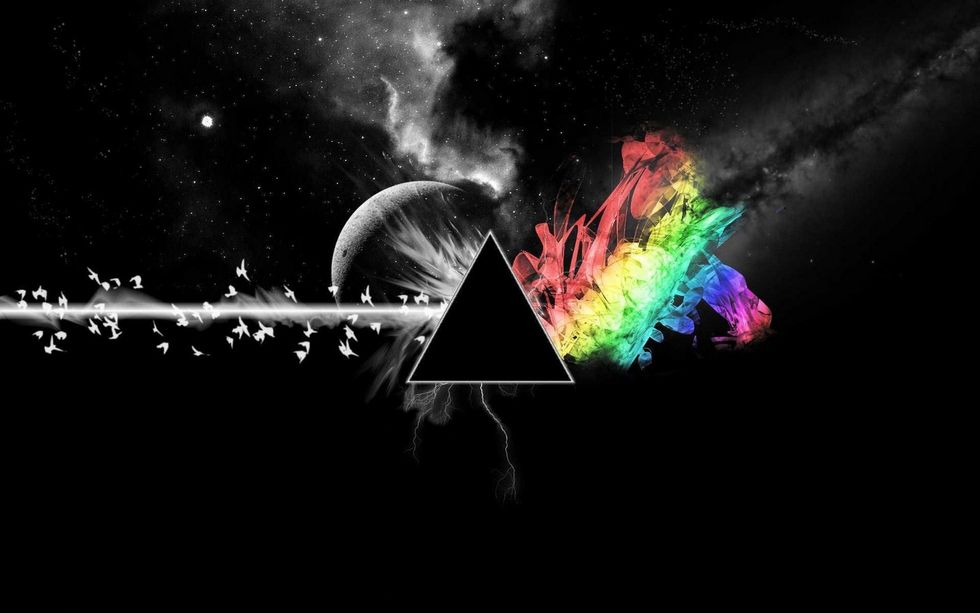
Regardless of your nationality, age, and interests, I have no doubt you are familiar with the following image.
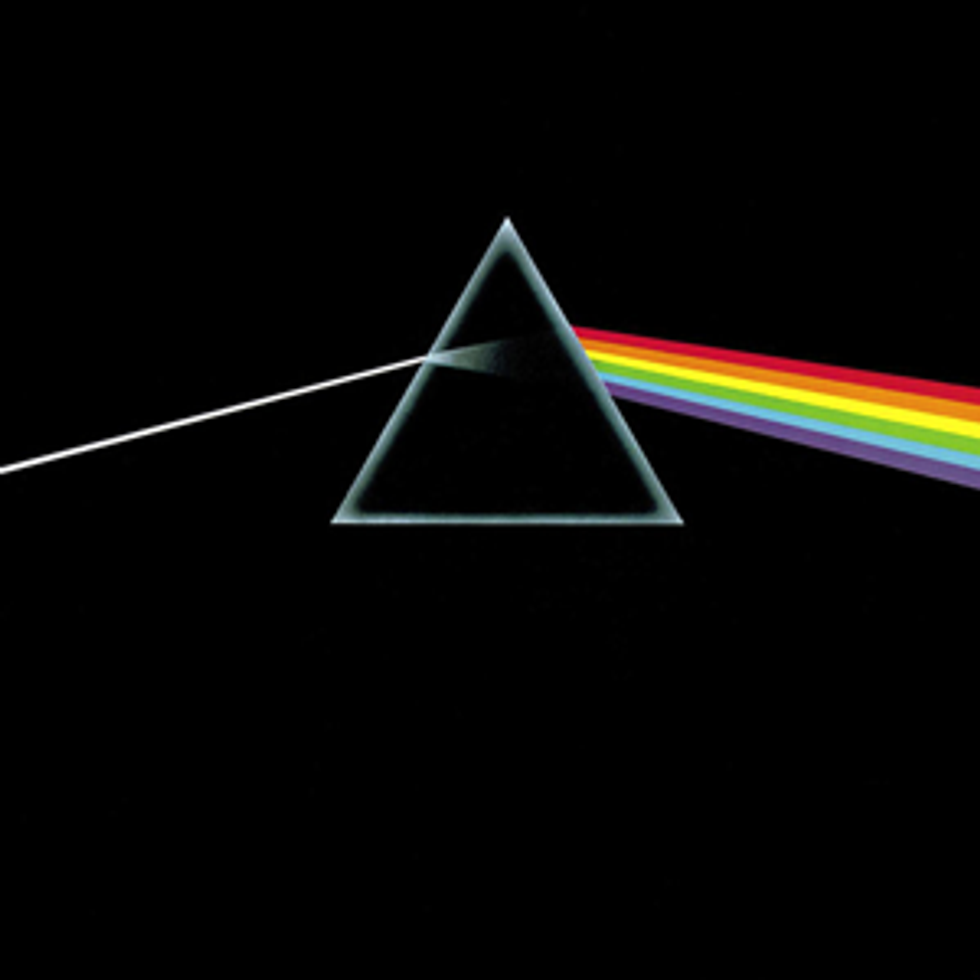
This symbol makes its way onto posters, t-shirts, and popular media with little to no explanation. It is simple, a prism upon a black backdrop, converting a beam of white light into a rainbow. This symbol serves as the cover art for one of rock's most progressive and astonishing albums, Pink Floyd's The Dark Side of the Moon.
While most are familiar with the title, not too many have heard a single song from it, let alone sat down and contemplated each song, nor the meaning of The Dark Side of the Moon. However, as most progressive rock fans know, Pink Floyd's concept albums are arranged in such a way that every seemingly insignificant detail plays into the larger picture. Today, we're going to discuss each detail, and how each one contributes to what The Dark Side of the Moon is and means. If you have not listened to the album in full, I would recommend you do so before or during your reading of this article, as it may help you to gain a better understanding of the overall atmosphere of the album. This is the first installment in a series of three articles, this one over analyzing Side A, the second, Side B, and the final one discussing the meaning of the madness. Keep calm and Breathe, my friends, as it's Time for Us and Them to take a journey to The Dark Side of the Moon.
Speak to Me
When you first set the needle onto the black void of a record (or click the Play button; I won't judge), it's likely you won't hear much for quite some time in. However, if you listen closely, you'll hear a deep, pounding heartbeat as soon as the album starts. This is a sound you will come to know for the duration of the album, as it is a continuing theme. After this, the ticking of a clock can be heard, cash registers chime, and you are met with a few spoken quotes muffled by the sounds:
“I've been mad for f***ng years, absolutely years. I've been over the edge for yonks. Been working with bands so long, I think. Crikey...”
“I've always been mad, I know I've been mad, like the most of us are. It's very hard to explain why you're mad, even if you're not mad.”
As the chaos ensues, as it crescendos, you are finally met with a scream, which leads you into...
Breathe
Ah, much better! Rather than the strange, ambient noise you are met with a pleasant (although rather psychedelic) instrumentation. The first (sung) lyrics in the song are as follows:
“Breathe,
breathe in the air
Don't be afraid to care
Leave but don't
leave me
Look around and choose your own ground”
Not much sense can be made out of it, similarly to the following verse:
For
long you live and high you fly
And smiles you'll give and tears
you'll cry
And all you touch and all you see
Is all your
life will ever be
These lyrics invoke a sort of existential theme, but nothing literal nor concrete can be made out of them.
Run,
rabbit, run
Dig that hole, forget the sun,
And when at last
the work is done
Don't sit down, it's time to dig another one
This is when the lyrics seem to take a morbid and hopeless turn. The rabbit must constantly work without stopping, leading a bleak and restless life.
For
long you live and high you fly
But only if you ride the
tide
And balanced on the biggest wave
You race toward an
early grave.
This final verse seems to illustrate that such a lifestyle that the rabbit leads, of constantly hurrying, will only hurry him to his death. Perhaps, “Breathe” is an ironic title, as it seems as though the rabbit has barely enough time to do so.
On the Run
If the idea of leading a life such as the rabbit's frightens you, this song will surely not make your favorites. On the Run is simply a collection of pounding synthesizer beats behind recorded sounds of an airport, including (but not limited to) heavy footsteps, panting, planes taking off, and a woman speaking over a public address system. This song heavily invokes the feeling of being late for a flight, and was intended to induce anxiety in listeners. Surely, if the rabbit were a human rather than a allegory, this would be a document of his daily life.
"Live for today, gone tomorrow, that's me...”
Time
As
soon as On the Run ends, you'll instinctively begin to turn up the
volume to hear the sound of clocks ticking. If you haven't yet
listened to this song, I would advise you to do the opposite and turn
the volume down, for as soon as the clocks stop ticking, loud,
startling alarms and chimes begin to ring out, certainly startling
any unfamiliar listener. Once this auditory assault is complete, the
song begins an ominous piano-and-percussion ensemble that lasts for
approximately two minutes. Soon after, the guitar kicks in, and
you're hit with your first verse.
“Ticking
away the moments that make up a dull day
You fritter and waste
the hours in an offhand way.
Kicking around on a piece of ground
in your home town
Waiting for someone or something to show you
the way”
Notably less subtle than the lyrics of “Breathe”, “Time” seems to encompass a similar theme: the wasting of time.
“Tired
of lying in the sunshine staying home to watch the rain.
You are
young and life is long and there is time to kill today.
And then
one day you find ten years have got behind you.
No one told you
when to run, you missed the starting gun.”
Anyone who claims they've never been startled at the revelation of their age is most likely lying. Time is fleeting, and such is a startling realization. You’re young, free, and have the rest of your life ahead of you. Then the next day is your 50th birthday.
“So
you run and you run to catch up with the sun but it's sinking
Racing
around to come up behind you again.
The sun is the same in a
relative way but you're older,
Shorter of breath and one day
closer to death.”
You desperately try to find the fountain of youth. Surely you can't be fifty! You try dying your hair, wearing trendy clothes, and caking your face with makeup, but nothing can stop it; it's irreversible.
“Every
year is getting shorter never seem to find the time.
Plans that
either come to naught or half a page of scribbled lines
Hanging
on in quiet desperation is the English way
The time is gone, the
song is over,
Thought I'd something more to say.”
You're not alone; everyone feels this way. You do, and I do. However, it remains unspoken of. You're terrified, knowing that nothing can stop the flow of time, and you have to face this without the support of billions of others, facing the same, unmentioned fear. After all, it is the English way.
The Great Gig in the Sky
Time never did stop for you, and, helpless to your constant aging, your body fell frail and weak, and you died. You have made it to The Great Gig in the Sky.
Lacking lyrically but still excelling vocally, this song is sung by Clare Torry, an English vocalist. Rather than singing choppy words, she utilizes her voice as an instrument, flowing with the sound of the instrumentals and singing no words at all. Rather, she grieves for your death in an unspoken, yet genuine way. On your journey through death, you hear some voices in the distance.
“And I am not frightened of dying. Any time will do, I don't mind. Why should I be frightened of dying? There's no reason for it – you've got to go sometime.”
“I never said I was frightened of dying...”
All this time, you were frightened for no reason at all. Your fate was inevitable, and there is beauty in it. As your body fuels the birth of vegetation from beneath the ground, you transcend into The Great Gig in the Sky, awaiting your next adventure. Surely, you will use your time well.
The record falls silent, the needle popping as it weaves through the near-microscopic grooves, before you are engulfed in thick nothingness, left only to contemplate what you've just experienced. Side A has ended, but The Dark Side of the Moon is a vast one, and you know your journey has only just begun.