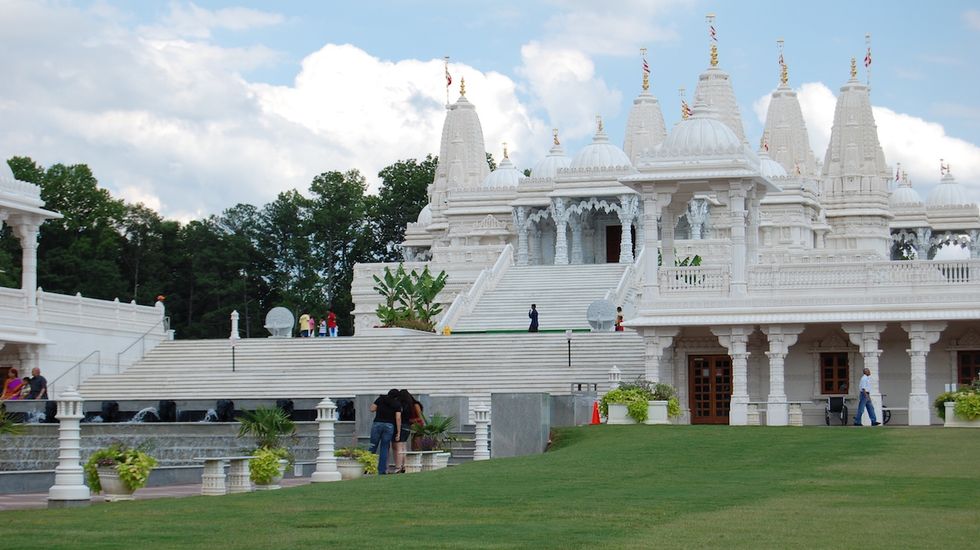
About a week ago (at press time), I went to a Hindu temple in Lilburn, Georgia, a suburb of Atlanta.
The BAPS Shri Swaminarayan Mandir is the largest mandir, or temple, in North America, and the tallest building in Gwinnett County. Ideally situated in a region with a sizeable Indian immigrant population, the mandir is truly an architectural marvel that no Western architect would dare dream. Inside, however, lay some surprising revelations that even I never expected.
Ever since my beginnings as a Christian intellectual, I have always wanted to visit a place of worship outside of Christianity to broaden my understanding. Not being in possession of a driver’s license, I always gazed longingly at every mosque, synagogue and mandir I passed, wondering what secrets about God’s character—be they real facets of him or human interpretations of those facets—lay within.
At about this same time last year, for the first time, the entire World Religions class at my school went to the mandir in Lilburn, about 15 minutes away. I heard their stories of awe and wonder—some of the cultural practices weirded them out (there are no practicing Hindus at my school that I am aware of, at least not in the high school), but they were impressed deeply by what they had seen. At the time, I knew next to nothing about Hinduism, but I became excited and thus selected World Religions as my Bible course for next year in the hopes that we would go back.
Obviously, we did. My teacher is an experienced missionary (he even accompanied me internationally on a mission trip) and has extensive experience traveling the Indian subcontinent—in fact, he circumnavigated the globe in summer 2016 with his oldest son and spent the bulk of his travels in India, where he actually ate beef (yes, cow’s meat) and lived to tell the tale. There is no one in the entire school more knowledgeable about Hinduism and Indian culture than he is. As a result, learning the true meaning of the word yoga (any devotion in Hinduism), the different forms of puja (how this devotion is practiced), the difference between Vedic, Vedantic and Bhakti (like Protestant, Catholic and Orthodox), and the concept of the avatar (different gods having different forms) was a lot more interesting coming from someone with real experience in the field. As such, he had connections to the mandir and arranged for 107 people (98 students and nine teachers)—about 20 percent of the student body and 10 percent of the faculty—to have a guided tour.
We arrived at the mandir, and I was at first unimpressed. It looked just like it did in the pictures. We got a photo taken on the steps, then put up our cameras and shoes. Our guide thanked and welcomed us, gave us a few unsurprising ground rules, and then, we entered the mandir.
It was incredible.
I’ve been to massive Catholic cathedrals and gazed at the art that went into their building, yet if they had been built anything like a Hindu temple—the sheer beauty and efficacy would be indescribable. Granted, the structure was completed 10 years ago, making everything seem like it had been built yesterday. But trust me when I say, these temples are insanely complex, and somehow still built to last. The mandir is 34,000 blocks of Turkish sandstone and Italian marble, mined in those countries and then shipped to India for carving. About a million man-hours were put into this carving, as artisans from around India worked for months, sometimes more than a year, to craft each piece. Each is entirely unique, not just in the gods, figures, and symbols that grace it, but also in where it goes.
The mandir’s design was planned to the T, with each carved block receiving a number corresponding to its location on the blueprint. This is because these blocks do not solely serve an aesthetic purpose—there is no steel anywhere in the mandir. It is constructed entirely of stone, weighing 123,000 tons, with individual blocks weighing as much as eight tons locked and counterbalanced perfectly, with no replacements. In the incredibly unlikely event that the mandir were to be damaged in the slightest, an entire reconstruction would be necessary because of the way the stones are linked. The guide, a volunteer at the mandir, said that the stones served yet a deeper symbolic purpose: different people setting aside their differences for the glory of God.
If you’re not Hindu, you’re probably wondering at this point why I didn’t say “the gods.” That is because almost any generalization non-Hindus make about Hindus is false. Among those is that Hinduism is a polytheistic religion, which is patently false, depending on who you ask. In fact, many Hindus believe that there is just One, represented by the holy sound om, and that everything that exists, including powerful deities like Brahma the Creator, Vishnu the Sustainer and Shiva the Destroyer, is connected to this One. This struck a chord with me, as I thought about Christianity and how much of a challenge ecumenism is, as opposed to in Hinduism, where almost any belief goes. Some Hindus, upon being “converted” to Christianity, accept it right away, as to them, the story is just another version of their own stories.
At any rate, while I walked around and stared at the murtis, or idols, I could not help but feel the presence of God.
It was the murtis’ lunchtime, and as the guide put the caste system lightly, I watched as each murti was given a plate of food before the door to their respective shrine within the temple was shut. The guide had told us that at other mandirs, food and water had disappeared after being offered. I knew what this meant: there was reason for Hindus to believe in their God. I’ve heard of miracles in Christianity, so I knew that, whether through God or Satan, something supernatural was at play. And as he spoke, I became more in tune with the presence of God in that place. It was as if He were reaching out to his people, even if they did not think of Him in the same way. It was a feeling I hadn’t expected. I expected the place to be more like a museum, where you looked around and were impressed, but never really had a spiritual experience. Instead, I was confronted with a surprising reality: that Hindus are more like Christians than we think.
Our trip to the mandir ended with an informational video. In it were descriptions of various acts of charity performed in the name of selflessness—not to the glory of anyone, not even God Himself. It was beautiful seeing that Christians are not the only ones who do charity, but disheartening to see it done for the sake of so doing, for then, it was no different than secular charity. Yet that did not diminish my love and appreciation for Hinduism.
In short, we are like the mandir.
Despite our differences, it is time to come together and realize that, although we interpret Him differently, we all love and worship the same God, the greatest unifying force in the universe. The only real difference is that most Hindus just don’t realize that God is more than just the sum of everything—He is infinite. They say that some infinities are bigger than others, and thus the infinity of God is greater than our infinite, ever-expanding universe could ever be. And He doesn’t just create, sustain, and destroy—He loves and forgives, and He calls us to do the same.
There is no karma—there is only love and hate, and all our debts are paid in full with interest by Jesus’ blood. I know we don’t do a great job of living a non-karmic lifestyle—I can personally testify to that effect—but Jesus, working through us, is the only way to true moksha, where all of humankind enjoys happiness for all eternity.