. . .
If you're a female and love music, you'll want to read this. If you're not a female and hate music, you'll STILL want to read this. Trust me, on this one!
When you listen to music, do you actually pay attention to the lyrics? For my ENGL394 course, I conducted a socio-linguistic research study in hopes to answer my inquiry question: "How do song lyrics in pop culture promote female empowerment and contribute to the feminist movement?"
Project Design:
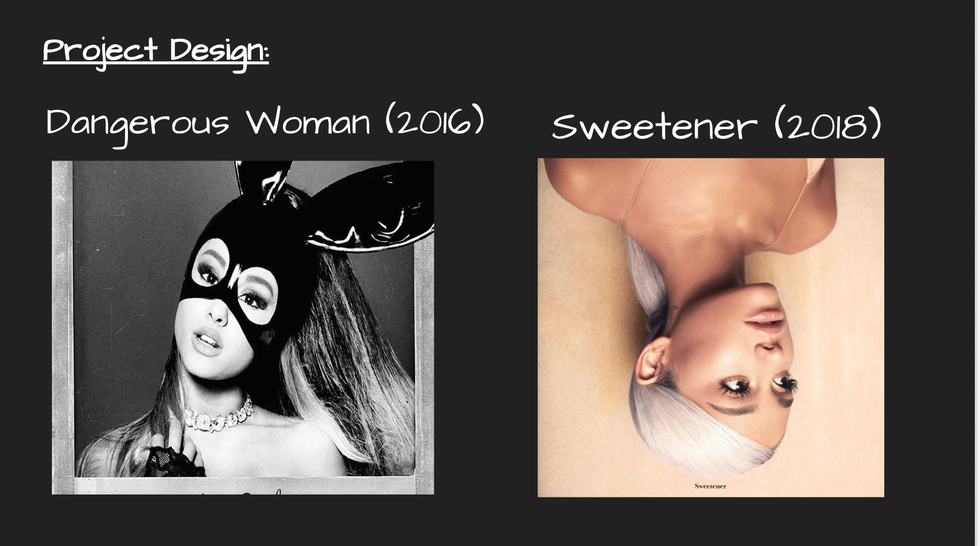
For my project, I was particularly interested in researching Beyoncé and Ariana Grande. Although I am biased and adore both artists, I was interested in finding out if other collegiate women felt as empowered as I do when listening to their songs. First, I picked two Ariana Grande songs; I tried to pick an older song and a more recent song. I picked "Dangerous woman" off of Ariana's album "Dangerous Woman" from 2016. Then, I picked a more recent Ariana Grande song, "God is a Woman," off of her album "Sweetener" from 2018.
Project Design:
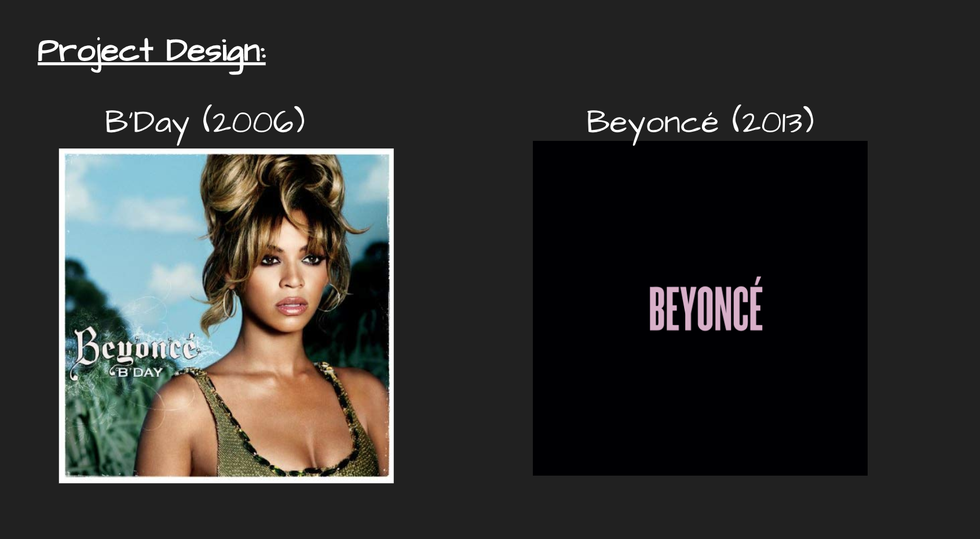
Then, I picked two Beyoncé songs. Again, I tried to pick an older song and a more recent song. First, I selected "Freakum Dress" from Beyoncé's album "B'Day," from 2006. Then, I picked "pretty hurts" from Beyoncé's 2013 album "Beyoncé."
Research Methods / Data Collection

In order to conduct my research, I decided to extend my survey to collegiate females. I used survey monkey (https://www.surveymonkey.com/user/sign-in/ ) to create my survey. My survey consisted of ten questions; nine short-response questions, and one multiple-choice question, which asked my respondents to note their demographic background. The remaining nine questions asked my respondents to define the word "feminist" in their own terms and to listen to each of Beyoncé's and Ariana Grande's songs. Subsequently, after listening to each song, respondents were asked to explain if the song made them feel empowered, or not, and to justify their response. If respondents did feel empowered, they were asked to note the song lyrics that stood out to them.
After weeks of extending my survey to friends, classmates, and friends of friends, I only received twenty-one respondents :( Although I was aiming for fifty respondents, I am grateful for my diverse sample of twenty-one collegiate females who had taken the time to answer my survey.
In order to organize my data, I compiled all of my respondent's answers onto a google spreadsheet. I used the A column to keep track of each respondent's number, and the horizontal columns in A-K to label each question from my survey. Then, I copy and pasted each respondent's answers to my questions, in the spreadsheet, and color coated their responses.
Here's what I found!
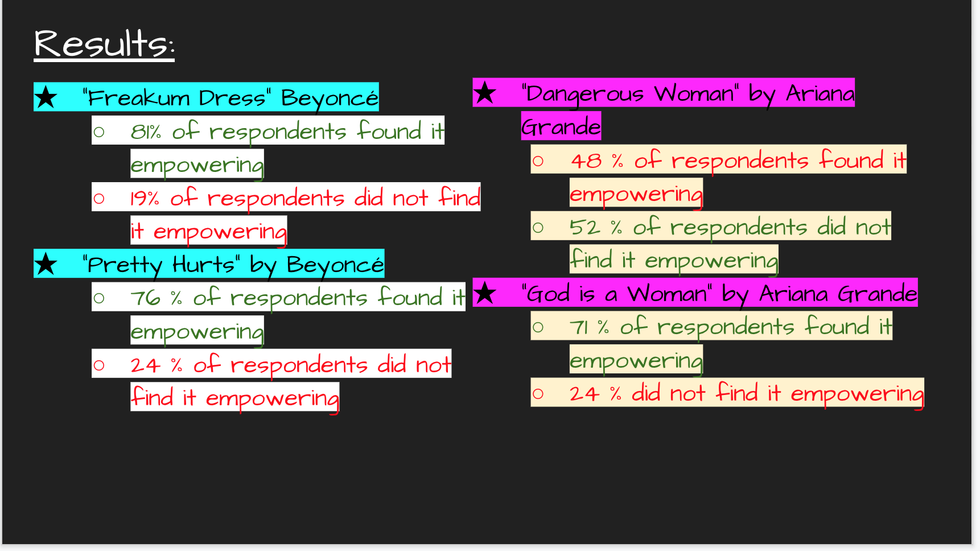
So... basically, in my study, a majority of respondents found Beyoncé's songs to be more empowering than Ariana Grande's.
Further analysis
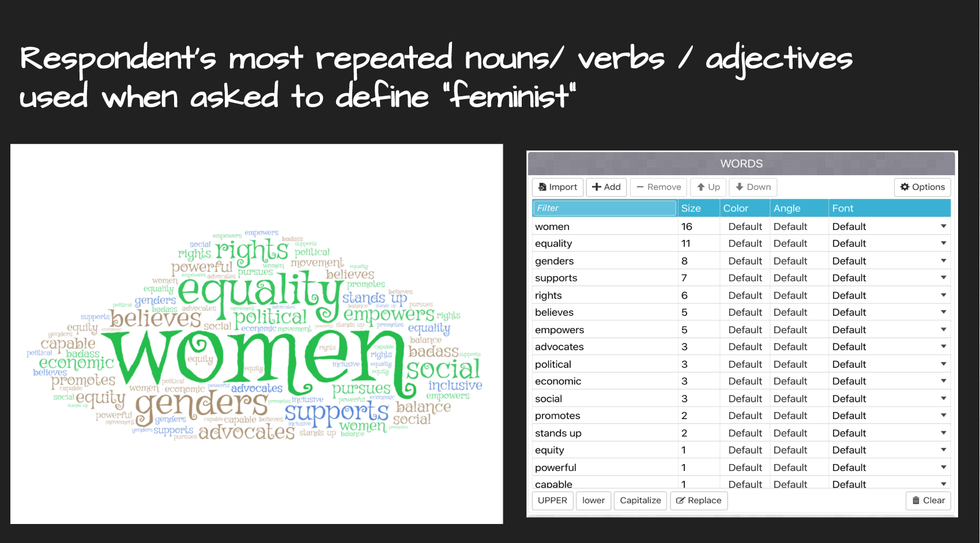
I decided to dig deeper and compared the nouns, adjectives, and verbs that my respondents used to define the word "feminist," to the lyrics that my respondents had included based on the songs that they found to be empowering.
I used https://wordart.com/create to create "wordles," which are images that are built based on words. I made sure that each word appeared in different colors, and used the "size" column to represent the number of times each respondent had mentioned the noun/ verb/ adjective in their response. Therefore, the most frequent words appeared to be the biggest.
As seen in the image above, I made a wordle to portray the most frequent nouns/ verbs/ and adjectives that respondents used to define "feminist."
More Analysis
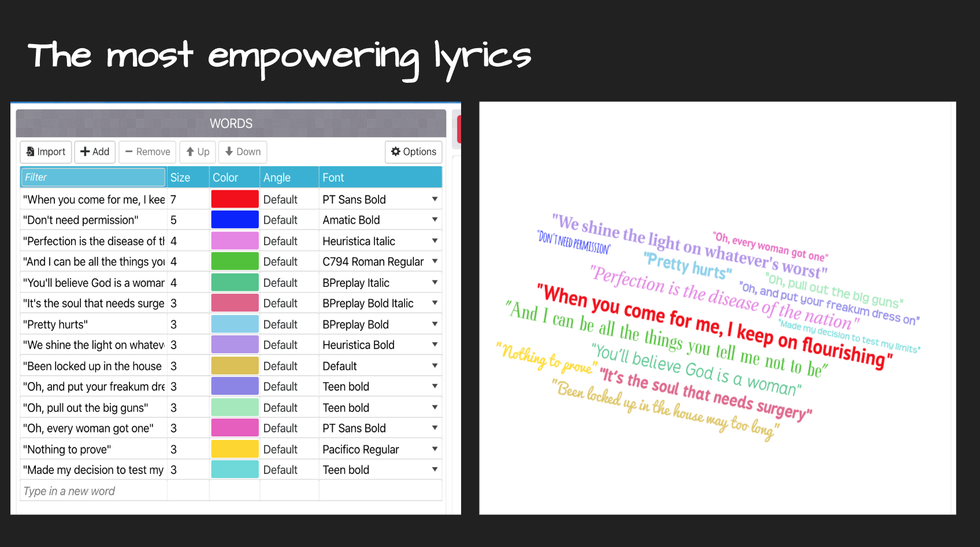
I repeated the same analysis process and created individual wordles for both of Ariana Grande's, and Beyoncé's songs. Then, I scanned each of Beyoncé and Ariana's individual wordles and compiled all the lyrics with the highest frequencies into a new wordle.
The final analysis
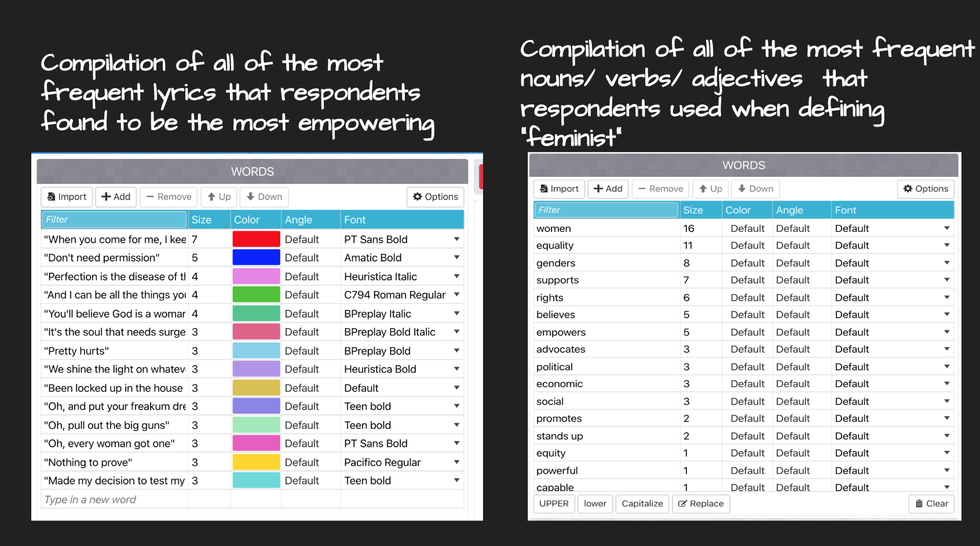
Finally, I put the accumulation of the most frequent song lyrics, side by side, next to the compilation of the most frequent nouns/ verbs/ adjectives that respondents used when defining "feminist." After looking at the two charts side by side, I was able to formulate my final conclusions. The common thread became explicit after I bridged the gap between the most frequently noted lyrics, and the most frequent nouns, verbs, and adjectives that respondents used to define the term "feminist."
Here are the results folks!
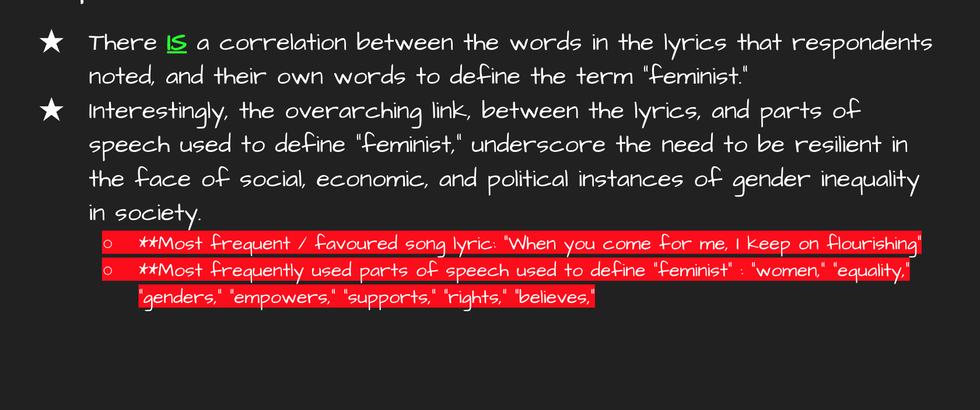
Implications of my results
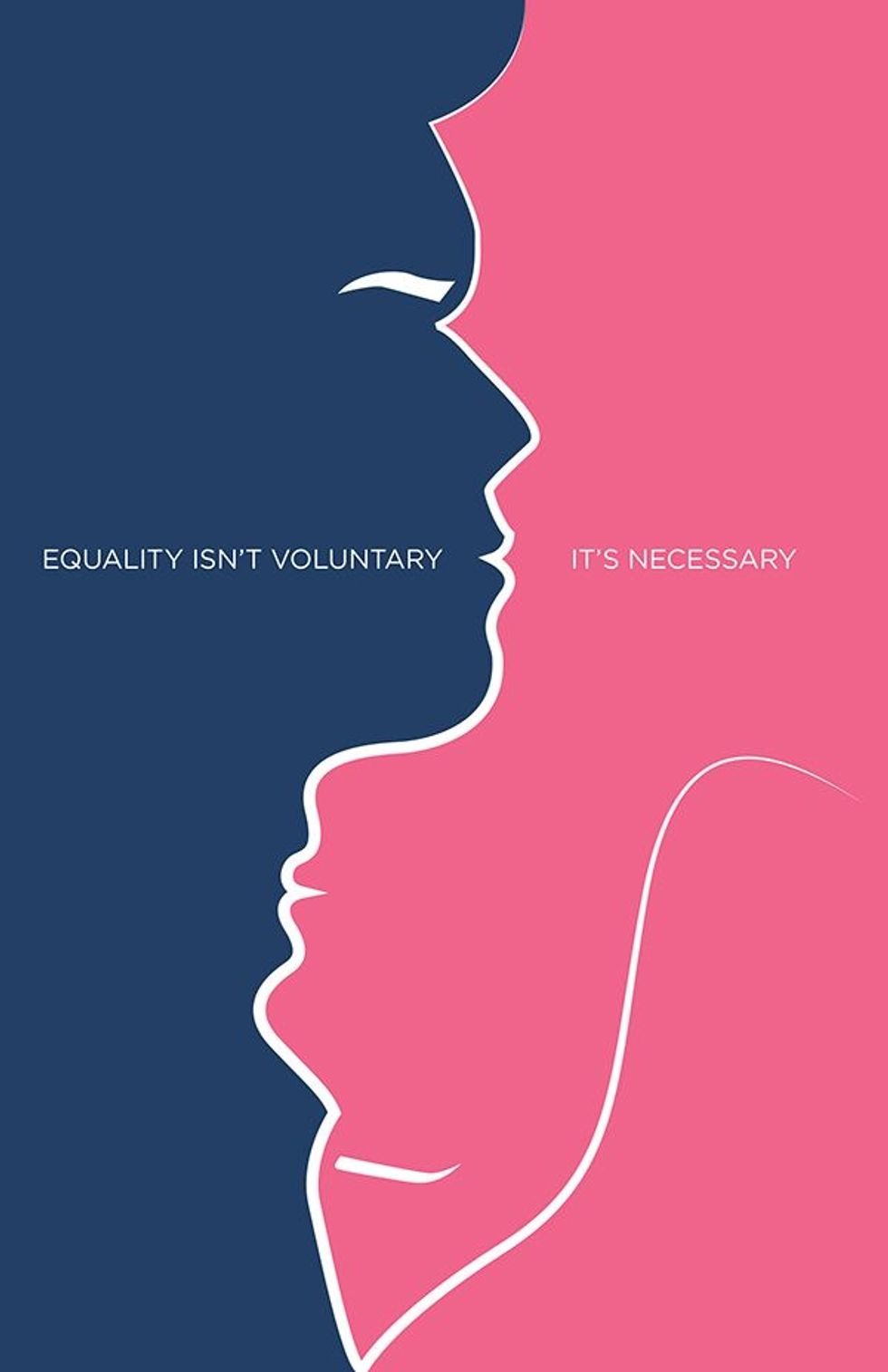
Photo credit to: https://www.pinterest.com/pin/170855379593920170/?lp=true
My results revealed that music serves as a proactive platform to shed light on social justice issues, such as gender inequality.
Although I only surveyed collegiate women, the results of my study are significant for all women because they serve as an outlet to inspire woman to empower each other. Especially in this day of age, it is monumental for women to band together in the face of social, political, and economic adversity. Influential artists, such as Ariana Grande and Beyoncé, serve as crucial role models that have done an outstanding job promoting the feminist movement. Despite their fame, they have used their power to their advantage. The fact that Beyoncé and Ariana Grande have used their music as their outlet to remind women that they are not alone, speaks volumes of how pivotal it is for women to band together.
Too often, women conform to meet unjust standards that society has set.
Too often, women feel insecure, and worthless as a result of society's beauty standards.
Too often, women let their worth be determined by their romantic partner.
However, songs such as Beyoncé's "Pretty Hurts," "Freakum Dress," and Ariana Grande's songs "Dangerous Woman," and "God is a Woman" call out society, and redefine what it really means to be "pretty."
Women can do anything that a man can do, and that is wholeheartedly, the damn truth.