

“[I]f every instrument could accomplish its own work, obeying or anticipating the will of others, like the statues of Daedalus, or the tripods of Hephaestus…if, in like manner, the shuttle would weave and the plectrum touch the lyre without a hand to guide them, chief workmen would not want servants, nor masters slaves."
-Aristotle, Politics IV:I
Throughout human history, the majority of humanity has had to work in agriculture in order to survive. But 200 years ago, that all changed. The ability of machines to do the work of many humans freed these people from their work, allowing them to pursue other occupations. Now the percentage of humanity working in agriculture has dropped to less than 7 percent in most developed countries.
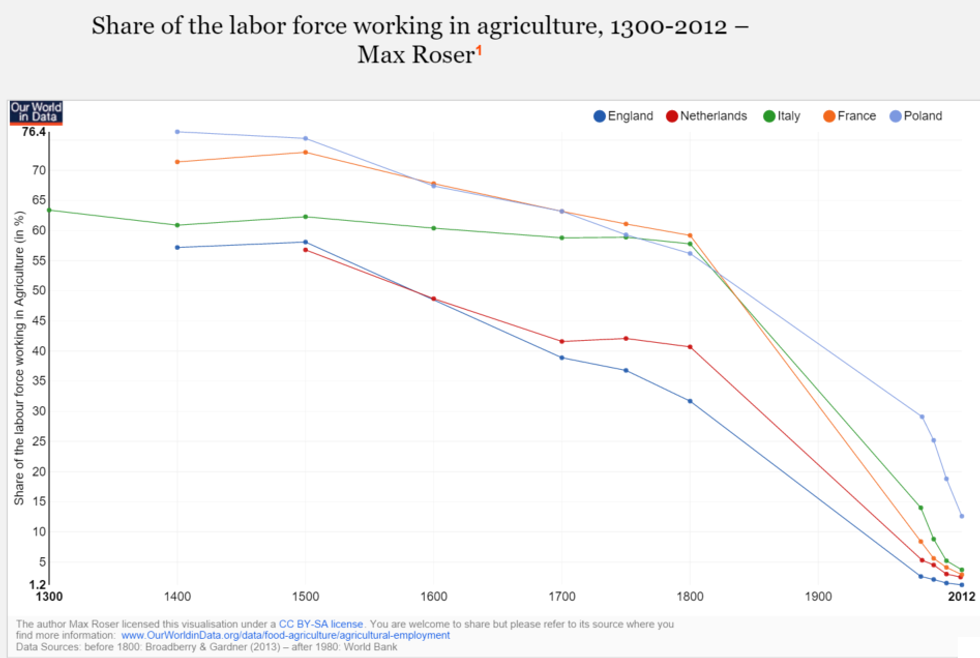
However, I am not writing a history lesson. I am giving you a warning that what has happened in agriculture will repeat itself with most occupations in the next 100 years. Due to the rise of technology, a large percentage of the labor force will find themselves replaced by machines, at least in industrialized nations such as the United States. Previously, people whose jobs were automated have been able to find work in other sectors of the economy. That is no longer the case.
Soon, it will become unrealistic to expect every person in the population to work for a living. Working for pay will no longer be a necessity – it will be a privilege.
The reason for this is fairly simple, albeit highly difficult for many people to accept. In jobs that hire the most people, human labor gets more expensive for the same productive output over time. In contrast, automated labor (using computers and robots) gets cheaper and more efficient over time. While this has technically been true throughout history, we are only now starting to see it have a significant impact on the economy.
Many have argued that technology will always create more jobs for people to replace the jobs that it makes unnecessary. They say that technology will only automate the jobs that people don’t want to do anyway, freeing those people up to work at more comfortable and pleasant jobs. CGP Grey does an excellent job of describing the flaws in their thinking in his documentary "Humans Need Not Apply":
"Imagine a pair of horses in the early 1900s talking about technology. One worries all these new mechanical muscles [such as cars] will make horses unnecessary.
The other reminds him that everything so far has made their lives easier⎯ remember all that farm work? Remember running coast-to-coast delivering mail? Remember riding into battle? All terrible. These city jobs are pretty cushy⎯ and with so many humans in the cities, there are more jobs for horses than ever.
Even if this car thingy takes off you might say, there will be new jobs for horses we can't imagine…
But you, dear viewer from beyond 2000, know what happened⎯ there are still working horses, but nothing like before…There isn’t a rule of economics that says 'better technology makes more, better jobs for horses.' It sounds shockingly dumb to even say that out loud, but swap 'horses' for 'humans' and suddenly people think it sounds about right.
As mechanical muscles pushed horses out of the economy, mechanical minds will do the same to humans. Not immediately, not everywhere, but in large enough numbers and soon enough that it's going to be a huge problem if we are not prepared. And we are not prepared.”
That example, while eloquent, does not prove that humans are being pushed out of the economy and will continue to be pushed out at an increasing rate. The following examples do.
The relationship between new technology and new jobs has changed fundamentally in the past couple of decades. In their article "It's a Man vs. Machine Recovery," Bloomberg Business explained that "the classic relationship between rising output and rising employment—known as Okun’s Law—now appears to be broken. If the law, which postulates that every 3 percent gain in output should reduce the jobless rate by a percentage point, still applied, then today’s nearly nine percent rate would be about one percent."
Okun's law predicts that U.S. employment and productivity should be tied together despite economic circumstances. Up until the turn of the century, it held up with a fair degree of accuracy. However, that is no longer the case.
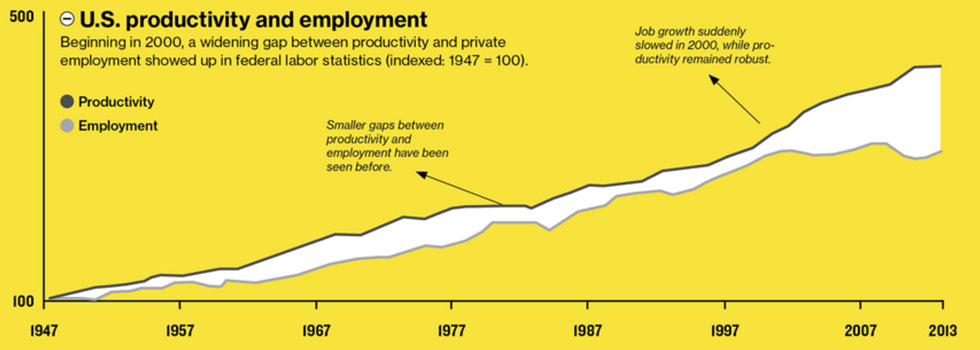
This is one reason why the automation revolution, or the "Second Machine Age", is not the same as other technological revolutions in the past such as the Industrial Revolution. The Industrial Revolution created as many jobs, if not more jobs, than it nullified. The automation revolution will not.
As economist Andrew McAfee pointed out in his first TED Talk on the subject ("Are droids taking our jobs?"), we can see this happening right now. As in, right now right now⎯ referring to our economy's recovery from the Great Recession and the workers' lack thereof: "Corporate profits are quite high; in fact, if you include bank profits, they're higher than they've ever been. And business investment in gear⎯ in equipment and hardware and software⎯ is at an all-time high. So the businesses are getting out their checkbooks. What they're not really doing is hiring."
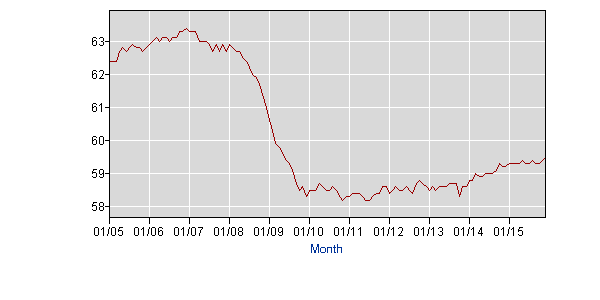
"So this red line is the employment-to-population ratio, in other words, the percentage of working-age people in America who have work. And we see that it cratered during the Great Recession, and it hasn't started to bounce back at all...the government's projection for the working-age population going forward...[shows] that [the] gap is not going to close."
The New York Times has also commented on the effect of automation on the recovery in their article "More Jobs Predicted for Machines, Not People": "A faltering economy explains much of the job shortage in America, but advancing technology has sharply magnified the effect, more so than is generally understood, according to two researchers at the Massachusetts Institute of Technology...they were originally going to write a book titled, "The Digital Frontier", about the 'cornucopia of innovation that is going on,' ... Yet as the employment picture failed to brighten in the last two years, the two changed course to examine technology’s role in the jobless recovery."
"The authors are not the only ones recently to point to the job fallout from technology. In the current issue of the McKinsey Quarterly, W. Brian Arthur, an external professor at the Santa Fe Institute, warns that technology is quickly taking over service jobs, following the waves of automation of farm and factory work. 'This last repository of jobs is shrinking — fewer of us in the future may have white-collar business process jobs — and we have a problem,' Mr. Arthur writes."
Not only do we have a problem now, but that problem will grow exponentially in the near future.
Several recent projections have been made as to how much of an impact automation will have on the economy of the United States based on the current trends. Gartner Inc., “the world's leading information technology research and advisory company,” has predicted that "robots will take over 30 percent of our jobs by 2025⎯ and white collar jobs aren't immune," as the headline of this Business Insider article exclaimed [emphasis added]. The article further described that "[a]rtificial intelligence and robots are not just challenging blue-collar jobs; they are starting to take over white-collar professions as well. Financial and sports reporters, online marketers, surgeons, anesthesiologists, and financial analysts are already in danger of being replaced by robots."
According to a recent survey by Pew Research Center, nearly half of the 2000 experts surveyed in the artificial intelligence field believe that technology will remove more jobs than it creates as soon as 2025. However, "[a]lmost all of the respondents are united on one thing: the displacement of work by robots and AI is going to continue, and accelerate, over the coming decade."
To figure out how much of an impact automation technology will really have, Dr. Carl Benedikt Frey (co-director of the Oxford Martin Programme on Technology and Employment at the Oxford Martin School, and economics associate of Nuffield College, both University of Oxford) and Dr. Michael A. Obsorne (associate professor in Machine Learning, an official fellow of Exeter College, and a faculty member of the Oxford-Man Institute for Quantitative Finance, all at the University of Oxford) published a 72-page study called "The Future of Employment," estimating the probability of the 700 most common occupations being computerized in the foreseeable future.
The Oxford researchers found that automation could easily wipe out as much as 47 percent of U.S. employment as early as 2033. It would be unfair not to point out that the key words in that sentence were "as much as" and "as early as," since their estimations were based on probabilities. However, I will take this opportunity to remind you that the unemployment rate during the Great Depression was 25 percent, the highest in our nation's history. If you are curious about the jobs most and least at risk of being automated according to the Oxford study, check out this article by This Is Money that lists the top and bottom 100 occupations most likely to be automated (ranging from 0.01 percent to 99 percent likely), or this article by Business Insider that covers the subject more concisely.
For those jobs, technological advances have made it more practical to use a machine than to hire a human, since human workers not only cost more but frequently require such things as lunch breaks, sleep, paid leave, insurance, and flexible schedules. The point will soon arrive when, for a significant percentage of American jobs, employers would have to be downright stupid to hire a person because a machine could do the job better and more quickly for less money.
Over the next few weeks, I will write several more articles on this topic. Citing a variety of examples from many areas of the labor force, I will show not only that automation is pushing humans out of the economy at an increasingly rapid pace due to new technologies, but that this is a beneficial advancement in the history of humanity. I will discuss the implications for the future of our economy and our society, and I will paint a picture of a future where humanity can finally be free from its eternal burden of endless labor. I will explain why a future where a decreasing percentage of the population spends the majority of their lives toiling in order to receive virtual representations of green paper is a utopia, not a dystopia, and possibly the greatest state of human existence since the beginning of time.
For more information on this subject, check out some of the following resources:
CGP Grey's 15 minute documentary: "Humans Need Not Apply"
Andrew McAfee's TED Talks: "Are droids taking our jobs?" and "What will future jobs look like?"
Michael Hendrix's "The Robots Are Coming" short article series from the U.S. Chamber of Commerce Foundation: "The Revolution Has Begun," "Automated Workforce," and "Smart Machines and the GDP"
Marshall Brain's articles: "Robotic Nation," "Robots in 2015," and "Robotic Freedom," along with his blog "Robotic Nation Evidence" and his fiction novel "Manna"






 man running in forestPhoto by