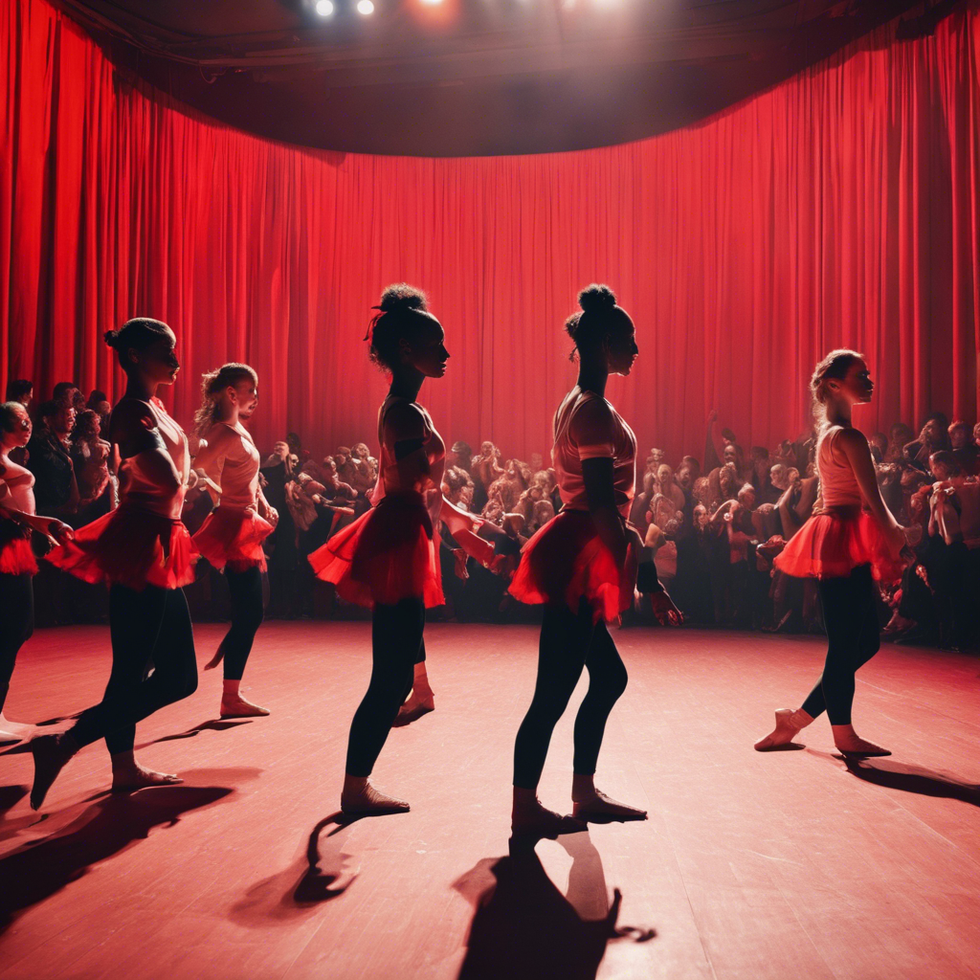
I'll start of with the definition of athlete, according to Merriam-Webster Dictionary, “a person who is trained or skilled in exercises, sports, or games requiring physical strength, agility, or stamina.” For starters, dancers have to have all three, physical strength, agility, and stamina in order to be successful in what they do. The physical strength that dancers have is incredible. There are many parts of dance that keep dancers fit and strong so that they are able to complete what they are supposed to with ease. Such as, extending and holding your body in positions, and during those you have to hold your entire body, which means engaging and being aware of every muscle in your body when dancing. Dancers have more of a slim and toned build because of how the muscles are being worked during practices. A study done on professional female dancers found that they have 12%-17% body fat and male dancers have 6%-7%. Which means that most of their body weight is muscle weight.
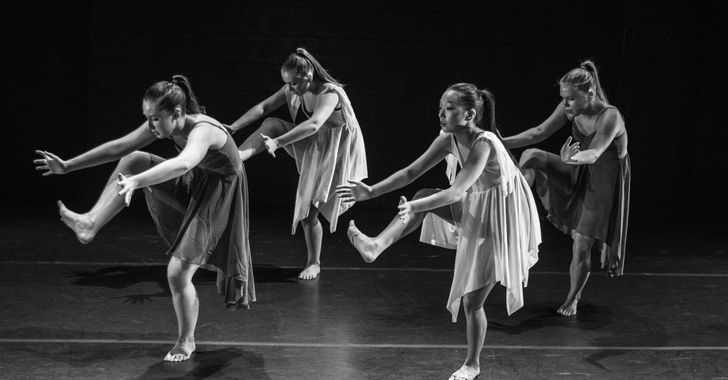 four women dancing grayscale photography Photo by ketan rajput on Unsplash
An example of a move that requires a lot of physical strength a leap. You have to take steps into it with strength and determination, and then when you plié (a controlled bend of the knees) and push off the group you have to use all of your strength to get high so you can totally complete the move. Even more so in slow movements you need to have strength, an example for this would be to developé your leg and holding it there. This requires a lot of core and leg strength but they must still be engaged in every other muscle.
The next two parts of the definition are agility and stamina. Two qualities dancers must have. Dancers have agility because they have the ability to be quick on their feet but yet graceful at the same time. It takes a certain amount of talent to be able to move how most dancers do.
In fact, many professional football players take ballet classes to help them perform better in their sport. One example is “Lynn Swann, a former Pittsburgh Steeler and 2001 inductee in the Pro Football Hall of Fame, who claims that his ballet training greatly improved his athletic skills and helped him become a better football player.” And according to, heathyliving.com, “Dancers develop quick, sharp minds and fast footwork. They learn to transfer their weight effortlessly and find their new center of balance instantly, skills that translate into quick and accurate starts and stops on the playing field."
Lastly, stamina is a huge part of dance because dancers throw everything they’ve got into their performances. They have turns, leaps, and jumps that all need to have complete control and strength over them. It takes a lot of endurance to dance completely full out, especially multiple times in a row.
Dance Requires the Same Time Commitment as Recognized Sports
As you all know being in a sport takes up a lot of your time and you have to get really good at time management because of it. Dance is the same way. When I was in high school I danced 3 hours a night sometimes a little more than that and on top of that every once in awhile we would an 8 hour practice on the weekends. And I did this year round, even summers. Not only in the spring or fall.
Now, to compare the commitment of what is truly classified as a sport by many to dance. A professional dancer trains 5 to 6 days out of the week which would consist of a warm up in the morning, 4 to 6 hours of rehearsal in the afternoon, and a possible night class later in the day. Whereas the time commitment of a professional football player is quite similar. They train 5 to 6 days out of the week as well. They start off the day with by lifting in the weight room for about an hour and then they have a few meeting for a couple of hours, and after that is practice in the afternoon for about 2 hours. Professional football players also have game days every week during the season. As you can see, the time commitment is not that big of a difference between the two.
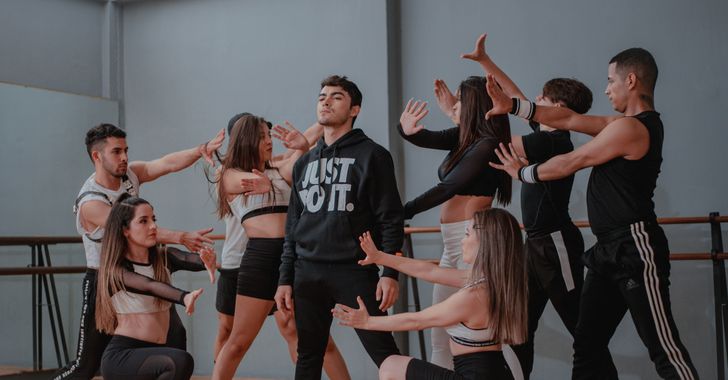 Photo by Miguel Ángel Hernández on Unsplash
Finally, one of the biggest reasons why many people don’t see dancers as athletes is because of competition. Sure, it’s true that many professional dancers don’t compete, they dance purely for entertainment purposes. However, many dance critics have described dance companies, like Rambert Dance Company,(a contemporary dance company founded in London in 1926, one of Europe's oldest dance companies)) as ‘elegant and athletic.’ For reasons that I stated before like their physical strength and agility.
The competition aspect of dance is a bit different from other typical sports. But it can somewhat be related to the sport of diving because you are judged on your technique and level of difficulty. However, there are many more things that go into judging dances, like choreography, skills, and execution. You compete against other dancers who are at the same age group or level and who are doing the same style as you. But at the end of the day there is a winner in each section and overall selected by judges.
I hope you now can see why dancers should be considered both artists and dancers. Dancers work so hard and should be regonzied for that. I’d like to end with a quote by dancer Shanna Lafleur, “It takes an athlete to dance but an artist to be a dancer.”
Frequently Asked Questions
Is dance considered a sport or an art? Dance is both. It satisfies the athletic definition — requiring physical strength, agility, and stamina — while also requiring artistic interpretation and expression. Most professional and competitive dancers are trained in both dimensions.
How does dance training compare to other sports physically? Professionally, dance training is comparable in intensity to sports like gymnastics, figure skating, and football. Professional dancers carry body fat percentages similar to those of elite athletes, and their weekly training hours match or exceed those of players in major team sports.
Do competitive dancers win based on skill or subjective opinion? Both, in the same way that diving, gymnastics, and figure skating are judged. There is a defined scoring rubric covering technical elements (strength, precision, difficulty) and artistic elements (choreography, execution). Judges are trained, and the criteria are applied consistently across competitors.
Why do some football players train in ballet? Ballet develops balance, proprioception (body awareness), explosive leg strength, and the ability to transfer weight quickly — all directly applicable to football movement. Players like Lynn Swann have credited ballet training with measurable improvements in their athletic performance.
What's the difference between a recreational dancer and a competitive dancer? Recreational dancers train primarily for enjoyment or performance. Competitive dancers train to meet specific technical and artistic standards judged against peers at the same age and skill level, with rankings and titles awarded.























 man running in forestPhoto by





 "I thought you knew what you signed up for."
 man and woman in bathtub
Photo by
man and woman in bathtub
Photo by  four women sitting on black steel bench during daytime
Photo by
four women sitting on black steel bench during daytime
Photo by  Uber app ready to ride on a smartphone.
Photo by
Uber app ready to ride on a smartphone.
Photo by  woman in red tank top and blue denim shorts standing beside woman in black tank top
Photo by
woman in red tank top and blue denim shorts standing beside woman in black tank top
Photo by  blue marker on white printer paper
Photo by
blue marker on white printer paper
Photo by  welcome signage on focus photography
Photo by
welcome signage on focus photography
Photo by  woman in white and black striped long sleeve shirt lying on bed
Photo by
woman in white and black striped long sleeve shirt lying on bed
Photo by  pink pig coin bank on brown wooden table
Photo by
pink pig coin bank on brown wooden table
Photo by  person holding iPhone 6 turned on
Photo by
person holding iPhone 6 turned on
Photo by  person holding pencil near laptop computer
Photo by
person holding pencil near laptop computer
Photo by  person slicing vegetable
Photo by
person slicing vegetable
Photo by