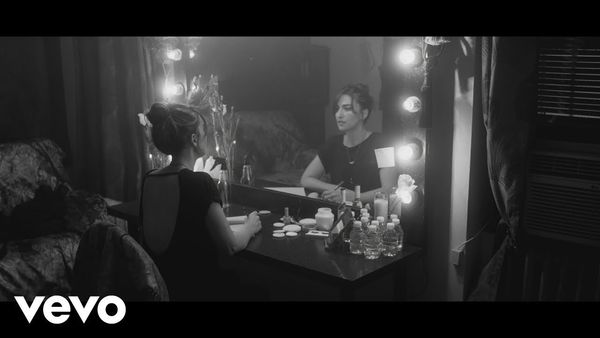


It is no secret that I’m a superfan of Florence Welch, songstress extraordinaire.
Welch's third studio album, "How Big How Blue How Beautiful," draws away from the fantastical imagery and booming vocals of her sophomore album, "Ceremonials," and the eclectic charm of her debut album "Lungs" - opting instead for a raw, simplistic approach.
Nine music videos were released for the album, and they were compiled into a short film directed by Vincent Haycock entitled "The Odyssey." I had the pleasure of seeing its exclusive New York screening in the East Village, which was followed by a live question and answer session conducted by Florence and Vincent themselves.
It may be interesting to note at this point, that Haycock recently confessed to turning down offers to work on some of the videos for Beyonce's controversial visual album "Lemonade." There should be no doubt as to why both Beyonce and Florence's teams wanted Haycock working on their visuals: the man has some serious talent.
"Delilah," the eighth chapter in "The Odyssey," attests to exactly how skilled Haycock really is. My favorite of the nine music videos, it depicts purgatory--a sort of no man's land between heaven and hell.
Where exactly is purgatory for Florence Welch? That would be a grungy old motel in LA.

"Delilah" opens with an old man bestowing some sage advice on love and forgiveness.
"You think you have lost your faith. But you have not. You have only misplaced your faith. You can't find it where it lies now-- deep in your soul. And the way to do that is through the simple process of love. LOVE yourself, FORGIVE yourself. You can't love and forgive other people if you don't, first of all, love and forgive yourself. You have to realize that people are fallible beings--they make mistakes, they have to be excused from these mistakes and allowed to continue on in this quest for a better life and for goodness. So love yourself and then love other people...please forgive yourself. Go on a JOURNEY of finding love and forgiveness."
As the music begins, Florence is suddenly seen on a bed surrounded by all the strong women in her life; her literal 'right-hand man' being none other than Isabella Summers (better known as Isa 'Machine'). She is then seen cutting the hair of her lover-- possibly a reference to the biblical Samson and Delilah (as Delilah cuts the hair of her lover in order to take away his power) as she sings the lines "I'm gonna be free and I'm gonna be fine."
The chords escalate as Florence throws her head back and forth in despair as she sings the lyrics, “It's a different kind of danger, and the bells are ringing out."
What kind of 'different' danger is Florence talking about? She's talking about the danger that comes from within; the self-destructive force that resides in everyone.
The warning bells are ringing out again; as Florence is about to descend into chaos as she pulls the pillars down and wrecks the temple of her mind.

Then, we meet Florence’s lover again: a man who watches her struggling on the floor of an empty corridor for a few seconds. The two perform a synchronized interpretive dance to suggest the pain they inflict on each other in their less than ideal relationship, as she confesses "I can never let go!" in the chorus.
Florence is quite literally thrown upwards by her lover as they conclude their cruel dance, and she leaves him behind to stalk through the hallways, wearing an enraged face as she throws over chairs and head bangs her way towards different rooms, all of which contain different sets of people.
She's then dragged away from hordes of aggressive men by a friend. This friend has clearly gone through the hell of heartbreak too, as she is later pictured throwing her head back and forth in agony just like Florence.
After fighting off all the men and dragging her lover down the hallway into oblivion, a distraught Florence rips away the hair on her stunt double’s head to reveal someone else entirely, and experiences a tragic revelation that she is not who she thought she was. The stunt double (who represents the destructive side of Florence) stands on one side, surrounded by all the men (one of which is Florence's lover), and Florence herself stands on the other side in disbelief. Her stunt double shoos her away from the men and Florence finally sees her unhealthy relationship for what it is.
This is such a powerful moment to witness because it is so hard to accept who you are. When you're especially heartbroken, it is easy to remain in denial. When confronted with the truth, it is often too hard to choke down, or can be downright shocking. You may even experience outright disgust, wondering, which me is the real me? Is this what I really am?
In a subsequently tear-jerking scene, the stunt double is seen comforting Florence--a clear reference to the self-love speech offered at the beginning of the video.

The stunt double is eventually shown drowned in the motel's pool-- signifying her 'death.' Welch is finally seen dragging her lover's body down the hall into permanent oblivion before throwing on a fierce red pantsuit. She leaves the motel, her “feet spinning round” as she emerges a new Florence, standing on the hood of a crimson convertible. Strings play in staccato movements as she sings the lines, “Too fast for freedom, sometimes it all falls down, these chains never leave me, I keep dragging them around."

Before the screen fades to black, she makes an honest admission: “Things are okay now, but I never know when it’s going to change.”
A video like this is really impactful. It shows girls that sometimes love and loss can really mess someone up, and they have to do what’s best for them to recover. If that means erasing toxic people from their lives and starting fresh, they should do that. If that means rebuilding themselves from the ground up and coming face to face with their true self, they should do that. The aura of bravery and empowerment that permeates this chapter of "The Odyssey" from start to finish does its part in inspiring watchers to take control of their lives.
Bravo, Florence! This is the six-minute primer on self-acceptance I didn't know I needed. We're rooting for you -- after all, you ARE us. We're struggling to accept that we deserve better, struggling to let go of someone we care about even though they hurt us, and perhaps most importantly, struggling to love and forgive ourselves.
The ultimate verdict? It's hard to dance with a devil on your back, so shake it out and dance with Delilah instead!









 man running in forestPhoto by