At the tail end of 2014, a heated debate over the importance of race in hip-hop reached it’s peak. It had begun in its present form nearly a year earlier when Macklemore and Ryan Lewis won Best Rap Album at the 56th Annual Grammy Awards. Many felt that they had been unfairly given the award over Kendrick Lamar, whos mammoth and eclectic sophomore album had been a favorite to win. In the subsequent debates over the importance of race in hip-hop, Iggy Azalea and Eminem, among others, were also the subjects of some criticism over cultural appropriation, institutional racism in the music industry, and racism implicit in the way these artists presented themselves.
At the end of 2014 rapper and producer Q-Tip took to Twitter in what is known as a Twitter seminar to educate Iggy Azalea (ever stubborn on the subject) on the cultural and historical roots of hip-hop. While this blog post will not attempt to enter this debate, it is important to draw on Q-Tips most important tweet within that seminar: “@IGGYAZALEA HipHop is a artistic and socio-political movement/culture that sprang from the disparate ghettos of NY in the early 70’s.”
Q-Tip’s words ring true to many in the hip-hop community. Born out of the tail end of the Civil Rights Movement, hip-hop has long been a conduit for social commentary and activism. As a representative tool for marginalized communities, hip-hop has been used to voice discontent, anger, sadness and celebration. Yet to outsiders, the genre has instead come to express nothing more than lean-sipping, loud-smoking, bottle-popping and misogyny. What was once a powerful movement has seen a vast expansion with the focus on celebrating black culture (for example) falling to the wayside. Yet the often-vilified genre is still producing an incredible amount of talented artists who aim to be activists through their music, actions and other artistic approaches. “P****, money, weed”, the often quoted hip-hop mantra, is certainly relevant, but it is not the only message in hip-hop as some might suggest.
The state of hip-hop activism in the past 15 years can be broken down into three categories. These three categories are protest songs, social commentary songs, and non-music related public appearances and discourse (shout out to Kanye with this one).
Protest songs, not limited to hip-hop but inherently tied to the genre, are songs that explicitly identify social and political issues on the global, national and state levels (KiD CuDi, Lil’ Wanye, and the Game, as martians, might also suggest an intergalactic level), and then name who they feel is to blame for these issues. They seek to identify not only the problem, but also the perpetrator.
An excellent example of this is Killer Mike’s song "Reagan," in which he indicts Ronald Reagan, Oliver North, the Bushes, Clinton, Obama (the once-revered “hip-hop president”), the economy, and even the hip-hop community itself for crimes against marginalized communities as a whole. Dead Prez’ blames a police state for a slew of issues, including mass incarceration, racism, and murder, in his song "Police State. "Dead Prez’ even goes on to suggest that we work toward a socialist economic structure, where man is equal. In "I Can’t Breathe," Kxng Crooked laments over institutionalized racism in the United States, using the death of Eric Garner at the hands of the NYPD as an example. He evokes an image of the Klu Klux Klan with the lyric:
“The grand jury never indicts
The grand dragon’s wearin’ his white, true indeed.”
He is referring to the fact that the actions of the grand jury reflect the racially motivated actions of the grand dragon, the term for a state leader in the KKK.
Social commentary songs are those that refer to a social justice issue, but don’t necessarily seek to name a perpetrator outright. Instead, the artists lament over issues in order to bring them to light. Consider Chance the Rapper’s "Paranoia," a hidden track on his popular mixtape Acid Rap. "Paranoia" is a personal and moving illustration of the fear and uncertainty of growing up in Chicago. Chance sings in whispered tones:
“I know you scared
You should ask us if we scared too
I know you scared
Me too.”
He invites the average listener into his world, using inclusion to spread the word about violence that doesn’t need to be occurring. J. Cole offers another example of song that uses social commentary as a means of activism with his track "Be Free." Without ever explicitly referencing the shooting of Michael Brown at the hands of a Ferguson, Missouri policeman, J. Cole incorporates eyewitness accounts from Brown’s friend Dorian Johnson to bring us to the tragic events in Ferguson. He is bringing to light the issue of excessive policing. Yet beyond that he is asking for everyone, black or white, to stop killing each other.

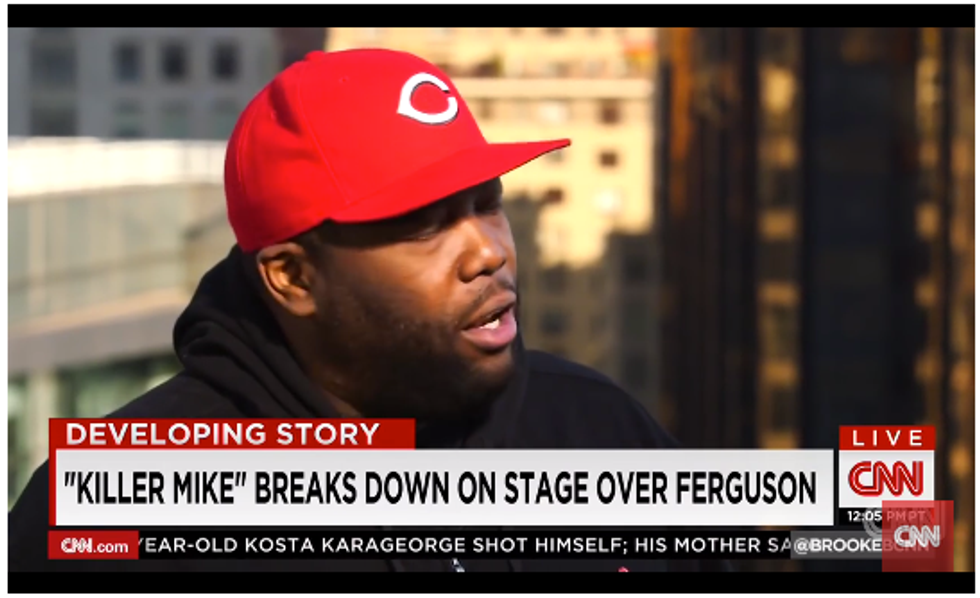
Hip-hop artists are known to be extremely vocal beyond the realm of music, delving into areas such as sports and fashion at much higher rates than artists in other genres. The same holds true when it comes to activism beyond music. Non-music related public appearances and discourse is common among rappers, and can often fall into the realm of activism. Rapper Killer Mike, who kills only the mic and the occasional FOX News anchor, is well practiced at making public appearances as an activist and advocate. Following the tragic events in Ferguson, Missouri, Killer Mike appeared on FOX News and CNN (multiple times), with CNN listing his credentials as “rapper and social activist.” He spoke about more than simply Ferguson as a single event, addressing racism and violence on a grander scale.
Childish Gambino has approached non-music activism in another way -- through his Twitter page. In a long series of tweets earlier this year, Childish Gambino remarked on what it means to be white versus what it means to be black in America with lines like, “i hope I’m so big and white my cousin wasn’t shot and stabbed twice in the neck twice last night.” His approach is both poetic and visceral; he uses the repeating line “i hope I’m so big and white” and follows it with a remark about black and white experiences. While unrelated to his music, it is a powerful tool for bringing awareness to an issue, and places a celebrities face to a movement.

Activism in music in general has always been a conduit for social discourse, hip-hop music is especially important. Hip-hop, since its inception, is inherently tied to marginalized groups. It has moved beyond advocating for civil rights in the United States, popping up in places such as the Middle East as a form of protest for those living under authoritarian rule. Due to its ties to marginalized groups, hip-hop has a better chance at mobilizing communities and making them understand how issues affect them and how they might voice their grievances.
It is not to say that hip-hop is without its flaws. I recently wrote a short piece detailing homophobia in hip-hop, and volumes could be written about misogyny in lyrics. These are issues with which the hip-hop community must reconcile. Yet we must not forget that there is a power in hip-hop that is unparalleled. More artists need to tap into that potential, and perhaps stop making songs about f****** groupies.