
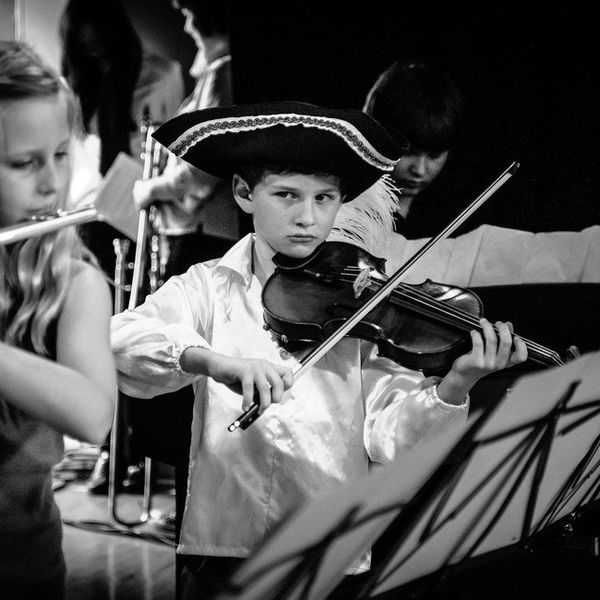

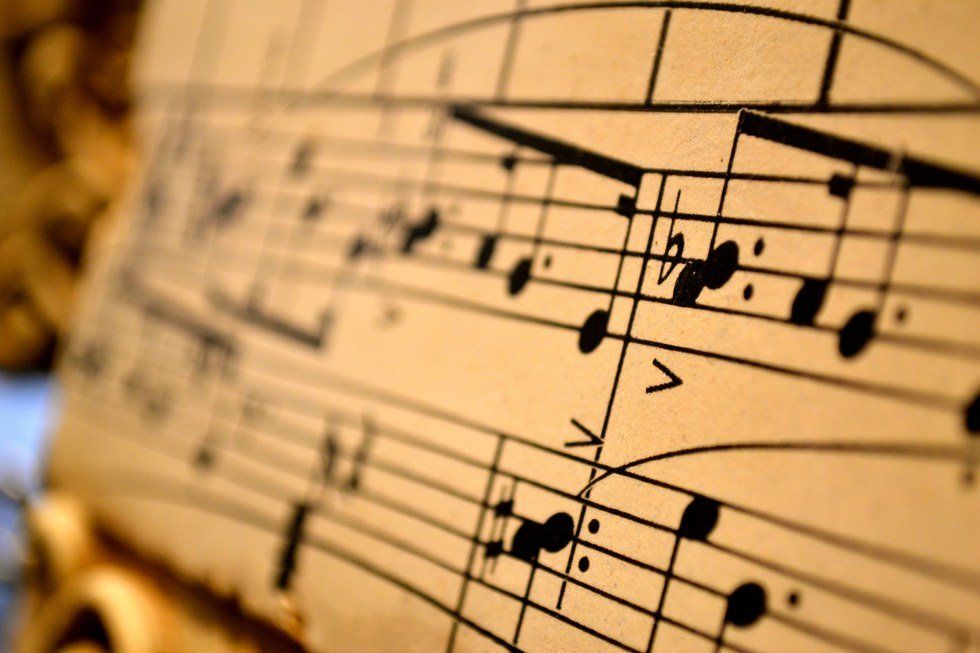
My band teacher once marveled over how astounding it is that music exists to my high school band as we rehearsed for a competition. After all, music requires one person or a group of people to read a page covered with random dots of ink, convert them into note names in their heads, and then send a command from their brains to their fingers and lips to press the right things and play the correct note, all at precisely the same exact moment. That observation made my head spin. Then I began thinking about how music is nothing more than a sound wave, and how bizarre it was that people have such strong reactions to slight changes in how something is vibrating.
Being in band was no walk through the flowers. It was filled with frustration and anger and tears, but as I walked across the platform to get my high school diploma, I couldn’t stop myself from thinking how my eight years spent in band was the most rewarding experience of my life. I made plenty of friends and was forced to spend a lot of time with my band teacher, who opened me up to so many concepts and ideas, both within music and outside of it, and ultimately served to better me as a person. So when I hear that music programs are often in jeopardy of being cut due to budget issues, I become very bothered.
According to the National Association for Music Education, music education promotes and improves a child’s logical reasoning, memorization, coordination, imagination, creativity, auditory skills, spatial intelligence, relaxation, a healthy self-esteem, academic performance, and emotional wellness. However, it seems to me that the majority of the population is unaware of any of these benefits. They only see it as a pointless pursuit that has no effect in the real world.
The problem with that sentiment is that it quickly unravels on closer inspection. There isn’t a single act committed that doesn’t have some sort of result, and with music education, the results are overwhelmingly beneficial. Through marching band, I learned discipline and memorization, while also improving my coordination, spatial reasoning, and teamwork abilities, since I would have to memorize three songs while also remembering a set series of moves and steps, that I needed my posture straight and the bell of my trumpet up, that I had to step off with my left foot on the first and third beats, and that I could not fidget – all while I had to keep in mind my place on the field or street in addition to watching my fellow band members. In jazz band, I had to further expand on my memorization ability while exercising a certain knack for logical reasoning and creativity by utilizing the 12 variations of a plethora of scales and modes (of which I can personally play all seven modes and six additional scales, which is nowhere near how many scales actually exist throughout the world) and following a designated pattern of chords and keys which can change multiple times in a single measure to create a solo out of thin air. On top of that, I took music theory, which can easily be summed up through this story: my music theory teacher, a highly intelligent woman, is able to teach a calculus class as a substitute teacher with ease but can never find anyone apt to fill her absences in music theory. Music theory takes just as much thinking, logical reasoning, and accuracy as calculus does, but creativity is also a large part of it.
As if this isn’t enough to prove why music is a highly valuable subject to study, there’s a huge social aspect to it as well. Being involved with music education instantly provides you with a group of like-minded people who, more often than not, are there to root for you to do your best. Being in band isn’t like any other activity I’ve ever done, because it didn’t limit itself to being nothing more than an activity. At the sake of sounding sentimental, my high school band truly was a family to me, and I can trust my old band members to always push me to do my best. Even after high school, I find friends in musicians, and music continues to give me a sense of purpose. To deprive kids of this same experience is criminal. Music education is essential to well-being of children.
Still don’t believe me? Think of it this way: most people will never have to use trigonometry or engage in academic conversations about Macbeth or know the rules to flag football after they’ve graduated – so why is music any different?















