


I expected certain buzzwords from The To-Do List, given that it was a movie about sex and sexuality, set in the protagonist’s wonderfully awkward high school years. Unwittingly or not, the movie provides viewers with interesting commentary on how these buzzwords have woven themselves into our conversations surrounding the spectrum of sex, hookups, and dating. Here are my thoughts on one of these buzzwords, and the ways in which it has evolved in my experience with hookup culture.
3. The ‘S’ Word
Disclaimer: I have definitely called someone a slut in my lifetime (derogatorily). I’ve probably been guilty of it multiple times. Here’s to all the people who didn’t impose their own moral standards, sexual or otherwise, upon the people around them, in private or public, explicitly or otherwise.
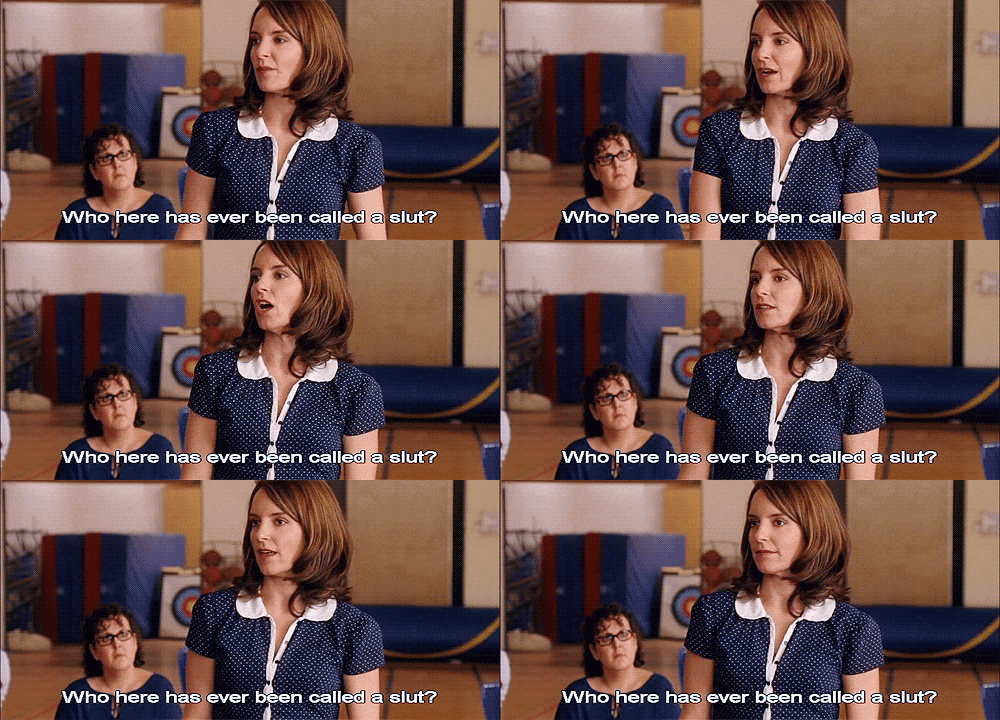
I have been called a slut. I’ve been called a slut in middle school, when I dated my friend’s ex (I’m not too proud of a lot of my middle school life choices). I’ve been called a slut in high school, when I broke up with someone and started dating someone else. I’ve been called a slut when I then broke up with that guy once I got to college. I’ve been called a slut to my face, and behind my back (or so I’ve heard). I’ve been called a slut when I didn’t appreciate some guy’s advances while walking on the street (dude, I don’t appreciate being catcalled on my way to Starbucks. Or work. Or a bar. Or on my way to my car. Or at the Farmer’s Market. Really, unless I’m wearing a large sign that says, “I moderately dressed up today so give me a compliment”, just don’t. Affirmative consent, people).
So as you can see, I’ve had some experience with the term. “Slut” is pretty much an all-encompassing term for when a woman does something in a romantic or sexual context that is surprising, upsetting, or enraging, by societal standards. In this case, “societal standards” refers to the immensely problematic moral policing towards women that people (myself included) have been guilty of. It’s not been a very nice word. Until recently.
“Slut” has made an interesting comeback, at least in my social circles. In The To-Do List, Brandy’s seemingly more sexperienced friend reads through Brandy’s checklist of sexual encounters and says, “I didn’t know you were such a slut”. “Slut”, in this context, is meant as a compliment. My own friends have used it to describe women whose sexual prowess and/or determination they admire. Personally, I’m ecstatic about this trend. It signals an open appreciation for women who strive to get some if they so desire. It signals the reclamation of a word that, for my whole childhood, was used as a term to belittle and deride the personal choices of a woman. It acknowledges and rejects the (relative) standards of propriety that women have been unfairly subjected to. It is a positive approach to the reclamation of sexuality, and the pursuit of sex, which has been gendered as a masculine act for as long as I can remember.
Man, I love this trend.
Also in The To-Do List, Brandy hurts one of her friends by hooking up with the latter’s crush. In response, the same friend who complimented Brandy earlier on her sluttiness, walks out on her saying “she doesn’t speak slut”. This moment was a stark reminder, after riding the euphoric wave of “slut” reclamation, that previous associations don’t just disappear when words absorb new meanings. “Slut” is a layered term, and hurts just as much, if not more, than it empowers. Brandy’s actions were rather hurtful, and justified her friend’s indignation. Using the word “slut”, however, shames Brandy’s pursuit of sexual pleasure as much as it does her choice to do so with a friend’s crush. It somehow equates sexual pursuit with betrayal and generally poor life choices, which makes me uncomfortable.
Here’s a novel (and pretty idealistic) proposition: how about we use other words? Words that shame the thing we want to shame, rather than words that, by association, also shame the ownership of one’s sexuality? I don’t think The To-Do List inserted this dual application of the word “slut” as consciously as I’m making it out to be, but the juxtaposition evokes an important point. I have been a teenager, and understand how hard it can be to get angst-ridden youths to talk about their feelings. More importantly, we are not going to get them to do so outside the framework of slang. I somehow simply don’t visualize Brandy’s friend saying “I’m deeply disappointed in the manner in which you sought to check yet another item on your list, because it really hurt our friend. I know you knew better, but feel like you need to take some time to think about what you’ve done.” Maybe it’s because I’m no longer a teenager, but I just can’t see kids these days expressing their feelings like that. Or adults, for that matter.
That being said, a new slang term for betrayal, one that doesn’t carry the weight of generations (at least two) of sexual shaming, would be nice. To the one teenager reading this blog, it’s time to get to work. To the rest of us who are older, it’s time to put the term to rest, unless used as a positive acknowledgement of anyone (cisnormativity is a thing of the past, folks) taking ownership of their pursuit of sexual pleasure. In times when we’re particularly tempted to use the term “slut” to derogatorily address someone, we can try using other words. It’s a good thing there are lots of them. Talking about our feelings is hard, but trying not to use a problematic term is good practice.
Next week, keep an eye out for number 4: The “P” Word.

















