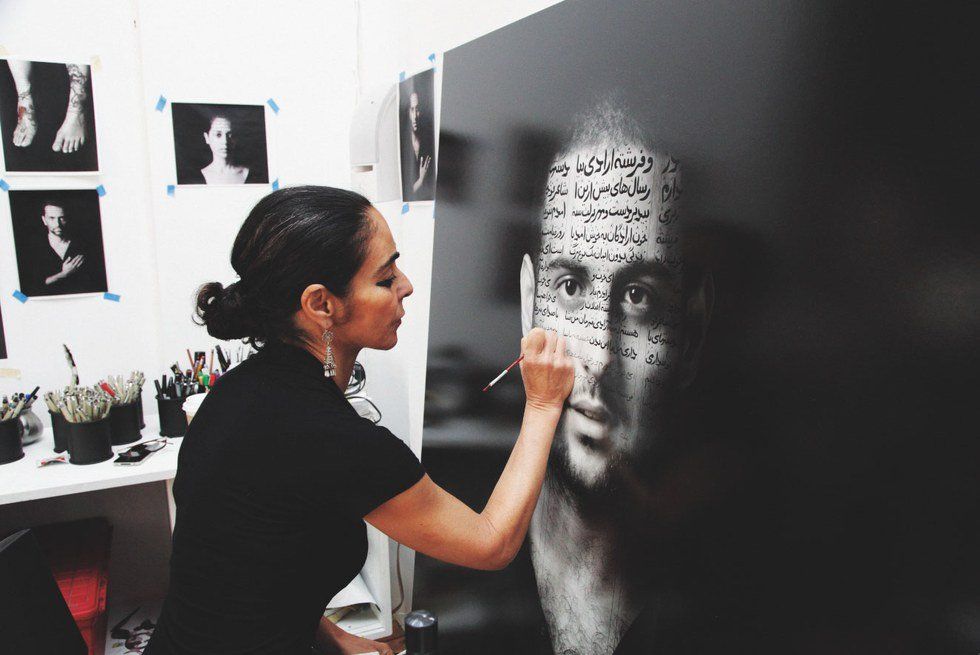
Shirin Neshat, celebrated film/video artist and photographer, was born in 1957 in Qazvin, Iran. Her parents rejected the religious Islamic values they were raised with in favor of Reza Shah's plan to reshape and modernize the country to mimic the Western world. In her youth, Neshat was enrolled in a Catholic boarding school in Tehran. In 1975, just a few years before the beginning of the Iranian Revolution, she left her home country behind to study in the United States at the University of California at Berkeley. What ensued during her time away was a cultural revolution.
Reza Shah took power in Iran during World War II in 1945, and ruled until 1979; the year that the Persian monarchy was overthrown by revolutionaries. His rule was essentially a dictatorship and was best known for his violent repression of religious and political freedom. The forced modernization of the country was disturbingly oppressive for women and his regime inspired revolutionaries to abolish the monarchy in favor of bringing a conservative religious government, led by Ayatollah Khomeini, to power.
When Neshat returned to Iran in 1990, she was shocked by the momentous cultural changes that had transformed her home. Her art, since her return to Iran, has been an effort to reconnect herself with her culture and quite often deals with women and their place in the Iranian Revolution.
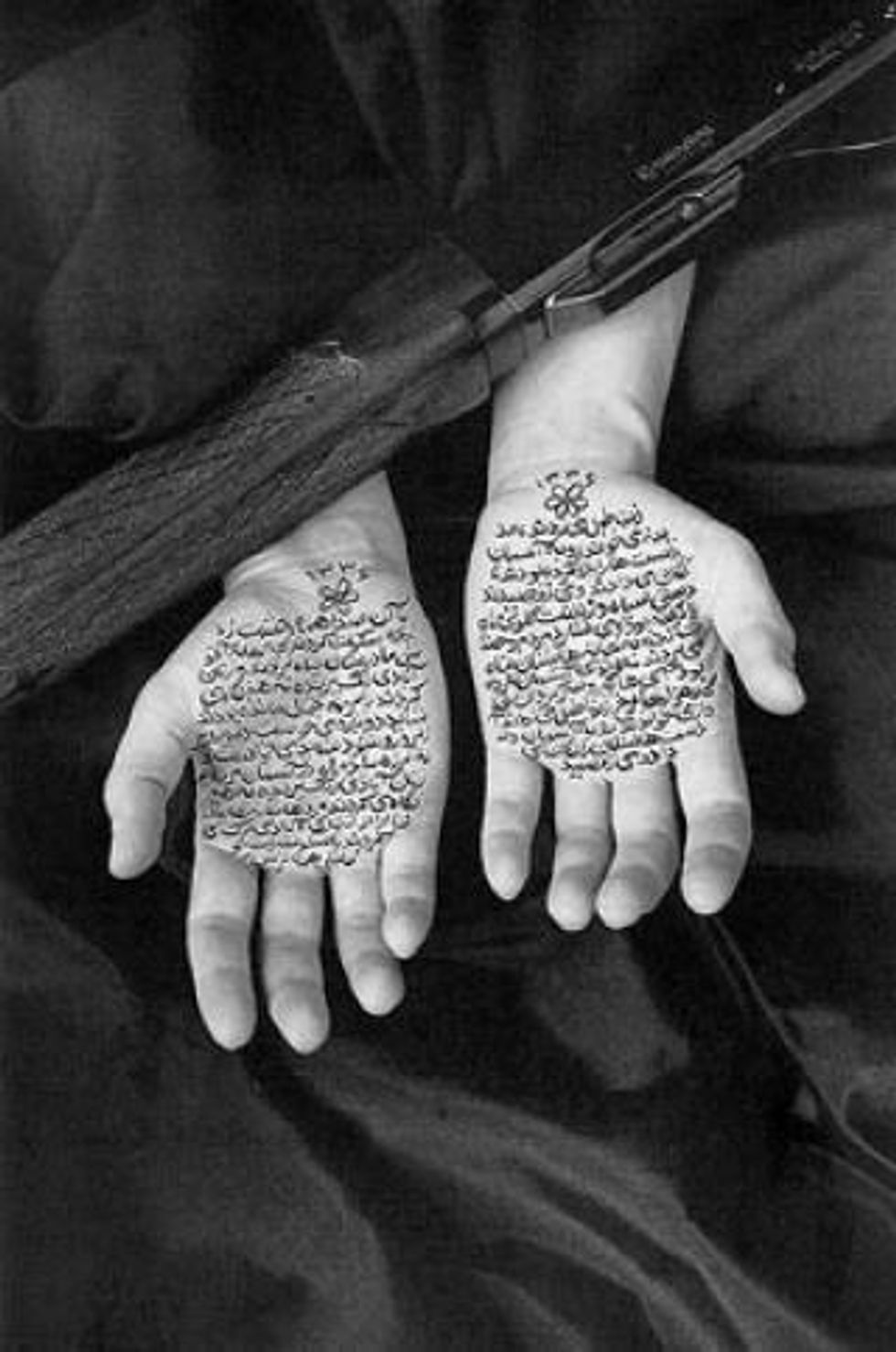
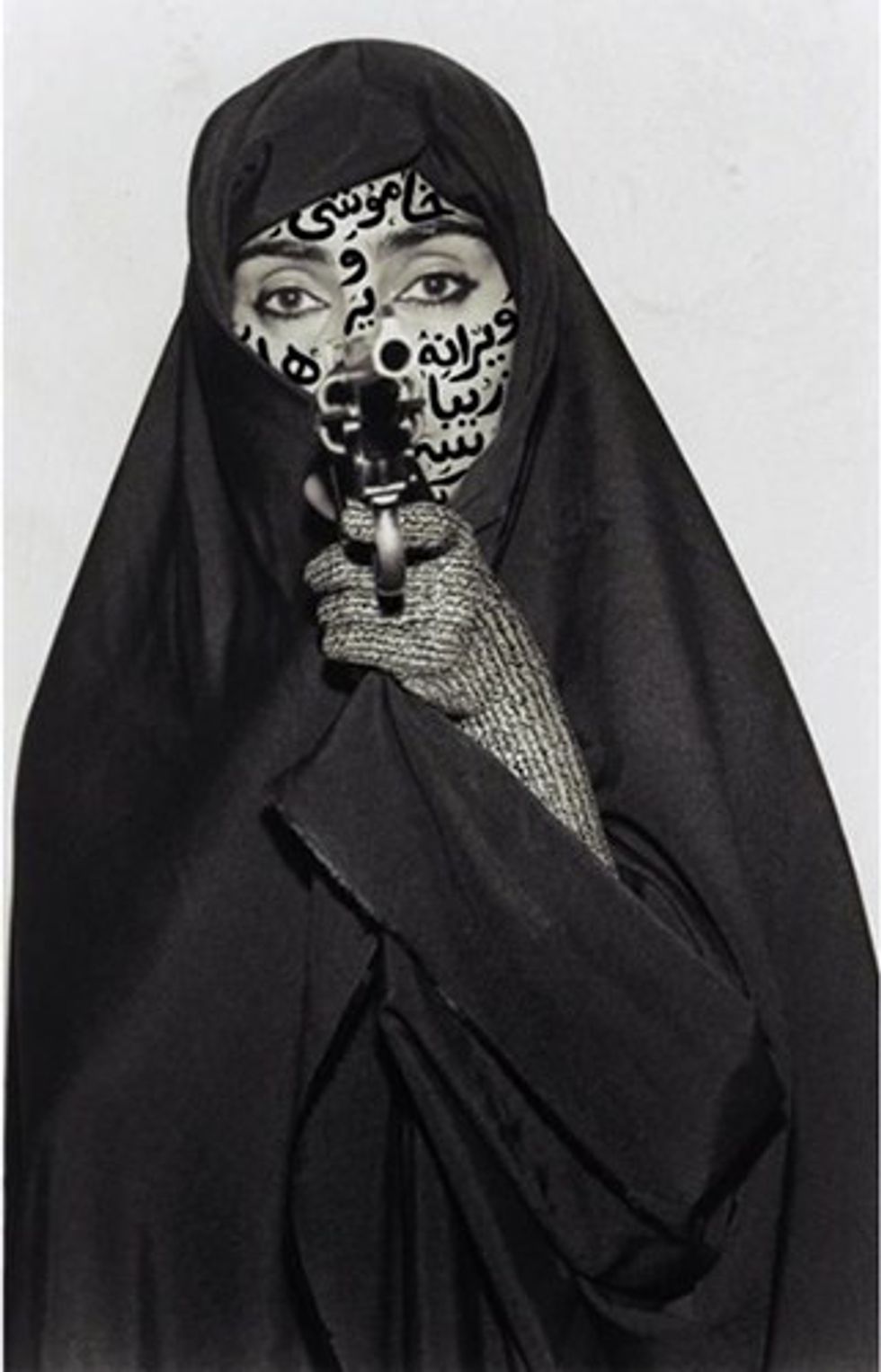
"Women of Allah" was Neshat’s first artistic work. The a celebrated black-and-white photo series depicted powerful veiled women and was suggestive of the significant presence of women in the Iran-Iraq War and the Islamic Revolution. The photos are symbolic of perspectives of female identity in the Middle East in the context of a constantly changing cultural landscape; interchanging accepted Western representations of Muslim women to contrast with religious and personal beliefs. Each image incorporates one or more of four symbols that are emblematic of Western views of the Muslim world; Islamic text, the veil, the gun, and the gaze. The ideas depicted in the series resonate deeply with Neshat and acknowledge her unique upbringing in Iran, the time she spend in the States, and the results of the religious revolution.
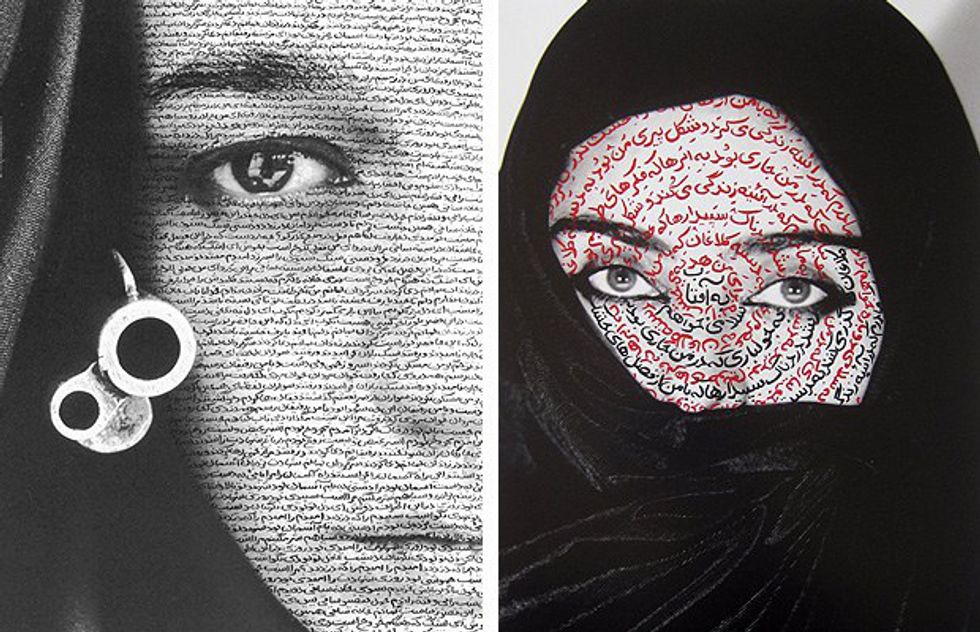
Through "Women of Allah," Neshat navigates female identity both through during and post-political upheaval in Iran. Veiled women were very much active in the revolution through all of its stages. While many women choose to don the veil solely to respect their faith, many during the Revolution wore their veils to convey the idea of being able to mutually be secular and politically active while campaigning against the Pahlavi regime. Neshat takes advantage of the misguided Western perception of the passive, weak Muslim women through depicting revolutionaries; chador-wearing women grasping guns and gazing compellingly into the camera.
These black-and-white photographs serve their purpose in creating a theoretic narrative of the female activists of the Revolution. Farsi calligraphy covers the skin of the women portrayed in the photos. In this instance, Neshat employs an artistic mode that was very present in art of the Islamic Revolution. She plays with the notion of the excessively aesthetic nature of Islamic calligraphy and the distinction between the dark chador in relation to the light backgrounds in effort to represent the stereotypes and cliches of Muslim society. Neshat uses the words of contemporary Iranian poets who had written about the roles of women in the Revolution, as well as those who had discussed martyrdom—another important theme of the series. Martyrdom, in the Islamic world, is used as an appellation for Muslims who have died while attempting to fulfill a religious commandment. The majority of the subjects in the series hold guns, illustrating religious martyrdom, a concept quite central to revolutionary culture in Iran.
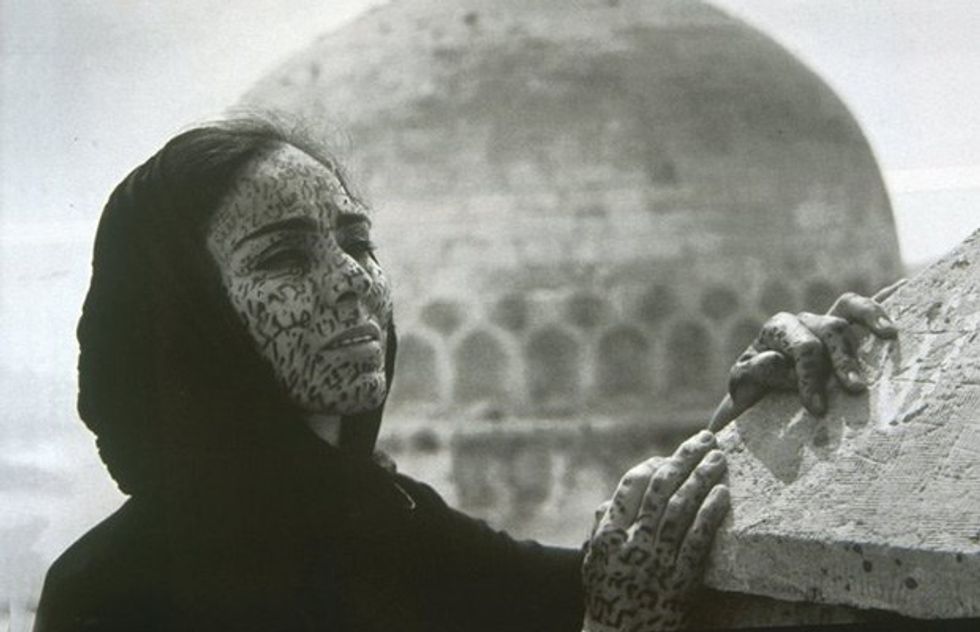
The presence of the veil is an important aspect of the series. Neshat challenges the common Western perception of the oppressed Islamic woman. The veil is intended to protect Muslim women from being sexualized under the male gaze, however, in the photo series, it serves in emphasizing the reversal of power. The photographed women dominate gazing back with strength.
Though "Women of Allah" was initially a response to national changes that made Iran unrecognizable to Neshat, the series has gained an even stronger directive in a post-9/11 world;a world that the West filled with rampant Islamophobia, and the authority of the white feminist agenda. Shirin Neshat and her brilliant work is monumental, and very much deserving of our attention.